
Oceanside homeowners deal with the same cast of pests as the rest of San Diego County. The useful questions are about your own property: what’s getting in, where, and what’s feeding it. This guide covers what a termite inspection legally covers, how the two kinds of termite differ, and how to check a company’s license before you sign anything.
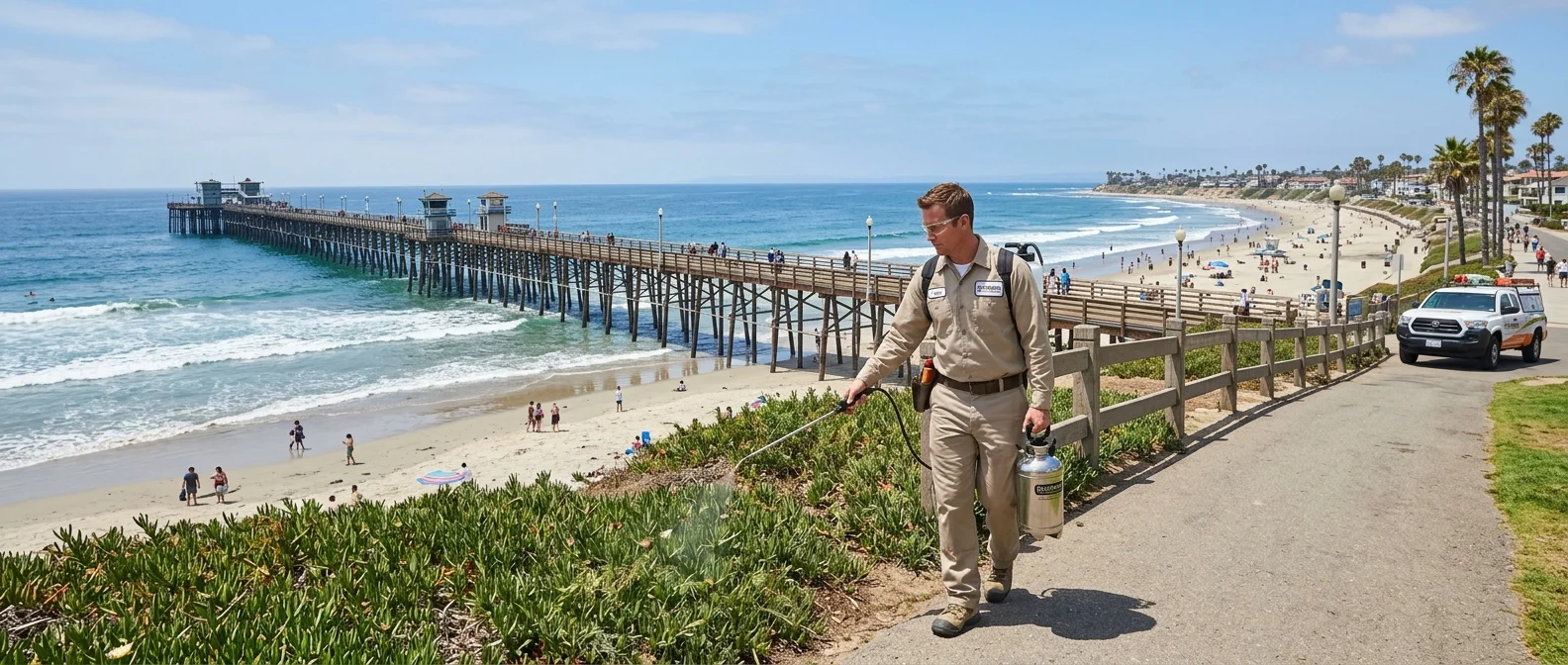
Common pests in Oceanside homes
San Diego County shares most of its common pest species, so the question worth asking in Oceanside is which ones are pressing on your property and what’s giving them food, water, and a way in.
The Argentine ant is the most common ant in and around the house and garden in California. You’ll find its foraging trails along foundations, across patios, and making their way into kitchens and bathrooms, sometimes seemingly out of nowhere. Widow spiders also do well around homes. The holes, cracks, crevices, trash, and clutter associated with human structures provide ideal habitat for the western black widow, and the non-native brown widow became established in southern California in the first decade of the 21st century.
Beyond ants and spiders, silverfish, earwigs, and slugs or snails turn up wherever there’s steady moisture. They find refuge in damp mulch beds and under decaying organic matter, then make their way indoors. Rodents matter too. Roof rats are agile climbers and usually live and nest aboveground in shrubs, trees, or dense vegetation such as ivy, and residential areas with mature landscaping provide good habitat. Once they’re inside, roof rats typically nest in enclosed and elevated spaces, such as attics, wall voids, ceiling voids, and cabinets.
The licensed companies in the network handle a broad range of issues through general pest control across San Diego County. What makes a plan work is what an inspector actually finds on your property, not a general description of the neighborhood.
What a termite inspection covers, and what changes from house to house
By California state law, the minimum requirement for termite inspections includes visual searches of accessible areas, and detection of difficult-to-find infestations may require removing walls, paneling, and stucco. What changes from one property to the next is where an inspector spends that effort.
Subterranean termites require moist environments. They usually nest in or near the soil and maintain some connection with it through tunnels in wood or through shelter tubes, and the soil is what keeps them from drying out. So damp ground around foundations, under elevated decks, and in poorly ventilated crawl spaces is what an inspector should be reading. Ask about evidence of water intrusion, drainage, and any consistently wet area near the foundation.
Building design matters more than the address. Stucco siding that reaches the ground may promote termite infestations, since termites might travel between the stucco and the foundation unseen, and substructural wood beneath a building should be kept at least 12 inches above the soil. Shelter tubes, sometimes called mud tubes, are the most commonly seen evidence of a subterranean termite infestation, and they are earth-hardened tubes built from saliva mixed with soil and bits of wood. Ask what the inspector could and could not reach during a termite inspection.
Drywood termites are a separate problem with separate rules. They infest dry, sound wood, they do not require much moisture or contact with soil, and they are most prevalent in southern California. Their nests usually stay entirely above ground and never connect to the soil, so the signs are different: fecal pellets and kickout holes, which are small holes under 2mm across through which termites push the pellets out of the wood.
Ant and spider pressure through the year
Ants and spiders are both year-round concerns around Oceanside homes. What changes through the year is intensity and where they shelter, not whether they’re there at all.
Ants, particularly the Argentine ant, are a perpetual concern here. Argentine ant colonies aren’t separate but linked to form one large supercolony with multiple queens, so a trail on the counter is the visible edge of something much larger. Ants often enter buildings seeking food and water, warmth and shelter, or refuge from dry, hot weather or flooded conditions, so a dry spell or a heavy rain can both push them indoors. Effectively managing these persistent invaders often requires a continuous, proactive ant control strategy rather than reactive spot treatments.
Spiders are the other constant. Web-building spiders like common house spiders, orb weavers, and cellar spiders set up wherever there’s prey and an undisturbed corner. The western black widow is the spider posing the greatest potential envenomation threat to humans in the western United States. The brown widow, established in southern California since the 2000s, causes alarm because of its relative’s reputation, but it isn’t nearly as dangerous as the black widow. Bites from black widow spiders are quite rare, even where these spiders are very common. The holes, cracks, crevices, trash, and clutter associated with human structures provide ideal habitat for the western black widow, so sheds, cluttered garages, under eaves, overgrown landscaping, and stacked outdoor furniture are the places to look. Activity becomes more noticeable as temperatures rise, but that’s a shift in intensity and in preferred nesting sites rather than a complete disappearance.
What to look for in an Oceanside pest control company
Choosing a pest control company in Oceanside comes down to license, method, and what they put in writing. Not all pest problems are the same, and the difference between a useful plan and a wasted one is usually the inspection behind it.
First, ask how they inspect before they quote. A company that names the pest, the evidence it found, where it found it, and which areas it could not reach is building a plan from your property rather than from a template. Ask what they could not access, and ask for the findings in writing.
Always verify licensing and insurance. A reputable company will hold all necessary California State Licenses, including an active Pest Control Business license from the Structural Pest Control Board (SPCB). You can easily check a company’s license status and complaint history through the California Structural Pest Control Board (SPCB) website: www.pestboard.ca.gov. The record shows the license type and its current status, and nothing more, so the name on it should match the name on your proposal.
Prioritize companies that practice Integrated Pest Management (IPM). This modern approach focuses on long-term prevention, thorough pest identification, and environmental awareness, using targeted treatments only when absolutely necessary. It’s about solving the root cause of the problem through inspection, sanitation, exclusion, and responsible product use, not just spraying indiscriminately. Ask about their safety protocols, especially regarding children and pets, and if they offer eco-friendly or low-impact options. They should be transparent about the products they use and how they apply them.
Finally, consider their overall reputation and responsiveness. Check online reviews on platforms like Yelp or Google, and don’t hesitate to ask for local references. A good company will communicate clearly, price transparently without hidden fees, and be straight with you about follow-up visits. If a recurring plan is proposed, ask what each visit is expected to control and how the result will be judged.
Frequently asked questions
How much does pest control cost in Oceanside?
There’s no flat rate. Price follows the pest, the size of the property, and whether you want a one-time visit or recurring service. The licensed company you’re matched with inspects first and puts the number in writing before treatment starts, because a figure given over the phone is an estimate rather than a quote.
What pests are most common in Oceanside?
Ants, spiders, rodents, and termites. The Argentine ant is the most common ant in and around the house and garden in California. Widow spiders take to the holes, cracks, crevices, trash, and clutter around structures. Roof rats favor residential areas with mature landscaping. Drywood termites are most prevalent in southern California and infest dry, sound wood.
Does the type of termite change the inspection?
Yes, and it’s the difference that matters most. Subterranean termites are the ones that need moist soil and keep a connection to it through tunnels or shelter tubes, so damp ground and wood-to-soil contact around the foundation drive that part of the inspection. Drywood termites don’t need much moisture or soil contact at all, and their nests usually stay entirely above ground, so those are found by their fecal pellets and kickout holes instead.
How do I check that an Oceanside pest control company is licensed?
Look it up with the California Structural Pest Control Board at pestboard.ca.gov before signing anything. The record shows license status and which branch the company holds, and the name on it should match the name on your proposal. Confirm insurance directly with the company at the same time.
When to call us
When common household pests become a recurring problem or you suspect termites, a licensed company is the right call. Pest Pros San Diego matches you with licensed local companies that inspect first and quote in writing. Call us at (858) 400-6561 to get matched with a licensed local pro.