
The same kitchen line shows up after you wipe it. Store ant killer San Marcos CA shoppers buy on the way home knocks down the workers you can see, then the trail is back by morning. That loop is the problem, not a new species every week. Document the path, the moisture, and the gap it uses. Then compare a licensed company’s written scope before anyone treats.
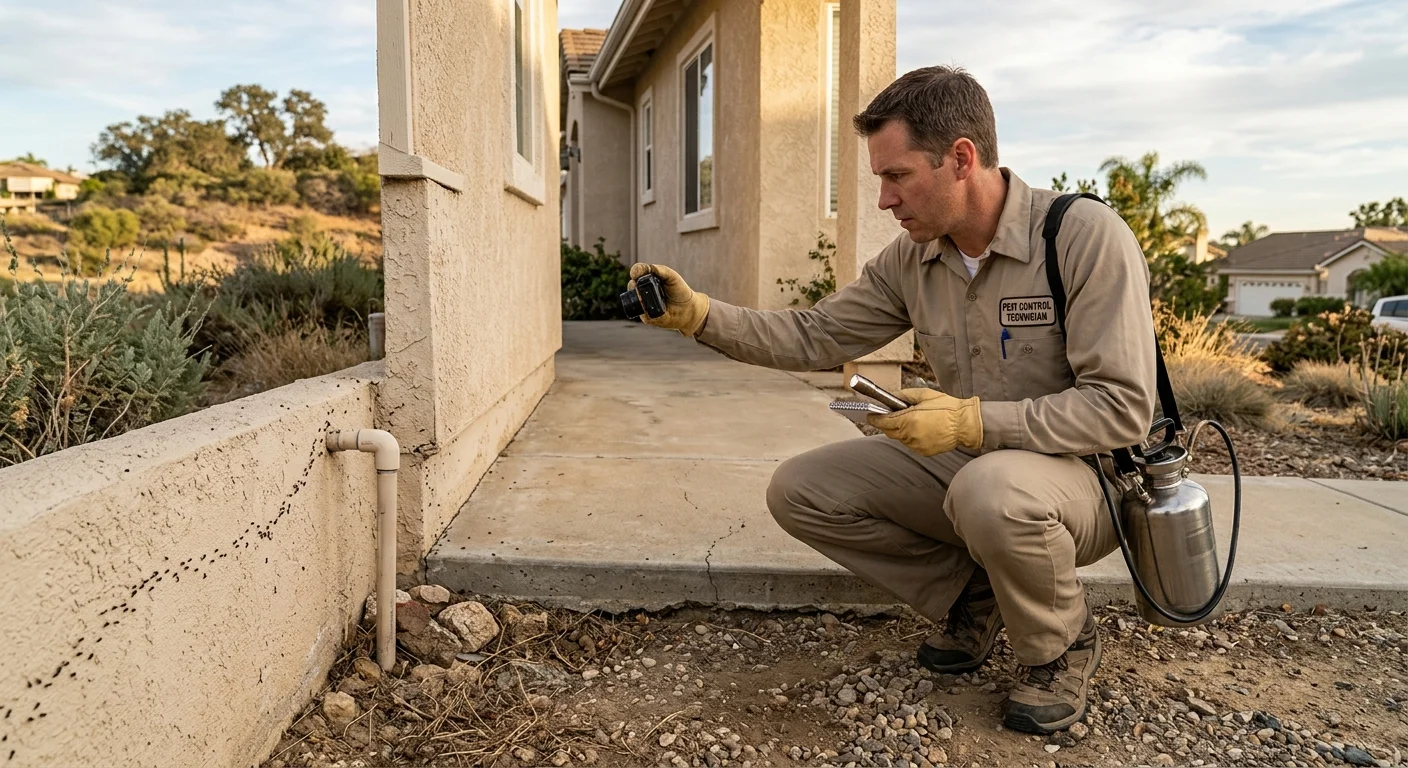
How to document the trail before calling
Treat the trail like evidence, not a mess to erase first. A photo of ants on a counter tells a licensed inspector almost nothing. A photo of the line from the food to the wall, then from the wall to the slab, tells them where to look.
Start at the food or water. Pet bowls, a sticky toaster tray, ripe fruit, and a slow drip under the sink are the usual indoor starts in San Marcos kitchens. Follow the line without spraying it. Note the time. Early morning and late afternoon are when many homeowners first notice movement on the range backsplash or along the patio slider.
Shoot three frames if you can. One close enough to show size and color. One wide enough to show the room or the foundation. One of the exact spot where the line vanishes: a gap at the wall-to-slab joint, a crack at the garage slab, a gap at a pipe chase, a sliding-door track, or the joint where stucco meets concrete. Write the date, the room, and whether the ants were carrying anything.
Do not mop with a residual spray and then call. You wipe the map the company needs. Wipe crumbs and standing water with soap and water if you have to live with the kitchen tonight. Leave the outdoor line alone until someone who holds California credentials for household pests can see it.
If you have more than one trail, label them. Kitchen to garage is not the same job as a patio to a planter. A trail that only appears after irrigation is a moisture note, not a random indoor outbreak. Keep kids and pets off any product you already put down, and keep the label. The matched company needs to know what is already on the surface.
Bring that packet to the inspection. It saves time on site and it keeps the conversation on this house, not a generic spray route.
Which San Marcos property conditions need inspection
San Marcos sits inland in North County, warmer and drier than Carlsbad or Encinitas, and not as hot or as clay-heavy as East County. Ants here follow irrigation, mulch, and the joints in stucco and slab more than they follow a coastal marine layer. Ant control in San Marcos CA starts with those site facts, not a county-wide slogan.
San Elijo Hills and the newer hillside tracts run on HOA watering clocks, dense ornamental beds, and tight stucco details. Drip lines at the foundation, bark piled against the wall base, and expansion joints at the garage are the usual outdoor highways. If the trail appears after the morning cycle, say so. That is a landscape moisture problem sitting against the house, not a mysterious indoor nest.
Lake San Marcos adds older lakeside landscaping, more shade, and more constant soil moisture near the water. Trails along patio walls, under decking, and at AC condensate lines show up there for a reason. Twin Oaks Valley still carries grove and rural-edge conditions: leaf litter, irrigation around fruit trees, rock borders, and soil nests under pots. A trail from a backyard avocado or citrus row into a mudroom is a different inspection than a condo kitchen off Craven Road.
Student and rental stock near California State University San Marcos and Palomar College often has shared walls, dumped food in kitchens, and delayed maintenance on sliders and weatherstrip. Tiny indoor lines in those units still need the same outdoor check. Argentine ants nest in soil and pavement cracks, then commute indoors. You will not find the colony in the toaster.
Have the inspector walk the full perimeter, not only the room you photographed. Look at irrigation heads that soak the slab, wood-to-soil contact at planters, gaps at utility penetrations, and any stored firewood or stacked lumber against the house. Indoor work without that walk is how the trail returns. For the wider county pattern, see our San Diego ant control guide. It is the same pest pressure, with different housing stock than Chula Vista or the coast.
People ask why ants feel worse some years in California. UC IPM treats Argentine ants as a year-round household pest, not a one-month swarm. Local irrigation, a warm inland stretch, and a supercolony already on the block explain a sudden kitchen line better than a viral “this year” claim. No county ranking of “worst pest year” sits in our verified files, so we do not invent one.
Why worker activity doesn’t identify the colony
The ants on your grout are foragers. They are not the nest. Killing them is like stopping the delivery drivers and calling the warehouse closed.
UC IPM describes Argentine ants as the most common ant in and around California houses and gardens. Workers are about 1/8 inch, dull brown, with one node between thorax and abdomen. They nest in shallow soil, under pots and rocks, in pavement cracks, and in moist spots along foundations. Colonies are not neat single mounds. They link into a large supercolony with multiple queens. That is why a trail of tiny ants in a San Marcos kitchen can look “solved” at 8 p.m. and rebuilt at 7 a.m.
Store sprays labeled as ant killer hit the workers on the surface. The rest of the colony keeps sending replacements. UC IPM’s ant guidance points severe Argentine ant pressure toward liquid borate baits in refillable stations, used as a labeled professional tool, not as a mix-it-yourself project. We will not give placement, strength, or off-label steps here. The licensed company follows the product label after it identifies the species.
If you have mounds and stings, you may not be looking at Argentine ants. Southern fire ants are native and present in San Diego County, including coastal and inland areas. UC IPM notes that spraying a fire ant nest can cause the colony to disperse, which makes control harder. The red imported fire ant is a quarantined pest in California, administered by CDFA. San Diego County is not in that interior quarantine area. A suspected find is still worth reporting to CDFA. Do not treat every small brown ant as a fire ant, and do not treat every sting as proof of a quarantined species.
Flying ants in spring or fall are a separate ID problem from a kitchen trail. Swarmers can be confused with termites. If you have wings, a pile of shed wings, or damage in wood, say that on the call. Household ant work is Branch 2 structural pest control. Wood-destroying work is Branch 3. Fumigation is Branch 1 only. Pest Pros San Diego does not hold those licenses and does not apply products. We match you with companies that do.
For why a perimeter spray often makes Argentine ant pressure worse, read why spraying Argentine ants backfires. The short version: you scatter foragers and leave the linked nests in the soil.
What to compare in a licensed company’s scope
“Best exterminator” ads do not tell you what will happen on your lot. A written scope does. Ask for that before anyone treats.
Confirm the company is registered with the California Structural Pest Control Board and that the people on site hold the right branch credentials for household ants. Public lookup is at the SPCB license search. We match you with licensed, insured pest pros who hold the appropriate California credentials for each service type. We do not inspect, spray, bait, or guarantee the job. Warranty and re-treatment language, if any, belong in that company’s own written agreement.
Compare the inspection, not the slogan. The findings should name what they saw (species if they can, trail locations, moisture, entry gaps) and what they will do about the colony, not only the visible line. UC IPM is the authority on ant biology and management at ipm.ucanr.edu. A scope that is only “spray the baseboards” is a worker knockdown plan. A scope that includes outdoor nesting sites, irrigation notes, baiting where the species warrants it, and exclusion of the gaps you photographed is a colony plan.
Ask how they will handle pets, kids, and food-prep surfaces, and tell them to follow the EPA consumer pesticide-safety basics plus the product label. Do not accept a recommendation that you apply a professional mix yourself.
Price is the question people type first: how much is an exterminator to kill ants. This brand has no fee schedule. No verified per-job dollar range for ant treatment sits in our claims file, so we will not invent one. Job size, species, access, and whether the yard is driving indoor traffic all change the quote. The matched company inspects first and quotes in writing before any treatment begins. For how San Marcos pest work is priced in general, see pest control cost in San Marcos. Use that page for cost factors. Do not treat any old graphic or competitor coupon as a local ant rate.
Compare follow-up the same way. Recurring visits, what happens if the trail returns, and who is responsible for landscape changes should be in writing. If two quotes differ, the difference is usually bait versus spray, indoor-only versus full perimeter, and whether irrigation and mulch against the slab are in scope. Pick the plan that matches the house you documented, not the loudest guarantee.
When to call us
Call when the same trail returns after wiping or spraying, when you cannot find where it enters, or when mounds and stings show up in the yard. That is licensed Branch 2 work on a real San Marcos property, not a weekend product run. Call us at (858) 400-6561 and we’ll match you with a licensed local pro.