
If you live in San Diego, you know ants aren’t just a nuisance; they’re a persistent challenge. From kitchen counters to bathroom floors, these tiny invaders can seem impossible to get rid of on your own. When DIY methods fall short against San Diego’s unique ant challenges, it’s time to consider professional ant control services.
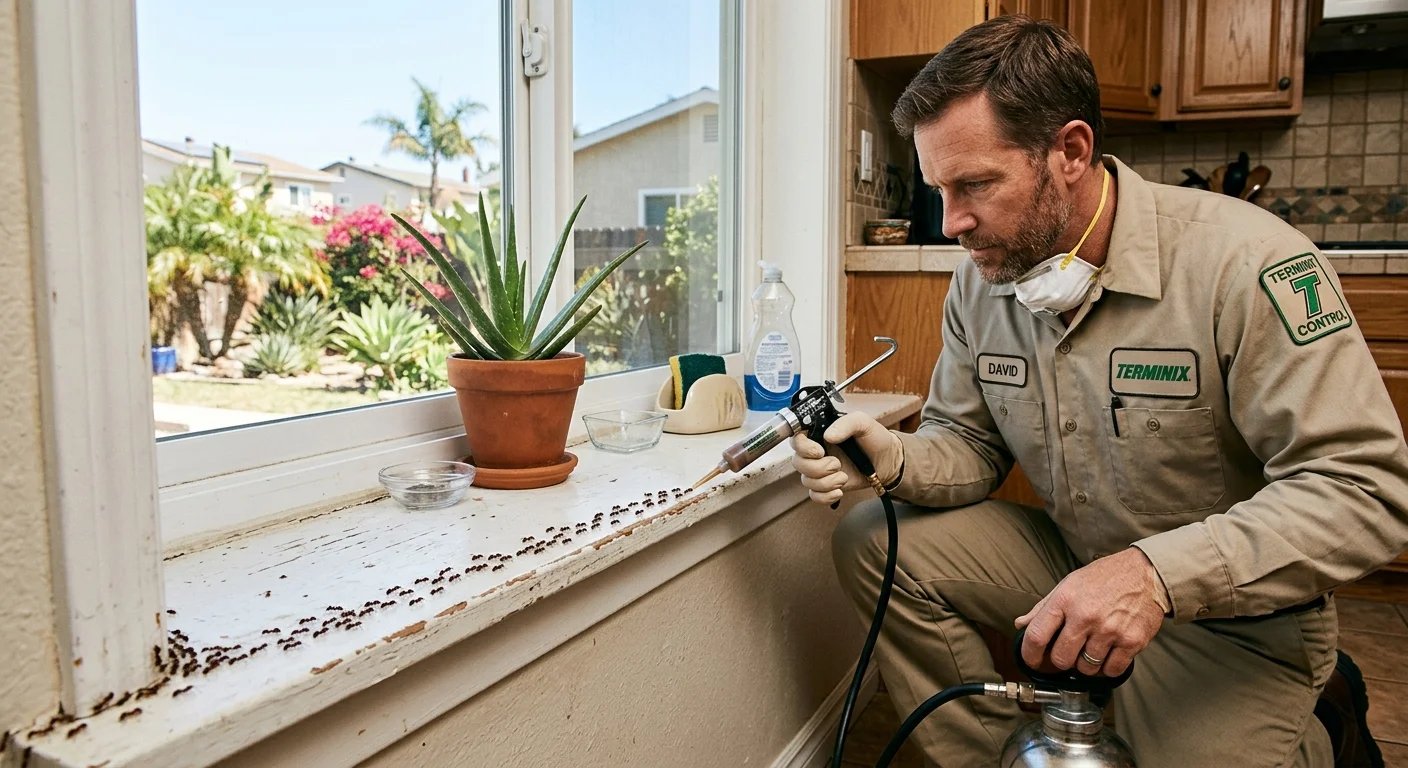
Pest Pros San Diego matches you with pros who understand the local ant species and their behaviors.
Why San Diego has such a persistent ant problem
UC IPM names the Argentine ant the most common ant in and around the house and garden in California. UC IPM also notes that Argentine ant colonies aren’t separate but linked to form one large “supercolony” with multiple queens. That is why spraying the ants you can see doesn’t settle it: UC IPM states that spraying ants indoors with pesticides will not prevent more ants from entering, and that when properly used, baits are more effective and safer than sprays. UC IPM also advises that if you hire a pest control company, you ask them to use baits and spot treatments rather than perimeter treatments or monthly sprays. That approach is what matters when you’re dealing with Argentine ants in San Diego.
Identifying argentine ants vs. other common types
Proper identification is the first step, because UC IPM notes that different attractants are more effective against different species of ants and at different times of the year.
UC IPM describes the Argentine ant as 1/8 inch and dull brown. Long trails of thousands of ants may lead from nests to food sources. UC IPM also notes that Argentine ant nests are often shallow, extending just below the soil surface, though under dry conditions they will nest deeper.
UC IPM describes the odorous house ant as 1/8 inch, dark brown to shiny black, with a very strong odor when crushed.
Carpenter ants are the other group worth separating out. UC IPM says carpenter ants, Camponotus species, and velvety tree ants also invade buildings in California, and that although they don’t eat wood as termites do, they hollow it out to nest and may cause considerable damage. If you suspect you have these wood-damaging ants, specific carpenter ant control in San Diego is the page to read. You can also consult the UC IPM website for detailed ant identification guides.
What a bait-based ant program looks like
Effective ant control goes far beyond spraying the ants you can see. The licensed companies in the Pest Pros San Diego network work a bait-led process aimed at the colony, not the foragers on your counter. Set your expectations from the source: UC IPM says it is unrealistic and impractical to attempt to totally eliminate ants from an outdoor area, so the goal is excluding ants from the building and cutting their food and water. That is the standard to hold ant control services to in San Diego.
Inspection and identification
Every service begins with a thorough inspection by the licensed company you hire. Their technician identifies the species of ant, locates entry points, pinpoints foraging trails, and finds potential nesting sites. This step is crucial because different ant species require different treatment methods, and it includes checking for moisture sources, food attractants, and conditions conducive to ant activity both inside and outside your home.
Targeted treatment plan
Once the scope and nature of the ant problem is clear, that company builds a treatment plan. For most ant species, especially Argentine ants, baiting is the cornerstone of the strategy. Baits are designed to be attractive to foraging worker ants, who then carry the slow-acting insecticide back to the nest. UC IPM describes that hand-off: workers carry small portions of the bait back to the nest, where it is transferred mouth to mouth to other workers, larvae, and queens to kill the entire colony. The product has to be slow-acting, so control is not immediate. UC IPM says it can take 5 to 10 days to see fewer ants, and that if the ants are not taking the bait, the stations get repositioned or the product changed. Contact sprays do the opposite job: they kill the foragers you can see and leave the colony intact. Baits get applied strategically in areas where ants are active, focusing on trails, entry points, and suspected nest locations.
Why a perimeter spray is not the plan
A lot of companies sell a residual spray around the foundation, often every other month. UC IPM is blunt about it: spraying around the foundation will not provide permanent control, because it kills only foraging ants without killing the colony and the queens. Perimeter treatments may appear to knock down the population, but ants will quickly build back up and invade again, and barrier sprays sometimes make things worse by trapping ants indoors. UC IPM rates those programs as less effective than a bait-based IPM program. Ask for baits and spot treatments instead.
Follow-up and prevention advice
Ant control is an ongoing process, so ask the company you hire how often they return to check and refill bait stations, and what that costs. Most of the work between visits is yours. UC IPM points to caulking cracks and crevices around the foundation, fixing leaky faucets and sprinkler heads, storing sugar, syrup, honey, and pet food in closed containers, wiping trails with soapy water to remove the scent trail, and keeping plants, grass, and mulch several inches back from the foundation.
How to get an ant inspection for your home
Dealing with ants can be frustrating, but finding a solution doesn’t have to be. Call Pest Pros San Diego and we match you with a licensed local company serving your part of San Diego County. That company inspects and quotes. Pest Pros San Diego does not inspect, treat, or set prices.
During the inspection, a technician from that licensed company visits your home. They’ll walk around your property, examining common ant entry points, identifying ant trails, and looking for signs of nesting activity. They’ll also work to identify the specific type of ant you’re dealing with, as proper identification is key to effective treatment. After the inspection, you’ll receive a detailed assessment of your ant situation. This includes explaining what was found, outlining the recommended treatment plan, and giving you a transparent estimate for the services. Prices are set by the company you hire, not by us, so ask each bidder to itemize the inspection, the bait products and stations, and the return visits. An inspection is an easy way to understand your options before you sign anything.
Frequently asked questions
What kind of ants are in San Diego homes?
UC IPM names the Argentine ant the most common ant in and around the house and garden in California, and describes it as 1/8 inch and dull brown. Carpenter ants are the other group worth identifying, because UC IPM says they don’t eat wood as termites do but hollow it out to nest and may cause considerable damage. UC IPM lists the Pharaoh ant, odorous house ant, thief ant, southern fire ant, and pavement ant among the other common ant pests in California.
How do I tell Argentine ants from carpenter ants?
UC IPM puts the Argentine ant at 1/8 inch and dull brown, and notes that long trails of thousands of ants may lead from nests to food sources. Carpenter ants are the ones that hollow out wood to nest, so look at what the ants are doing to the wood rather than guessing from a photo.
Why does spraying Argentine ants make the problem worse?
UC IPM states that spraying ants indoors with pesticides will not prevent more ants from entering, and that pesticide sprays only provide temporary control. Baits work differently: UC IPM says workers carry small portions of the bait back to the nest where it is transferred mouth to mouth to other workers, larvae, and queens to kill the entire colony. UC IPM adds that it can take 5 to 10 days to see fewer ants.
How do I check that a pest control company is licensed in California?
Look the company up with the California Structural Pest Control Board at pestboard.ca.gov before signing anything. The record shows license status and the branch held: Branch 1 is the control of household and wood-destroying pests by fumigation with poisonous or lethal gases, Branch 2 is household pests excluding that fumigation, and Branch 3 is wood-destroying pests and organisms by insecticide or structural repairs and corrections, also excluding fumigation. Termite work sits in Branch 3, or Branch 1 when the proposal is a whole-structure fumigation. The name on the record should match the name on your proposal.
When to call us
If you’re seeing persistent ant trails indoors, noticing signs of wood damage, or if DIY methods simply aren’t working, it’s time to bring in the professionals. UC IPM says the best option for a persistent problem is a pest management professional trained in IPM, because they have access to more effective materials such as fipronil and to application equipment that can prevent contamination of the environment. Call us at (858) 400-6561 to get matched with a licensed local pro.