
Finding sawdust-like debris near wooden structures can be alarming for any San Diego homeowner. It often signals a hidden problem, and telling carpenter ant activity apart from termite damage decides what you do next. This page sticks to what UC IPM publishes, and says so where the answer belongs to an inspection instead.
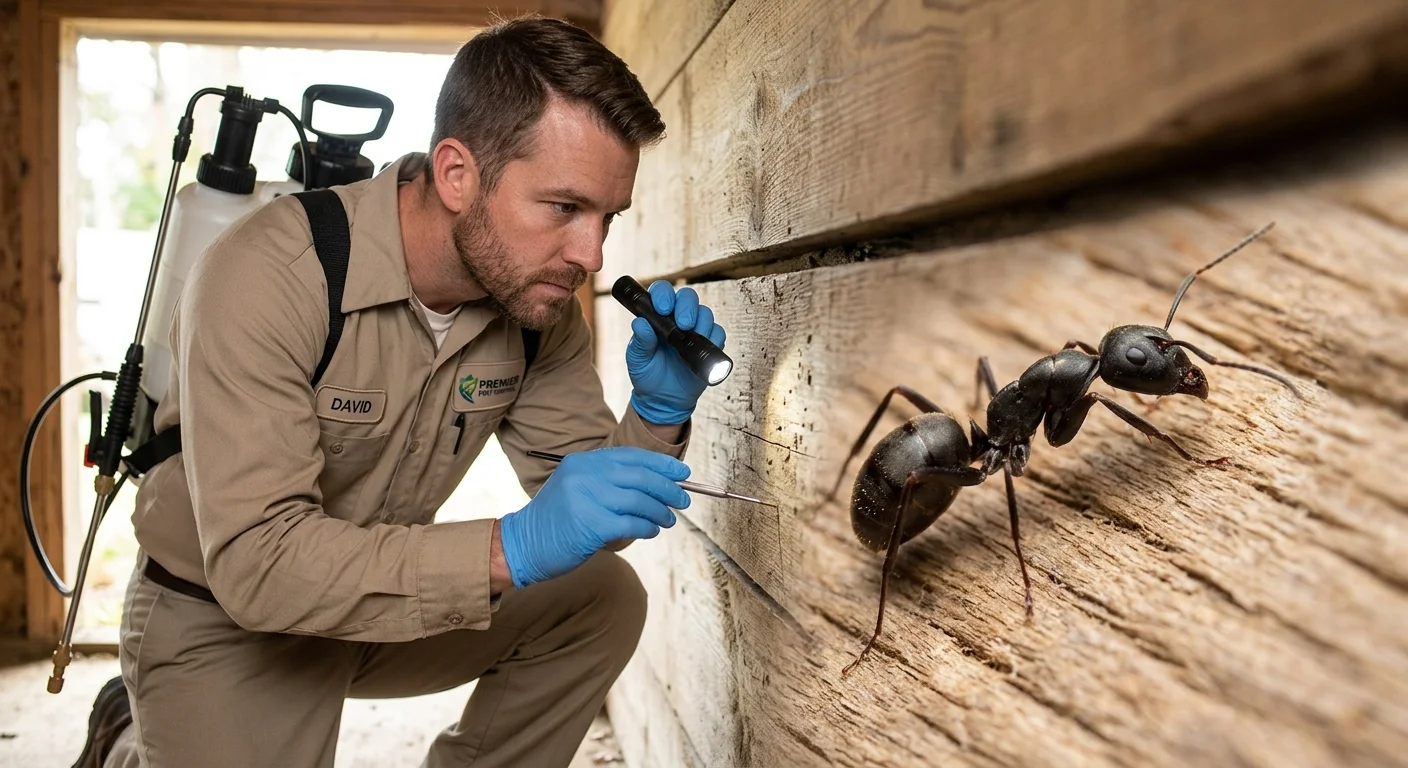
What carpenter ant damage looks like vs. termite damage
Carpenter ants and termites both damage wood, but not in the same way. UC IPM puts it plainly: carpenter ants don’t consume wood like termites but excavate it to make their nests. UC IPM’s ant guide says the same thing about carpenter ants and velvety tree ants, that they don’t eat wood as termites do, they hollow it out to nest and may cause considerable damage.
So look at the debris, not the hole. UC IPM says carpenter ant sawdust is fibrous versus the 6-sided shaped pellets of drywood termites. Those hexagonal pellets are diagnostic for drywood termites, which matters here because the western drywood termite is commonly found along the Pacific coastal region and into the Central Valley and deserts of Southern California. You may also hear something: UC IPM lists a faint rustling in walls, floors, and woodwork alongside sawdust and frass as signs of infestation.
Subterranean termites leave a third kind of evidence. They build earth-hardened shelter tubes, sometimes called mud tubes, from saliva mixed with soil and bits of wood or even drywall, and UC IPM calls those tubes the most commonly seen evidence of a subterranean termite infestation. You can learn more about these differences in our article about flying ants vs. termite swarmers.
Misidentifying the pest sends you to the wrong treatment while the real one keeps working. If you suspect termites, professional termite treatment is the right path. For carpenter ants, UC IPM notes the galleries often begin in an area where there is damage from water or wood decay, and from there the ants can expand the nest into sound wood and compromise structural integrity.
Where to find their nests around your San Diego property
Start with where these ants actually live. UC IPM says carpenter ants can become pests in any urban setting with ornamental shade trees, but that they are particularly common in forested foothill and mountain communities. That’s worth knowing before you settle on carpenter ants as the answer, because a far more common San Diego ant is the Argentine ant.
Outdoors, the parent nest is the one that matters. UC IPM says the nests carpenter ants build indoors are typically satellites of a larger, parent nest located outside in a live or dead tree, a woodpile, or landscaping materials, and that the queen or queens reside in the parent nest. In natural settings they excavate into the heartwood of living trees or into dead trees and stumps. A stump left behind after a tree comes out fits that description exactly, so having it ground out by a tree service like Branch Pro San Diego removes a nest site rather than a symptom.
Indoors, UC IPM says they commonly nest in wall voids, hollow doors, and insulation, and that several satellite nests can be associated with a single parent nest. Because the queen stays outside in the parent nest, clearing ants out of a room doesn’t end the colony.
Finding the main colony is what makes ant control hold. UC IPM’s own method is to inspect the property for nesting sites inside and outside by observing ant activity and following trails, preferably after sunset when carpenter ants are most active. As for what draws them, UC IPM says carpenter ants feed on dead and living insects, nectar, fruit juices, and sugary honeydew excreted by plant-sucking insects, and that reducing the number of insects that produce honeydew might control ants around structures.
Why DIY sprays often fail to solve the problem
Grabbing a retail spray is the normal first move, and it usually misses the colony entirely.
The ants on the trail are foragers, and there aren’t many of them relative to the nest. UC IPM notes that only about 10% of the ants are out foraging at any one time. That’s the reason UC IPM says that if toxic baits are used, they should be slow-acting formulations, so the ants carry the toxicant back to the nest and share it with the rest of the colony. A contact spray does the opposite.
Carpenter ants are also picky about what they’ll take. UC IPM describes attracting them first to a nontoxic food source like sugar milk or diced crickets or mealworms, then replacing that with several different toxic baits labelled for ant control and letting the ants choose the one they prefer. It also says to make sure ants are listed as a target pest on the label of any bait you buy.
Some of the effective materials aren’t sold to you at all. UC IPM says only a licensed pesticide applicator can apply silica gel, and that perimeter sprays with fipronil, which it calls very effective against carpenter ants, can only be applied by a licensed applicator.
And there’s the identification problem underneath all of it. A generic ant spray aimed at what turns out to be drywood termites costs you the weeks in which an inspection would have found them.
How vetted pros locate and treat the main colony
Pest Pros San Diego is a referral service. We don’t inspect, we don’t treat, and we don’t hold a Structural Pest Control Board license. We match customers with licensed local pest control companies, so what follows is what to ask the company you hire.
Ask how it will find the nest, not just the trail. UC IPM’s approach is to inspect inside and outside the structure by observing activity and following trails after sunset, and to set out nontoxic bait such as sugar milk or diced crickets or mealworms and follow the workers back. Ask whether the inspection covers the outdoor sites where the parent nest sits: trees, stumps, woodpiles, and landscaping materials.
Ask what gets applied, where, and under what label. UC IPM describes applying an insecticide directly into the nest once it’s located, which may require drilling holes to gain access, and names pyrethroid sprays such as permethrin or cyfluthrin, dusts containing disodium octaborate tetrahydrate, and desiccants such as diatomaceous earth or silica gel. Ask the company to name the product and hand you the label for anything applied inside.
Ask about the license. In California, Branch 2 is the practice relating to the control of household pests excluding fumigation with poisonous or lethal gases, and you can check any company through the SPCB license search.
Ask what changes outside, because that’s the part that lasts. UC IPM’s nonchemical measures include trimming tree branches and shrubs away from structures, sealing off potential entry points such as where utility lines enter, reducing mulch around building perimeters to a depth of 2 to 3 inches, eliminating earth-to-wood contact, replacing decayed or damaged wood and correcting what caused the decay such as clogged rain gutters or leaky pipes, increasing ventilation to damp attic or subfloor spaces, and storing firewood off the ground and several feet away from structures.
Frequently asked questions
How do I know if I have carpenter ants and not Argentine ants?
Size, mostly. UC IPM’s ant table puts carpenter ant workers at 1/4 to 1/2 inch, black or bicolored red and black, and the Argentine ant at 1/8 inch, dull brown. The same table lists carpenter ant nest sites as tree stumps, firewood, fence posts, hollow doors or window frames, with sawdust-like frass deposited outside the nest.
Do carpenter ants eat wood?
No. UC IPM says they don’t consume wood like termites but excavate it to make their nests. That’s also why the debris is fibrous sawdust rather than the six-sided pellets drywood termites leave.
Does finding carpenter ants mean I have a moisture problem?
Often. UC IPM says the galleries often begin in an area where there is damage from water or wood decay, and its prevention list includes replacing decayed or damaged wood and correcting problems that cause decay, such as clogged rain gutters or leaky pipes. Treating ants without fixing the water is how you end up booking a second visit.
When to call us
If you’re seeing persistent ant activity, sawdust-like debris, or damaged wood and you want the identification settled by someone licensed to do it, that’s the point to hand it off. Call us at (858) 400-6561 to get matched with a licensed local pro.