
Applying a store-bought product can’t confirm the termite species, infestation boundaries, or treatment result. For San Diego homeowners, identification comes before choosing a DIY termite treatment. Treating one visible spot may leave the larger question unanswered.
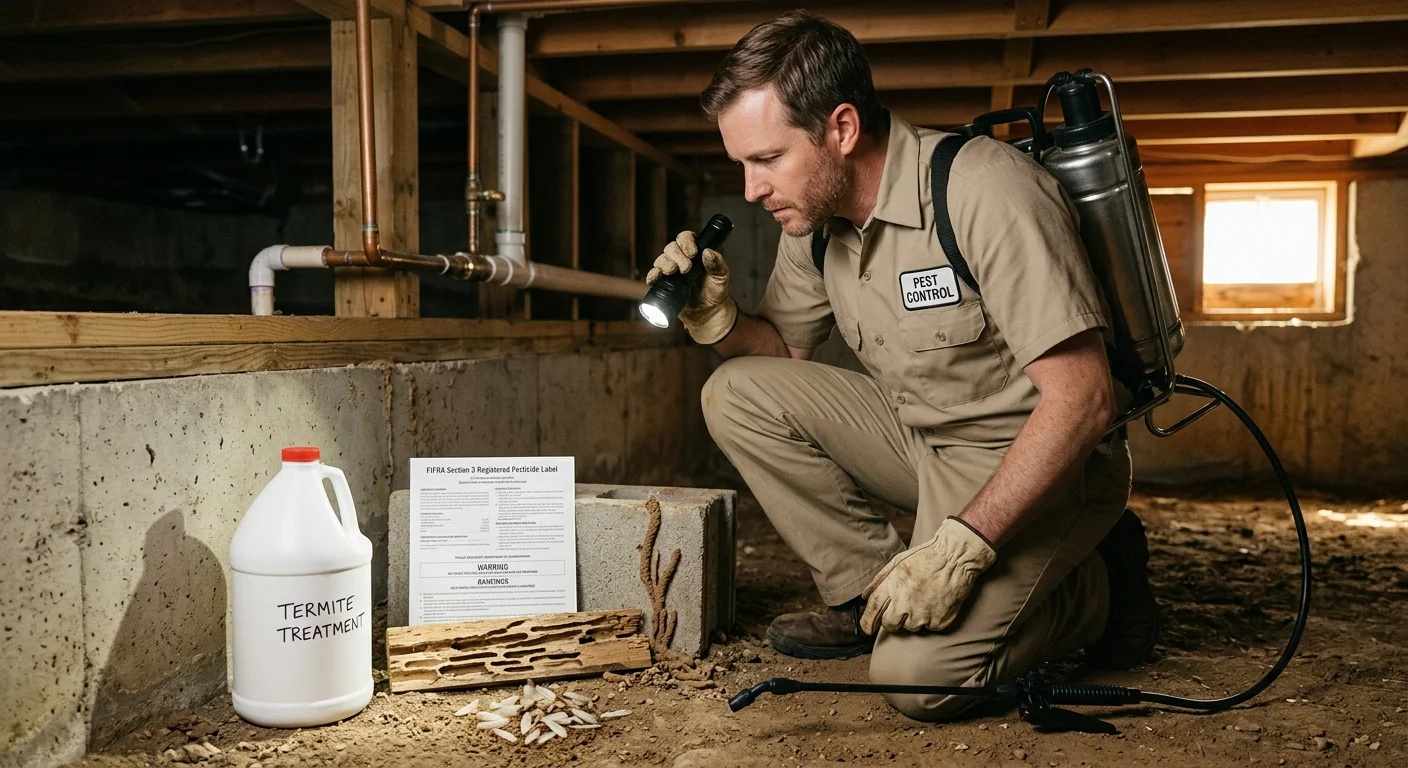
Why termite identification comes before treatment
Drywood and subterranean termites don’t occupy a structure the same way. They also aren’t managed with the same treatment plan. A product labeled for termites doesn’t settle which termite you’re dealing with.
Western drywood termites occur across Southern California, including the Pacific coastal region. They live within wood and don’t require soil contact. According to UC IPM’s drywood termite guidance, their six-sided fecal pellets are diagnostic. The termites push those pellets through tiny kickout holes.
Subterranean termites nest in soil and build shelter tubes between soil and wood. UC IPM says they can forage year-round in California. Their activity may extend well beyond the place where damage first appears. They also don’t produce the diagnostic pellets associated with drywood termites.
San Diego County’s geography doesn’t make identification automatic. A coastal Encinitas home shouldn’t be treated as a drywood case based only on location. Likewise, an El Cajon property isn’t automatically a subterranean case. UC IPM reports subterranean termites across nearly every region of California. It also reports Formosan termites in a small area near San Diego, not across the whole county.
Start with the evidence, not a product shelf. Pellets, shelter tubes, swarmers, damaged wood, and exit holes need to be read together. Our guide to drywood and subterranean termites in San Diego explains those differences in more detail.
A professional termite inspection can identify visible and accessible evidence. It can also show where access limits the conclusion. That matters because even a formal wood-destroying organism report covers visible and accessible areas, not every concealed space.
Identification also changes the treatment conversation. Soil treatments, bait systems, localized drywood treatments, heat, and fumigation solve different problems. If you’re comparing professional methods, read our guide to liquid and bait termite treatment.
What store-bought labels do and don’t establish
The registered label governs how a specific product should be handled and used. Read the entire label before opening the container. If the pest, site, or proposed use isn’t clearly covered, don’t improvise.
A label can tell you what that particular product permits. It may address required precautions, storage, treated sites, and restrictions involving people or pets. Those directions don’t transfer to a different product, even when the packages make similar claims.
What the label can’t do is diagnose your house. It can’t establish whether pellets came from an active drywood termite infestation. It can’t decide whether a shelter tube connects to a larger subterranean colony. It also can’t map concealed galleries inside framing, trim, roofing components, or other wood.
The label doesn’t confirm that a visible damaged area is the only affected area. It doesn’t show whether a barrier, inaccessible void, or structural feature kept a treatment from reaching its intended target. It also can’t certify that termite activity has ended.
These limits matter because UC IPM doesn’t recommend do-it-yourself treatments for drywood termites. Its subterranean termite guidance also states that all effective products for those infestations are for professional use. That guidance is stronger than a package’s general marketing language.
Don’t use this page as an application guide. Mixing, drilling, dosage, and placement depend on the exact product and treatment plan. Using more product doesn’t answer the missing diagnostic questions.
DIY steps can still support a sound decision. Save the label and receipt. Record where you found the evidence. Take clear photos before cleaning or repairing the area. Note where any product was used, then share that information with the company inspecting the property.
For a broader comparison of manageable household tasks and work that needs professional diagnosis, see DIY versus professional pest control in San Diego.
Which evidence can remain hidden after treatment
A quieter surface isn’t the same as a confirmed result. Termites can occupy wood or travel through areas that aren’t open to view. A change at one accessible spot doesn’t establish what happened elsewhere.
Drywood termite colonies can remain inside wood. UC IPM notes that whole-structure fumigation has an advantage over localized treatment because it addresses accessible and inaccessible infestations together. Localized methods depend heavily on finding the extent of the infestation. That extent can be difficult to determine.
That doesn’t mean every drywood termite finding requires fumigation. It means the decision needs evidence. A licensed termite company should explain why a localized treatment, heat treatment, wood replacement, or whole-structure approach fits the findings.
Subterranean termite evidence can also be incomplete. Their colonies nest in soil, sometimes far below the surface, and foragers reach structures through shelter tubes. Treating a visible area doesn’t confirm what remains in the soil or at another entry point. It also doesn’t show whether moisture or wood-to-soil contact still supports access.
Recent DIY work can complicate the next inspection. Removed pellets, patched holes, discarded wood, and painted surfaces may erase useful context. Before changing an area, photograph the evidence from several angles. Include nearby walls, trim, foundations, or other reference points.
Keep the product container or a readable image of its label. Write down the date and exact location where you used it. Don’t rely on memory or a broad note such as “garage.” A record like “north wall beside the side door” gives the inspector better context.
Ask what remains unconfirmed after the inspection. Visible and accessible findings may support a clear recommendation. They still shouldn’t be presented as proof that every concealed space was examined. Honest limits are part of a useful inspection.
This distinction matters before repairs, a home sale, or another treatment. Covering damage may improve the surface while leaving its cause unresolved. A treatment decision should separate three questions: what termite is present, how far the evidence extends, and what result can actually be checked afterward.
What to ask a licensed termite company
A useful consultation should produce more than a treatment name. The company should connect its recommendation to identified evidence and explain what remains uncertain.
Start with the termite itself. Ask which species or termite group the evidence supports. Then ask what features led to that conclusion. Pellets, kickout holes, shelter tubes, swarmers, and damaged wood don’t all point to the same plan.
Ask these questions before approving work:
- What visible evidence did you find, and where was it found?
- Which areas were accessible during the inspection?
- Which areas couldn’t be inspected?
- Does the evidence support drywood or subterranean termites?
- Is the proposed treatment localized or whole-structure?
- What infestation areas is the treatment designed to reach?
- What findings would change the proposed treatment?
- What preparation belongs to the property owner?
- How will the company evaluate later evidence?
- Are any warranty or re-treatment terms offered in writing?
- What work, areas, or conditions does the written agreement exclude?
California divides structural pest control work by license branch. Branch 3 covers wood-destroying pest work using insecticides, repairs, and corrections, excluding fumigation with lethal gases. Only Branch 1 licensees may perform structural fumigation. You can verify a person or company through the California Structural Pest Control Board license search.
If fumigation enters the discussion, ask which licensed fumigation company will perform it. Follow that company’s written preparation checklist. California re-entry isn’t a homeowner judgment based only on elapsed time. The licensed fumigator must test during aeration and post the re-entry notice before anyone returns.
For non-fumigation work, ask the Branch 3 company to explain why the selected approach fits the evidence. Our termite treatment service page outlines how we connect property owners with appropriately credentialed local companies.
Share every DIY step before the inspection. Provide product names, labels, dates, locations, photos, and any removed material. This helps the inspector separate original evidence from changes made afterward.
Don’t approve treatment based only on a verbal price or broad promise. The matched company should inspect first and quote in writing before treatment begins. Review its own agreement for scope, exclusions, preparation duties, and any offered warranty terms.
When to call us
Call when the termite type is uncertain, evidence appears in multiple areas, or the proposed treatment needs a licensed company. Call us at (858) 400-6561 and we’ll match you with a licensed local pro.