
Two proposals for the same house can look nothing alike. One recommends liquid applied to the soil around the foundation, the other recommends in-ground bait stations on a monitoring schedule. Before you compare the two, you need to know which termite the inspector actually found.
Which termite species the inspection must identify
Liquid and bait are not two ways of doing one job. They belong to different biology, so a report that never names the species can’t support either recommendation.
UC IPM describes subterranean termites as termites that need soil contact for moisture. They nest in soil, sometimes many feet below the surface, and build shelter tubes between that soil and the wood in your house. Their colonies are large. UC IPM puts foragers in the hundreds of thousands. Reticulitermes, the most common group, turns up in nearly all regions of California.
Drywood termites work differently. UC IPM calls the western drywood termite (Incisitermes minor) California’s second most important termite pest and says it’s commonly found along the Pacific coastal region and into the deserts of Southern California. It doesn’t need soil contact. Its colonies usually hold fewer than 1,000 individuals. The giveaway is the fecal pellet: UC IPM says drywood pellets have six hexagonal sides and are diagnostic for the species, pushed out through kickout holes less than 2mm across.
That difference decides the whole conversation. Soil-connected termites can be reached through the soil. A colony living inside a beam with no soil connection can’t be, so a ground station has nothing to intercept. Our guide to drywood and subterranean termites in San Diego walks through the physical signs side by side.
There’s also a local wrinkle worth asking about. UC IPM notes the Formosan termite (Coptotermes formosanus) is currently restricted to a small area near San Diego. That’s a real finding for this county and nowhere else in California, and it’s a fair question to raise with an inspector who works your neighborhood.
Ask for the species in writing on the report. A report that says “termites” and jumps to a product hasn’t finished the first step.
How liquid treatment and bait stations differ
UC IPM lists three professional approaches for subterranean termites, and the first two are the ones on your proposals.
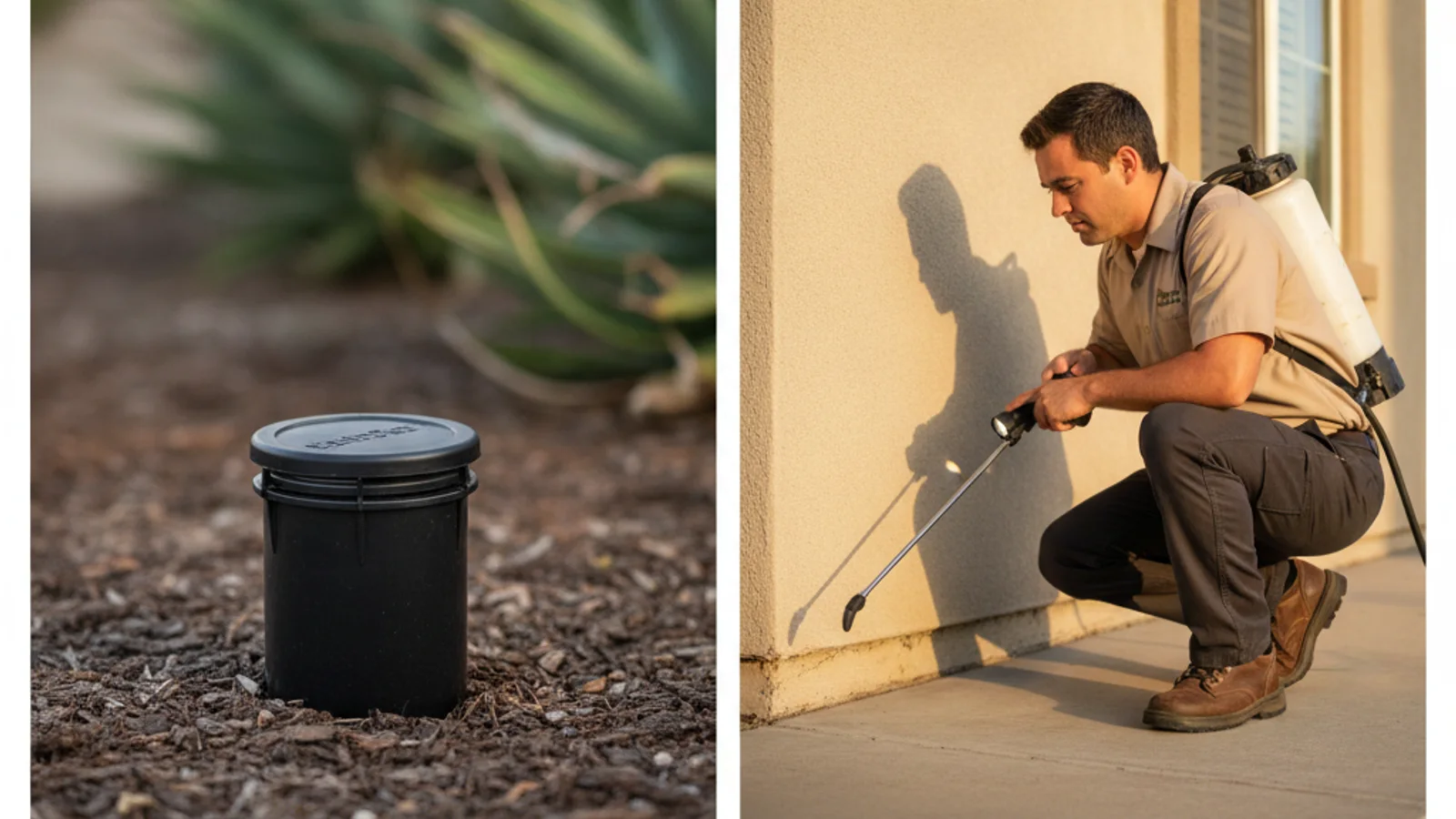
Soil-applied insecticides are the liquid option. UC IPM names nonrepellent chemicals such as fipronil and imidacloprid. The idea is a treated zone in the soil that termites move through rather than avoid. Baiting systems are the other route. UC IPM describes them as slow-acting insecticides consumed during feeding and shared within the colony, which means the workers carry the effect back rather than dying where they stand.
Neither is automatically the better buy, and this page won’t tell you one always wins. What separates them for a homeowner is shape, not strength. Liquid work is usually a defined application event around a structure. Bait is a program: stations get installed, then checked, and the checking is the part you’re paying for over time. Ask how long that monitoring runs and what happens when it lapses.
Drywood termites sit outside both. For those, UC IPM separates whole-structure approaches from localized ones. Whole-structure means sulfuryl fluoride fumigation with monitoring, or heat treatment held at a minimum of 120°F for 33 minutes or more. Localized means chemical liquids and dusts, foams, microwave devices, electrocution, or replacing the wood. UC IPM says whole-structure treatment has an advantage over localized work because it should reach every infestation, including hidden ones, while localized methods are less reliable when nobody can say how far the damage runs.
If tenting is on the table, our post on termite treatment without tenting in San Diego covers what the localized alternatives can and can’t promise, and our San Diego termite fumigation guide explains what a tented job involves.
One rule cuts across all of it. UC IPM says all effective subterranean products are for professional use only, and that do-it-yourself drywood treatments are not recommended. This isn’t a category where you buy the pro product and skip the pro.
What site conditions can change the recommendation
Two houses with the same species can still get different plans, because the ground and the structure are part of the decision.
Soil contact is the first thing an inspector reads. UC IPM lists habitat modification alongside chemicals: removing wood-to-soil contact and cutting moisture sources. In San Diego County that lands differently depending on where you live. A 1950s slab tract home in Clairemont or El Cajon presents a different perimeter than a raised-foundation Craftsman in South Park with a crawlspace an inspector has to enter. Coastal North County properties in Del Mar, Solana Beach and Encinitas carry salt air, marine humidity and mature landscaping pressed against stucco. East County houses in Lakeside and Alpine sit on drier ground with irrigated islands around them, and UC IPM notes subterranean termites nest deeper when conditions are dry.
Access changes it too. Hardscape, added patios, pool decks and additions built over original grade all limit where soil work can physically go. A property line six feet from a neighbor’s wall in the South Bay is a real constraint. So is a well or a storm drain.
Season matters less than people expect here. UC IPM says California subterranean termites can forage year-round, with the least activity from November through February and the most in summer. Nobody has to wait for a swarm to act.
Structural repair is a separate scope from killing termites, and it’s worth separating on the estimate. In California, work on wood-destroying pests using insecticides or structural repairs falls under SPCB Branch 3. Fumigation with lethal gases is Branch 1 only. General household pest work is Branch 2. Naming that structure is useful when you’re reading two bids that don’t match: they may not even cover the same license scope. Our termite treatment referral service matches San Diego County homeowners with companies licensed for the branch the job needs.
Questions to ask before approving a treatment plan
Bring the report and the proposal to the same table, then work through the gaps.
- Which species did you find, and what evidence? Ask for pellets, shelter tubes, damaged wood or swarmers to be described, not just concluded.
- Why this method for my house? The answer should reference soil contact, access and the extent of the infestation, not a product name.
- What exactly is treated, and what isn’t? Get the areas listed. UC IPM’s own caution about localized work is that the extent is hard to determine.
- Is monitoring included, for how long, and what does it cost after? This is the real difference between a bait program and a one-time application.
- What does the label require for occupants, children and pets? The current product label controls that, not a sales sheet. Ask to read it and ask who explains re-entry.
- Who holds which license? Verify the company and the individual on the SPCB license search. Cancelled licenses don’t appear in that search, so contact the board directly if a record you expect isn’t there.
- What’s the written warranty or re-treatment term? Those terms belong to the company’s own signed agreement. We don’t set them and can’t promise them for anyone.
- Is a WDO report part of this? A Wood Destroying Pests and Organisms Inspection Report, SPCB form 43M-41, is issued by a registered Branch 3 company and covers visible and accessible areas only. Lenders usually want one before financing.
If fumigation ends up being the recommendation, the re-entry decision is not yours or the salesperson’s. The California Department of Pesticide Regulation sets the standard: a structure may be reoccupied when sulfuryl fluoride reads 1 ppm or less, and nobody enters until the fumigation company posts the notice with the safe re-entry time and date. Anyone who talks past that is telling you something the state doesn’t allow.
Get both proposals in writing, on the same scope, before anything is applied. The company you’re matched with inspects first and quotes in writing before treatment begins. For general background on pesticide use and your rights as a customer, the EPA’s pest control guidance is a plain starting point.
When to call us
Termite work in California is licensed work, and the species determination that drives the whole plan takes a trained eye inside a crawlspace or an attic. If you’ve found pellets, shelter tubes, or swarmers, or you’re holding two proposals that recommend opposite methods, get a licensed inspection before you sign either one. Call us at (858) 400-6561 and we’ll match you with a licensed local pro.