
The bottle says it kills fleas, so you sprayed the living room, and two weeks later the ankles are itching again. A house spray is one narrow tool aimed at one part of a problem that lives in carpet fiber, under furniture, on the pet, and out in the yard. Knowing what it can’t reach is what keeps you from spraying the same room four times.
What a house spray can and can’t reach
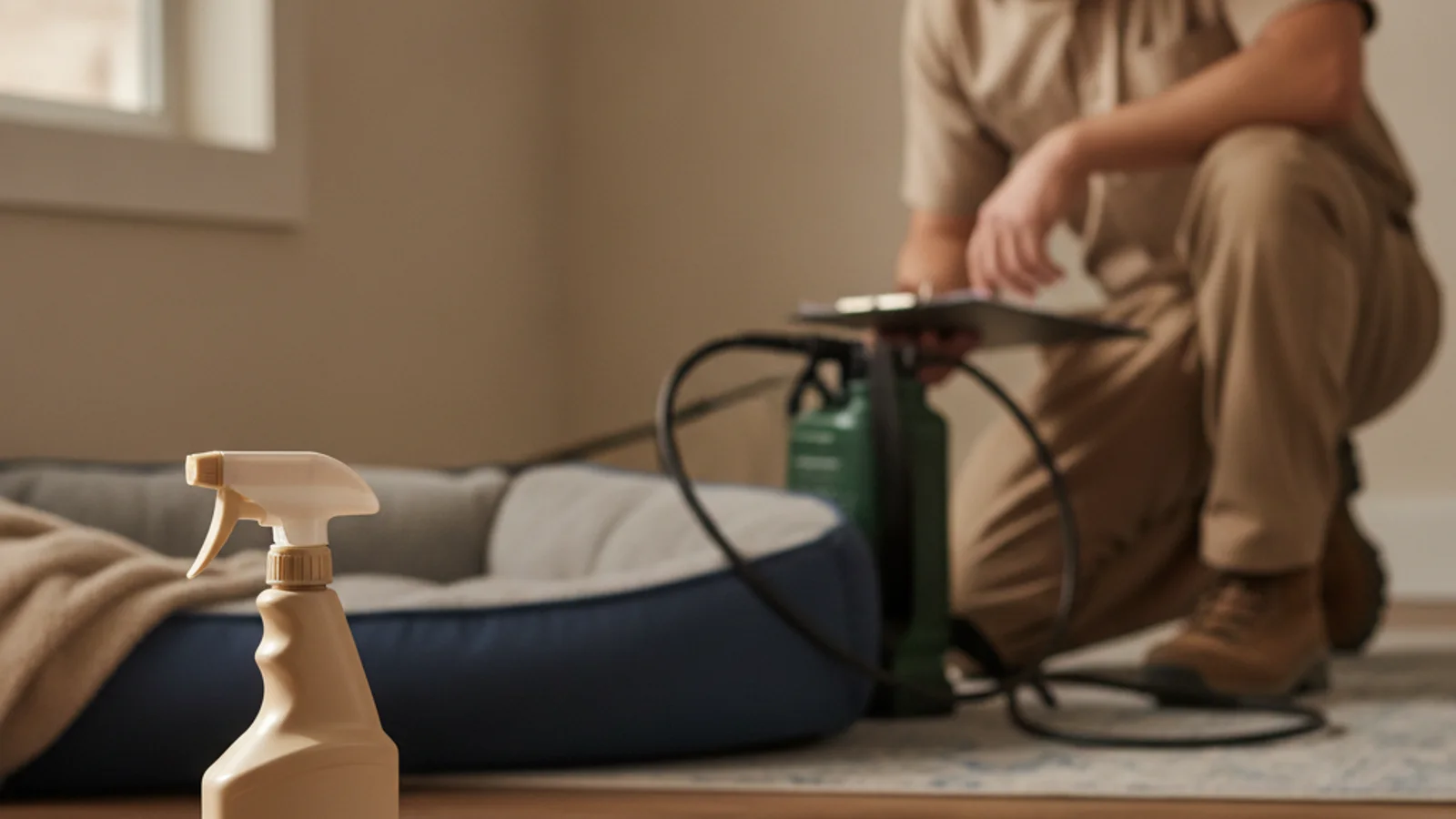
A spray only affects what it contacts, in the places its own label permits. So before you buy, check the label for the exact area you had in mind. Deep carpet backing, the underside of upholstery, the gap under a fixed cabinet run, subfloor seams and the inside of a heating duct are all worth checking for by name, because a product that doesn’t list a site isn’t cleared for it.
Then there’s the pet, which is the part people most often mistake. Household surfaces and an animal’s coat are two different uses, and only the label in your hand says which one that product covers. We won’t tell you to put a house product on an animal, and this page gives no rates, mixes, or application instructions of any kind.
The yard is the third gap, and an indoor bottle never reaches it. UC IPM notes that some wild animals can lead to outdoor flea problems as well, including feral cats, opossums, squirrels, and coyotes, and advises limiting food, water, and shelter for these animals on your property. A shaded side yard where the dog lies down, a raised foundation with a crawl space opening, or a spot under a deck all sit outside the reach of an indoor bottle.
Where the pet rests is the place to concentrate on. UC IPM’s advice is to locate heavily infested areas, usually areas where the pet rests, and concentrate treatment there. That’s a question about your own floor plan, not your ZIP code, so walk it: carpet the dog sleeps on, a crawl space opening, a shared wall or a shared laundry in a condo building like those in Pacific Beach. Tell the company you call what you found there.
One biology note worth keeping straight: UC IPM describes adult fleas as reddish-brown, wingless insects no larger than 1/8 inch. If something is flying around the room, it isn’t a flea, and you may be treating the wrong pest entirely. Our flea treatment guide for San Diego covers how the household side and the pet side have to move together.
Why the registered product label controls
The label isn’t marketing copy on the back of the bottle. It’s the directions for that specific product, and it overrides any advice you read online, including ours.
Read the full current label before you buy, not after. Front-panel wording is designed to be reassuring, and two bottles that look nearly identical on the shelf can differ in target pests, approved locations, and precautions. Check whether fleas are actually named. The EPA’s own bed bug guidance works the same way, telling people to look for EPA-registered pesticides that have bed bugs listed on the label, and to use foggers only if bed bugs are listed. Check whether the exact area you have in mind is listed. Check what the precautionary statements say about people, pets, ventilation, and re-entering the treated space.
Here’s the part homeowners most want us to answer and we won’t fake: whether a given product is safe around your kids or your pets. That depends entirely on the label of the product in front of you, and formulations change. We can’t declare a flea spray safe for a nursery or a cat household without that exact current label. If a precaution reads ambiguously, call the manufacturer using the contact information printed on the container.
Some general context helps. The EPA’s safer pest control resource explains how consumer pesticide products are meant to be selected and used. It’s useful background, and it doesn’t replace the label. Retailer descriptions, review threads, video demos, and AI summaries don’t replace it either.
A few habits to avoid outright. Don’t combine two products because one didn’t seem to work. Don’t move a product into an unmarked container. Don’t stretch a permitted indoor use into a crawl space, a pet bed, or an attic just because the pest is the same. And don’t shorten the interval between uses hoping for a faster result. When the label doesn’t cover the situation you actually have, that’s the signal to get an inspection instead of a second bottle.
When pets need separate veterinary guidance
The household and the animal are two different decisions with two different professionals behind them. We’re a referral service for pest control companies, so the animal side isn’t ours to advise on, and we won’t pretend otherwise.
What that means in practice: flea products applied to an animal belong to a conversation with your veterinarian. Species, weight, age, pregnancy, existing medication, and health history all bear on that choice, and a veterinarian is the one with your pet’s record in front of them. A dog product and a cat product are not interchangeable. Never assume they are.
It also means the household treatment and the pet treatment need to be sequenced, not stacked blindly. If a licensed pest control company is scheduled and your veterinarian has a product on the animal, say so to both. Each one needs to know what the other is doing so nobody doubles up on an active ingredient without knowing it.
The same care applies to the rest of the household. Fish tanks, reptiles, birds, and rabbits all react differently than a dog does, and the label of the household product is where their precautions appear. So is guidance on children’s toys, bedding, food surfaces, and how long to stay out of a treated room.
There’s a wildlife angle in San Diego County too. If the feral cats, opossums, squirrels or coyotes UC IPM names are moving under a raised foundation or through a canyon-edge yard, the animals feeding fleas may never be treatable at all. That’s a structural exclusion problem, not a spray problem. And if the household includes both fleas and ticks, the identification matters, because they aren’t the same job. See our flea and tick treatment referral service for how those get scoped.
What to ask a licensed company before treatment
You’re not obligated to accept a treatment plan you don’t understand. A few direct questions separate a real plan from a routine spray-and-go visit.
Ask them to inspect and tell you where the activity is, before quoting. Ask which rooms and exterior areas are in scope and which are excluded. Ask what preparation you’re responsible for, especially vacuuming, laundering bedding, and clearing floors. Ask them to name the product and hand you the label information for anything applied inside. Ask how long people and pets stay out, and get that from the label, not from a guess. Ask whether the yard is included, and whether crawl space access is part of the price. Ask what follow-up looks like and what the written agreement says about re-treatment, because those terms belong to that company, not to us.
Then ask about credentials. In California, Branch 2 is the practice relating to the control of household pests excluding fumigation with poisonous or lethal gases, and you can verify any company through the SPCB license search. Pest Pros San Diego doesn’t hold that license or perform treatments. We match customers with licensed local pest control companies.
On money, HomeGuide’s 2026 national cost guide puts a flea exterminator at $200 to $400 for a one-time visit with an inspection and treatment, and $300 to $600 per year for an annual contract. That’s a national figure, not a San Diego quote. We have no fee schedule and that isn’t our price, so use it only as a market reference. The figure that matters is the written quote from the company after it inspects. Our flea and tick treatment cost breakdown covers the factors that move it, and our comparison of DIY and professional pest control helps you judge which parts you can reasonably handle yourself.
When to call us
Call when fleas keep returning after you’ve treated the floors, when the source may be a crawl space or a yard you can’t reach, or when you share walls and don’t know how far the problem runs. Call us at (858) 400-6561 and we’ll match you with a licensed local pro.