
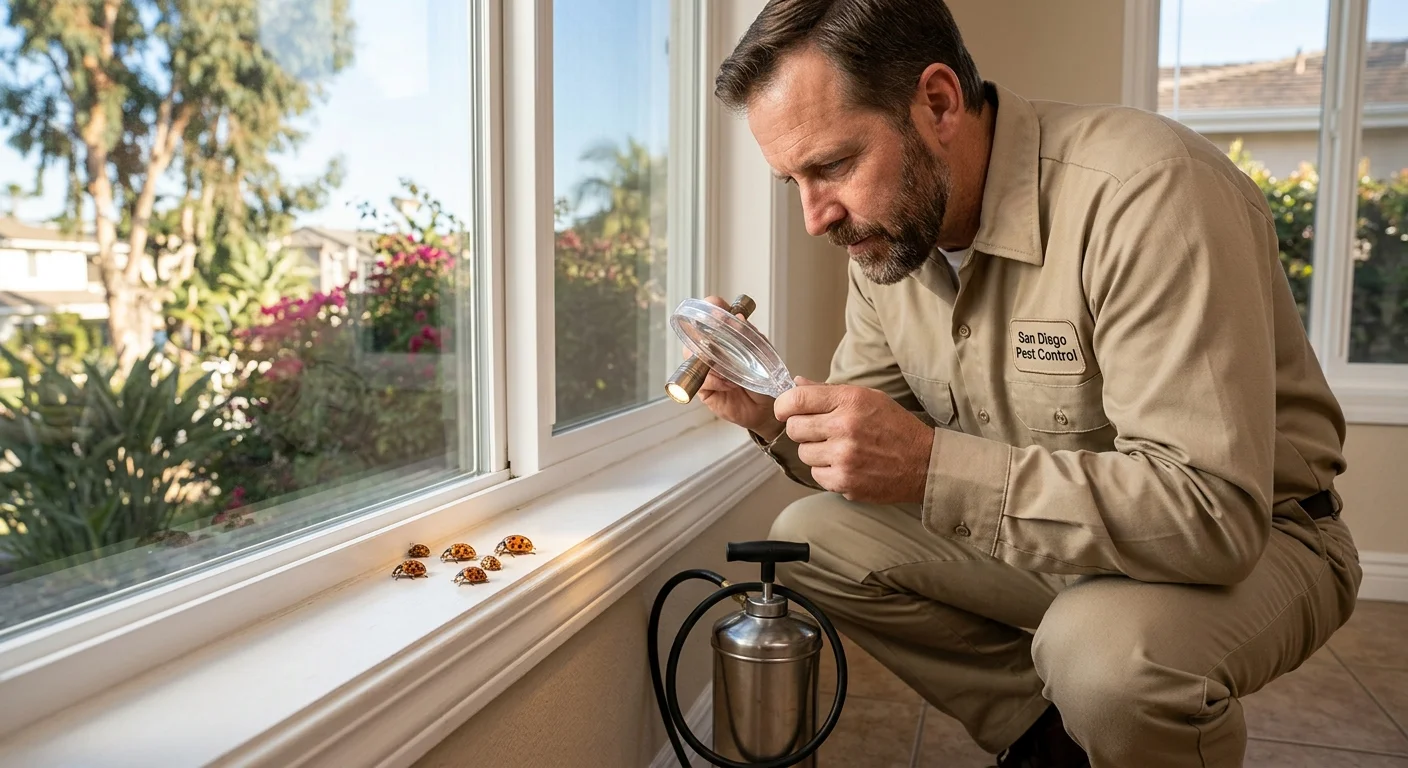
Small, rounded beetles near a window often get called ladybugs. That label doesn’t confirm the insect or whether ladybug pest control is needed. Start by documenting what you found, where it appeared, and whether it keeps returning.
Why ladybug is an imprecise household label
“Ladybug” is a familiar homeowner label, not a complete identification. It may describe the insect’s shape, color, spots, or simply where someone found it. Those details can start an identification, but none should settle it alone.
That distinction matters when beetles appear indoors. A single insect resting beside a window presents a different decision from repeated clusters across several rooms. Neither observation identifies a species by itself. It also doesn’t prove that the insects are breeding inside, entering through one opening, or damaging the building.
Describe what you can actually see. Avoid converting an uncertain observation into a firm diagnosis. “Small orange beetle with dark markings” is more useful than naming a species you haven’t confirmed. If the color changes under different lighting, say that too.
San Diego County location also deserves precision. Record the city and neighborhood rather than writing only “San Diego.” A condo in City Heights, a detached home in Chula Vista, and a coastal property in Encinitas give an identifier different building contexts. The address isn’t necessary for an initial call, but the property type and general location help.
Don’t assume that every ladybug-like insect requires treatment. Identification comes first. The answer may involve monitoring, correcting an entry point, or discussing control with a licensed company. Our general pest control referral service can connect you with a local company when the evidence calls for professional help.
Field marks from UC IPM, not a species guess
UC IPM’s lady beetles page (updated September 2025) describes lady beetles, or “ladybugs,” as round- or half-dome-shaped insects with hard wing covers. About 200 species occur in California. Coloring and patterns differ by species, so spot count alone does not finish an ID.
Two field marks from that page are worth photographing:
- The convergent lady beetle (Hippodamia convergens): the adult has converging white marks on the thorax. The number of spots may range from 0 to 13.
- The multicolored Asian lady beetle: it ranges from red to yellow with no spots or up to 19 spots on the wings. The thorax is often cream colored with black markings. UC IPM calls this a larger lady beetle.
UC IPM also notes that spotted cucumber beetles have long antennae, while lady beetles have short or sometimes hard-to-see antennae. Photograph the thorax, wing covers, and antennae. Do not name a species from color alone. Keep the photo log below even after you think you recognize a mark.
Which features and locations to photograph
Take several clear photos before removing or disturbing the insects. One distant picture rarely captures enough detail. A short photo set gives a pest professional more to assess.
Start with a view from directly above. Then photograph the side and front if possible. Include one image showing the full insect without digital zoom. Add another beside a familiar object for scale, but don’t rely on memory when describing size.
Capture these visible details:
- The main body color
- The number and placement of visible markings
- The shape of the back and head
- Any color around the head or outer edges
- Whether every specimen looks alike
- The insect’s size relative to the same reference object
Photograph the discovery site as well. Show the whole window, door, wall, ceiling, light fixture, or cabinet area. Then take a closer image of the exact crack, frame, screen, or trim where you noticed activity. Don’t dismantle finished surfaces just to obtain a picture.
Write down the room and floor. Note whether the insects were on the indoor or outdoor side of the glass. Record the date, approximate time, and number you could plainly count. If more appear later, add a new entry rather than replacing the first one.
Keep one intact specimen in a closed, clearly labeled container if you can do so without handling it directly. Don’t crush every specimen before requesting identification. A damaged insect can remove the features an identifier needs.
Our San Diego pest season calendar can help organize the timing of a sighting. Use it as context, not as proof of species. The insect in your photo still needs to be identified from the available evidence.
What indoor activity can and can’t establish
An indoor sighting establishes only what you directly observed. It can show that one or more insects were present in a particular place at a particular time. Repeated notes can also show a pattern across rooms, windows, or dates.
That record doesn’t automatically establish an infestation. It doesn’t reveal the entry point unless you watched the insects enter. It doesn’t prove a nest, breeding site, structural problem, or need for pesticide treatment. A cluster near glass also doesn’t explain how the insects reached that location.
Use a simple room-by-room log. Record exact places such as the west-facing bedroom window, the upstairs hallway light, or the sliding door track. Note whether the insects were moving, still, or already dead. Include any recent changes you can verify, such as an opened window, damaged screen, delivered plant, or stored box brought indoors.
Don’t spray first and investigate later. An unconfirmed product choice can erase useful evidence without answering the identification question. Pest Pros San Diego doesn’t apply pesticides or set treatment plans. The company you are matched with should inspect the evidence and explain its recommendation.
This is also where the difference between observation and diagnosis matters. A homeowner can document visible activity well. A licensed professional can compare the specimen, inspect likely access points, and decide whether control belongs in the proposal.
Our guide to DIY versus professional pest control explains that decision boundary. Documentation and basic housekeeping may be reasonable first steps. Species identification and treatment selection become professional questions when the sightings persist or remain unclear.
When a licensed company should identify the insect
Request a professional identification when the insects keep appearing, occur in several rooms, or collect in places you can’t examine safely. The same applies when your photos don’t show enough detail for a reliable answer. Uncertainty is a valid reason to pause before choosing any treatment.
A useful inspection request should be specific. Tell the company how many sightings you’ve recorded and which rooms were involved. Share the clearest photos and your date log. Mention whether you found live and dead specimens. Ask the inspector to identify the insect before discussing control.
You can also ask these practical questions:
- What visible features support the identification?
- Does the evidence show indoor activity or only indoor presence?
- Which entry points were actually observed?
- Is treatment recommended, or is monitoring enough?
- What work is included in the written proposal?
- Which pesticide label applies if a product is proposed?
California places general household pest work that excludes fumigation within Structural Pest Control Board Branch 2. Pest Pros San Diego doesn’t hold that license or perform the work. We match customers with licensed local pest control companies.
Before hiring, use the California Structural Pest Control Board license page to reach the state’s public lookup. Confirm the company, license type, and current status yourself. Don’t rely only on a logo, vehicle, advertisement, or verbal claim.
Our broader San Diego pest control guide explains what to gather before requesting a match. Good evidence helps the licensed company focus its inspection without pretending the answer is already known.
When to call us
Call when ladybug-like beetles keep returning or their identity remains uncertain. We’ll connect you with a licensed local company that can inspect the evidence and explain its recommendation.
Call us at (858) 400-6561 and we’ll match you with a licensed local pro.