
Tiny specks that hop when you get close, gathered in a bathroom sink or along a damp patio threshold, are usually springtails. They’re a moisture indicator more than a pest problem, which means the useful question isn’t what to spray, it’s where the water is coming from. Confirm the identification first, because the same hop gets mistaken for fleas every summer.
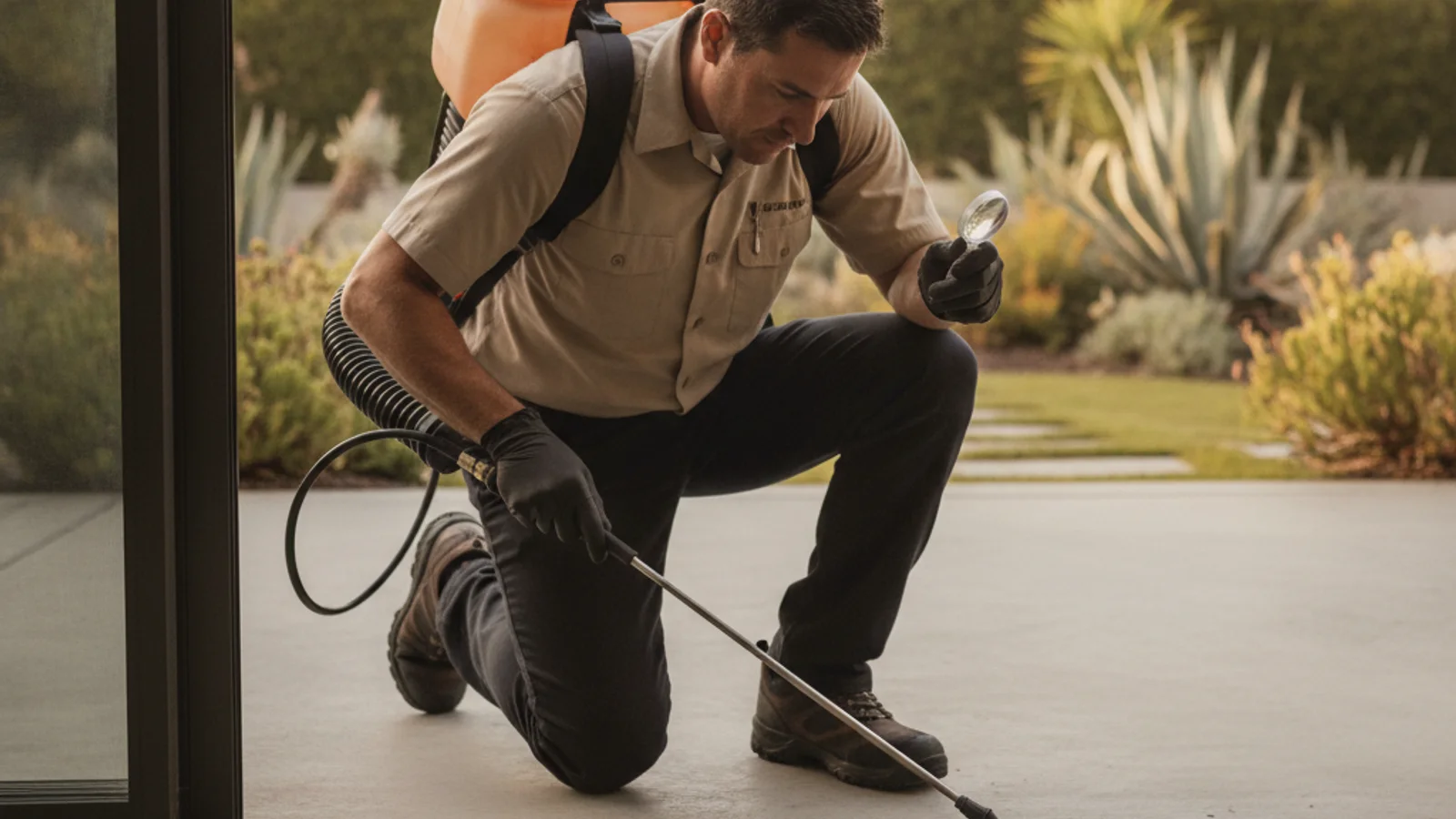
How to confirm the insects are springtails
Get close enough to see size and movement first. UC IPM’s Pest Notes on springtails describes them as “minute, wingless insectlike arthropods about 1/16 inch long,” with adults running whitish, bluish, or dark gray to black. That is comma-on-a-page small.
The movement is the giveaway. UC IPM explains that “springtails get their name from the ability to jump up to several inches high by means of a tail-like mechanism (furcula) tucked under the abdomen.” They don’t fly, they don’t run in a line the way ants do, and they don’t crawl steadily. Disturb the group and it scatters upward in every direction at once.
That jump causes the most common misidentification. UC IPM notes that “because they jump when disturbed, springtails are sometimes confused with fleas.” The difference matters, because a flea problem points at a pet and a very different treatment. Fleas are darker, flattened side to side, and concentrate where an animal rests. Springtails cluster where water sits, and they show up in numbers on wet surfaces with no animal anywhere nearby.
Where you find them narrows it further. UC IPM says springtails are “often trapped in sinks, washbasins, and bathtubs” and “may also occur around floor drains, in damp basements, crawl spaces, and wall voids.” Outdoors they turn up in swimming pools, moist landscaped areas and vegetable gardens. A sink basin with no drip and no houseplant nearby is an odd place to find them; a sink under a slow supply-line leak is not.
Two reassurances worth having before you panic. UC IPM states that “springtails do not bite humans or pets, nor do they spread disease or damage household furnishings,” and calls them “mainly a nuisance by their presence.” So you have time to find the source properly rather than reacting.
Other small moisture-associated pests get confused with springtails too, and each points somewhere slightly different. If what you’re seeing is larger, silver and fast along a baseboard, compare it against our guide on getting rid of silverfish in San Diego. If it curls up and has many legs, check our page on millipedes in San Diego.
Why moisture matters before pest treatment
Springtails live in damp organic material. UC IPM describes them living “in soil, especially soil amended with compost, in leaf litter and organic mulches, and under bark or decaying wood.” Take the moisture away and their habitat goes with it. Leave the moisture and no product keeps them out for long.
UC IPM is direct about the product question: “insecticide sprays are generally not recommended for springtail management. They are often no more effective than vacuuming, and repeated applications may be required.” The stated key is different. “The key to managing springtails is to reduce moisture and excess organic matter in gardens, plant pots, and around building foundations.”
Note the honest limit on that. Drying a spot out is the lever that works, but a single fix rarely ends the activity on its own, especially when the water has more than one source. An irrigation adjustment plus a mulch pullback plus a drainage repair is a plan. Any one of the three by itself is a partial answer, and springtails will keep appearing at the wettest remaining spot.
San Diego County’s own conditions push this in a specific direction. Because summer here is dry, most of the standing moisture around a home is something we created: irrigation controllers, drip emitters, air conditioning condensate lines, pool splash-out, and hose bibs. The wet ground in a July yard is almost always plumbing rather than weather, which is good news, since plumbing can be adjusted.
Geography changes which source is likeliest. Coastal properties in Ocean Beach, Pacific Beach or Encinitas get heavy marine layer overnight, so shaded north-facing walls and patio slabs stay damp long into the morning without any leak at all. Inland North County and East County homes in Poway, Escondido and El Cajon run more irrigation to hold landscaping in dry heat, which shifts the source toward planters and sprinkler overspray. Older central-city neighborhoods with raised foundations have crawl spaces that hold humidity, which is exactly the wall void and crawl space habitat UC IPM lists.
UC IPM’s statewide integrated pest management program publishes this guidance for California conditions, which makes it a better reference for a San Diego home than general advice written for a humid climate.
What to document around drains, patios, and walls
Before anyone treats anything, build a short record of where the water and the insects actually are. It takes an afternoon and it makes a professional inspection far more productive.
Work through the interior first. Check under every sink for a slow supply-line or trap drip. Look at floor drains in laundry rooms and garages. Check the base of the water heater and the washing machine hookup. Look at houseplant saucers, which UC IPM specifically names as a springtail habitat, since potting soil amended with compost is exactly what they live in. Photograph anything damp and note the room and the date.
Then walk the exterior perimeter. Note where mulch or soil sits against the stucco rather than a few inches below it, and where irrigation sprays the wall instead of the plants. Find the air conditioning condensate line and see where it discharges. Check hose bib collars and the seam where a patio slab meets the house, since a slab that slopes toward the wall keeps that joint wet after every watering.
Look at the patio and hardscape specifically, because that’s where outdoor moisture meets the structure. Planter boxes built against a wall, decorative gravel over damp soil, potted plants standing directly on concrete, and shaded slab corners that never dry. Write down which of these hold moisture in the morning.
Keep a simple activity log alongside the moisture notes: where you see them, roughly how many, what time of day, and whether it follows an irrigation cycle. If activity spikes the morning after the sprinklers run, you’ve likely found your answer without anyone opening a wall.
What you should not do is guess at products. This page gives no mixing, dosage, or application directions, and adding an unlabeled treatment to a damp area can make identification harder without changing the habitat. The EPA’s guidance on pest control is a fair orientation on why habitat work comes before chemicals.
How to compare a licensed company’s written plan
When you do bring in a company, read the proposal for whether it addresses moisture at all. A springtail plan that is only a perimeter spray hasn’t engaged with what UC IPM actually recommends, and it’s likely to need repeating.
Here’s what a solid written plan names.
- An identification, in writing. The species or at least the group, and what the inspector observed that supports it. Not “small bugs.”
- The moisture findings. Specific locations, not a general note about humidity. It should read like a list of places, because that’s what you’re going to fix.
- Habitat recommendations you can act on. Irrigation changes, mulch and soil grading at the foundation, drainage corrections, houseplant handling.
- Any product use, explained by its label. Where it goes, what it’s labeled for, and what the precautions are around children and pets. If a product is proposed for a damp area, ask why it’s expected to do something a habitat fix wouldn’t.
- Follow-up terms from the company’s own agreement. What triggers a return visit and what it costs. Those terms are theirs to set, and they vary.
- A licensing reference you can verify. General household pest work in California is Branch 2. Confirm the company and its field representative through the Structural Pest Control Board license search. Cancelled licenses don’t appear in that search, so check status rather than assuming.
Be skeptical of anything promising a clean sweep from one visit. Nobody can promise that drying alone or a single pesticide treatment ends springtail activity. We match homeowners across San Diego County with licensed, insured local companies through our general pest control referral service, and the matched company inspects first and quotes in writing before any work begins. For a broader look at how household pest work is handled locally, see our overview of pest control in San Diego.
When to call us
Call a licensed pro when the moisture source isn’t something you can reach, like a crawl space, a wall void or a slab leak, or when the activity keeps returning after you’ve corrected the obvious water. Springtails in a wall void usually mean water in a wall void, and that’s worth a professional set of eyes before it becomes a repair. Call us at (858) 400-6561 and we’ll match you with a licensed local pro.