
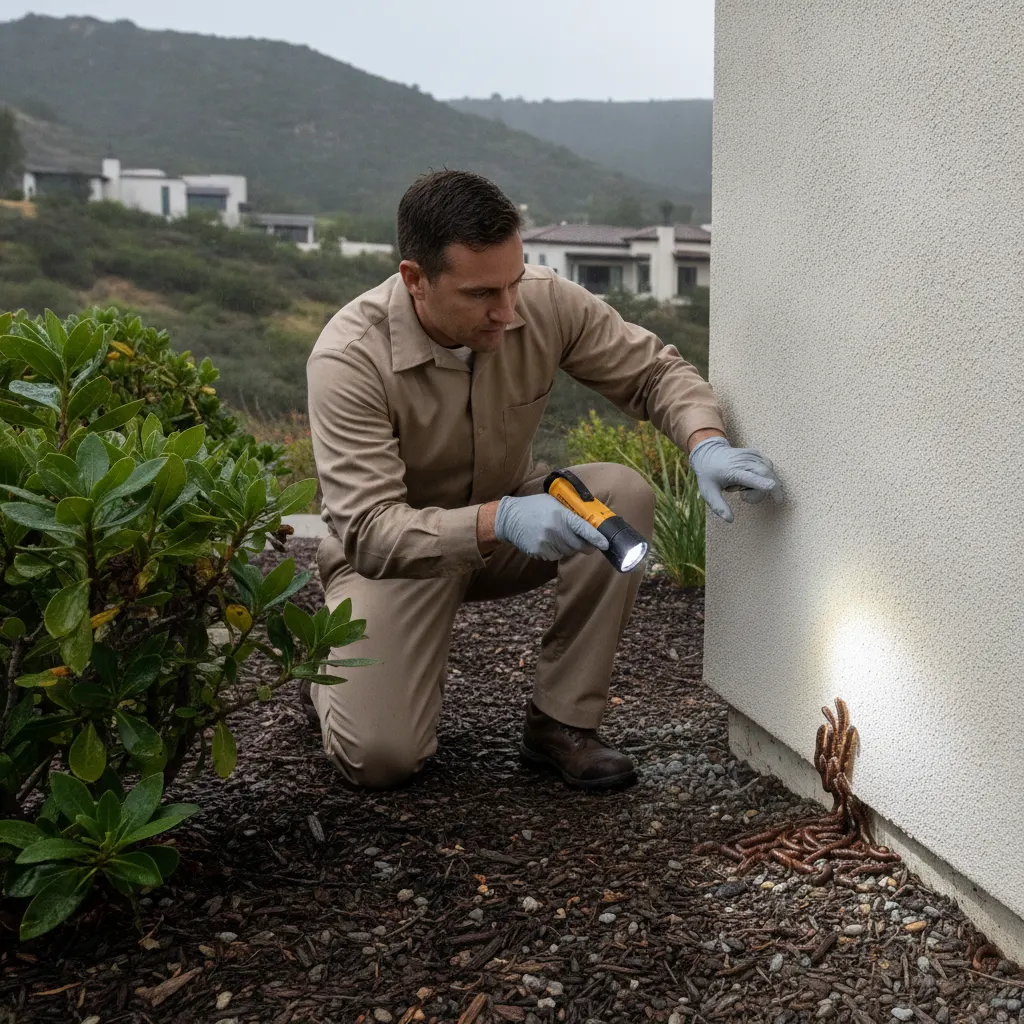
Those dark, worm-like bugs with dozens of tiny legs covering your porch, driveway, or garage floor after a storm are almost certainly millipedes. UC IPM says that when disturbed they don’t bite, though some species exude a defensive liquid that can irritate skin or burn the eyes. UC IPM also says millipedes rarely need to be controlled, since they do not cause damage indoors and pose a minimal health hazard, and that those that stray indoors can be swept out or picked up and released back outdoors.
UC IPM notes that occasionally large numbers of millipedes migrate, often uphill, as their food supply dwindles or their living places become either too wet or too dry. That is the pattern behind a driveway full of them after a storm. Here’s how to tell them apart from look-alikes and what actually stops it.
How to identify millipedes and tell them apart
Millipedes are long, cylindrical, segmented bugs, usually dark brown to black. UC Statewide IPM puts adult millipedes at half an inch to six and a half inches long, depending on the species. The giveaway is the legs: two pairs of legs per body segment on most species, so a millipede appears to have rows of legs rippling down its entire length. When you touch one or it feels threatened, it curls into a tight, flat coil instead of running.
That coiling behavior is the fastest way to separate a millipede from the bug most often confused with it.
| Bug | Legs per segment | Behavior when disturbed | What UC IPM says about it |
|---|---|---|---|
| Millipede | Two pairs (more common) or four pairs | Most curl up when prodded or at rest | Lives in and feeds on rotting leaves, rotting wood, and other moist decaying plant matter |
| House centipede | One pair | Never coils up when disturbed | Has long legs that enable it to run rapidly; comes out at night to search for insects to eat |
| Earwig | Six legs | Hides by day in dark, cool, moist places | Prominent forceps at the tail end are used for defense; earwigs aren’t harmful to people |
UC IPM says centipedes never coil up when disturbed, and that the house centipede has long legs that enable it to run rapidly. So if it darts for cover, it’s a house centipede. If it curls up when you nudge it, it’s a millipede. UC IPM says millipedes normally live in and feed on rotting leaves, rotting wood, and other kinds of moist, decaying plant matter, and that generally their role is a beneficial one in helping to break down dead plant matter.
Why millipedes invade San Diego homes after rain
UC IPM says millipedes normally live in and feed on rotting leaves, rotting wood, and other kinds of moist, decaying plant matter. It also says that occasionally, large numbers of millipedes migrate, often uphill, as their food supply dwindles or their living places become either too wet or too dry, and that they may fall into swimming pools and drown. A driveway, a stucco wall, or a lit porch is the solid ground a migrating millipede runs into on the way.
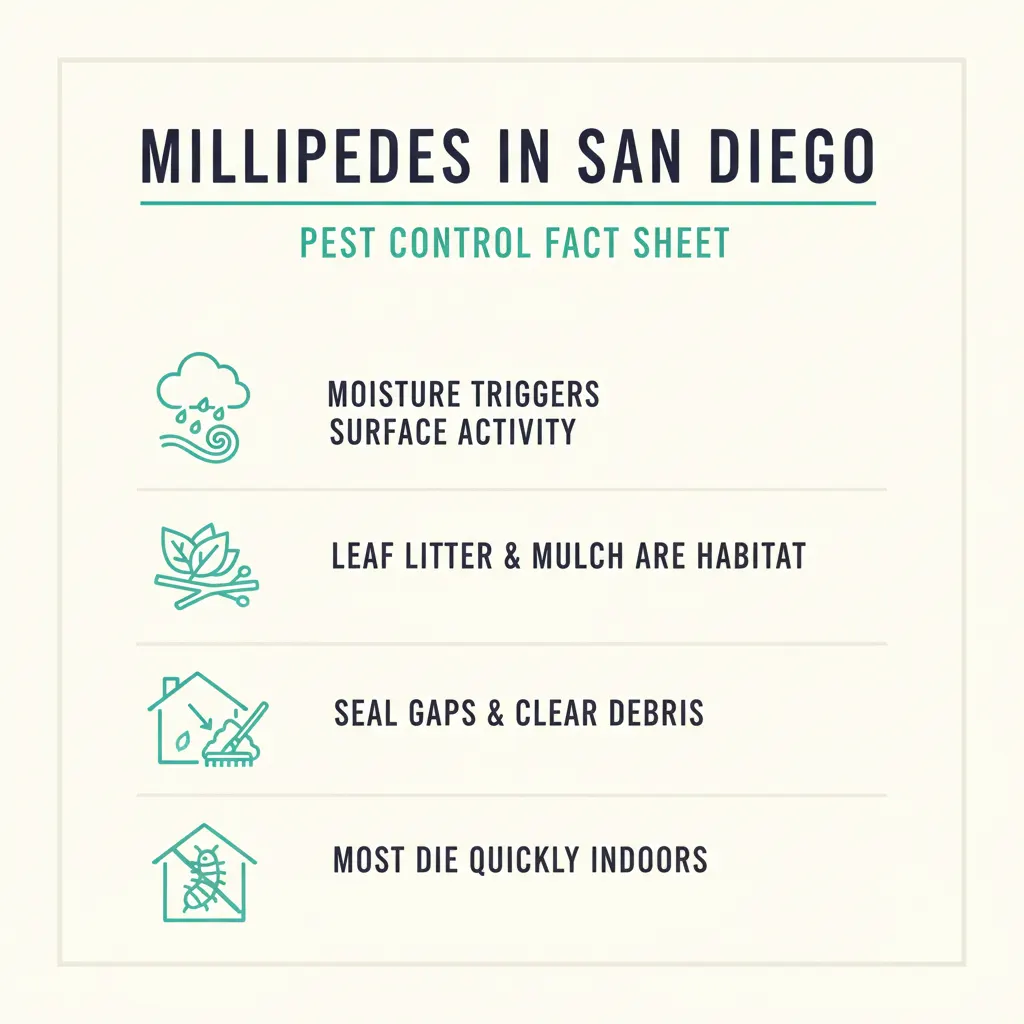
The trigger UC IPM names is a change in moisture, in either direction: too wet or too dry. A property with deep leaf litter and mulch beds carries the habitat UC IPM describes, so that is where the migration starts. It isn’t a sign anything is wrong with your home. Our San Diego pest season calendar covers when other weather-driven pests tend to show up.
Are millipedes dangerous to people or pets?
UC IPM says that when disturbed millipedes don’t bite, but that some species exude a defensive liquid that can irritate skin or burn the eyes. Keep it away from your eyes, and wash the area with soap and water if it gets on you.
UC IPM says millipedes do not cause damage indoors and pose a minimal health hazard. Outdoors is a different question: UC IPM notes that when they become numerous, millipedes may damage sprouting seeds, seedlings, or strawberries and other ripening fruits in contact with the ground.
How to stop a millipede invasion
Millipedes die quickly once they’re inside a house or stranded on dry pavement. Penn State Extension notes they don’t live more than a few days indoors, which is also why treating the inside of the home isn’t necessary. That means the population you see after a storm isn’t building a home inside your walls. The real fix is cutting off the conditions that let so many build up outside in the first place.
- Pull mulch and leaf litter back from the foundation. Keep a several-inch gap of bare soil or gravel between mulch beds and the exterior wall so migrating millipedes hit open, dry ground before they reach the house.
- Fix drainage that pools water against the foundation. Make sure gutters and downspouts direct water away from the house, and grade soil so it slopes away from the foundation rather than toward it.
- Thin out dense ground cover and compost piles near entry points. Millipedes concentrate wherever damp organic matter builds up, so keeping it away from doors and low vents cuts the population close to the house.
- Seal gaps around doors, low vents, and the base of the foundation. Weatherstripping and caulk close the same small openings ants and other ground-level pests use.
- Sweep or vacuum them up rather than spraying indoors. Since they die on their own from the dry indoor environment, a broom and dustpan or a vacuum handles a stray batch on the porch or garage floor faster than any spray would.
UC IPM is clear on pesticides here: although some products are labeled for controlling centipedes, the use of such products is rarely justified for centipede or millipede control. Moisture and exclusion are the levers. A general pest control visit is the place to ask which of them a company will actually address.
When to call a pro for millipedes
UC IPM says invasions are usually over within a few days, so one heavy night after a storm usually doesn’t need professional help. It’s worth calling when the same wave comes back despite clearing mulch, drying out crawl spaces, and fixing drainage, because at that point the moisture source is something you haven’t found yet.
If millipedes keep showing up on your property every time it rains, we can connect you with a licensed local company. See our pest control services in Poway page, browse pest control services across San Diego, or call (858) 400-6561 to get matched with someone in your area. When you talk to any company, it’s fair to ask for their license number and verify it at pestboard.ca.gov before they treat.
Frequently asked questions
What are the worm-like bugs with lots of legs in my San Diego yard?
They’re almost certainly millipedes. They’re dark, cylindrical, segmented bugs with two pairs of legs per body segment on most species, and they curl into a tight coil when disturbed instead of running. They live in moist soil, mulch, and leaf litter, and heavy rain pushes large numbers of them to the surface at once.
Do millipedes bite or sting?
UC IPM says that when disturbed millipedes don’t bite, but that some species exude a defensive liquid that can irritate skin or burn the eyes. Wash the area with soap and water if it happens, and keep it away from your eyes.
Why do millipedes show up in my house after it rains?
UC IPM says that occasionally large numbers of millipedes migrate, often uphill, as their food supply dwindles or their living places become either too wet or too dry. A heavy rain is the wet end of that. The migration runs into whatever solid ground is closest, which is often a driveway, porch, or foundation.
Are millipedes harmful to my house, garden, or pets?
UC IPM says millipedes do not cause damage indoors and pose a minimal health hazard. In the garden it says their role is generally a beneficial one in helping to break down dead plant matter, but that when they become numerous they may damage sprouting seeds, seedlings, or strawberries and other ripening fruits in contact with the ground.
How do I get rid of a millipede invasion?
UC IPM says eliminating moist hiding places around the home will kill or discourage millipedes, which outdoors means removing rotting wood and decaying grass and leaves from around the house’s foundation. It adds that if there is excessive moisture in sub-floor crawl spaces or basements, take measures to dry out these areas, and that sealing cracks and other openings to the outside helps prevent millipedes from entering. Sweep or vacuum any that make it inside; UC IPM says the use of pesticides is rarely justified for millipede control.
How is a millipede different from a centipede?
UC IPM says millipedes have two, more commonly, or four pairs of tiny legs per body segment, and that when prodded or at rest most millipedes curl up. Centipedes bear one pair of legs per body segment and, unlike millipedes, never coil up when disturbed. UC IPM says the house centipede has long legs that enable it to run rapidly and comes out at night to search for insects to eat.