
House centipedes are hunting something. UC IPM says centipedes are usually found in damp, dark places, that indoors they occur in damp areas of basements, closets, or bathrooms, or anywhere in the home where insects occur, and that they hide in cracks by day and come out at night to search for insects to eat. It also says reductions in the number of household centipedes occur when their food source, other household pests, is reduced, and that airing out damp places may help. So the two things worth changing are the dampness and the other bugs.
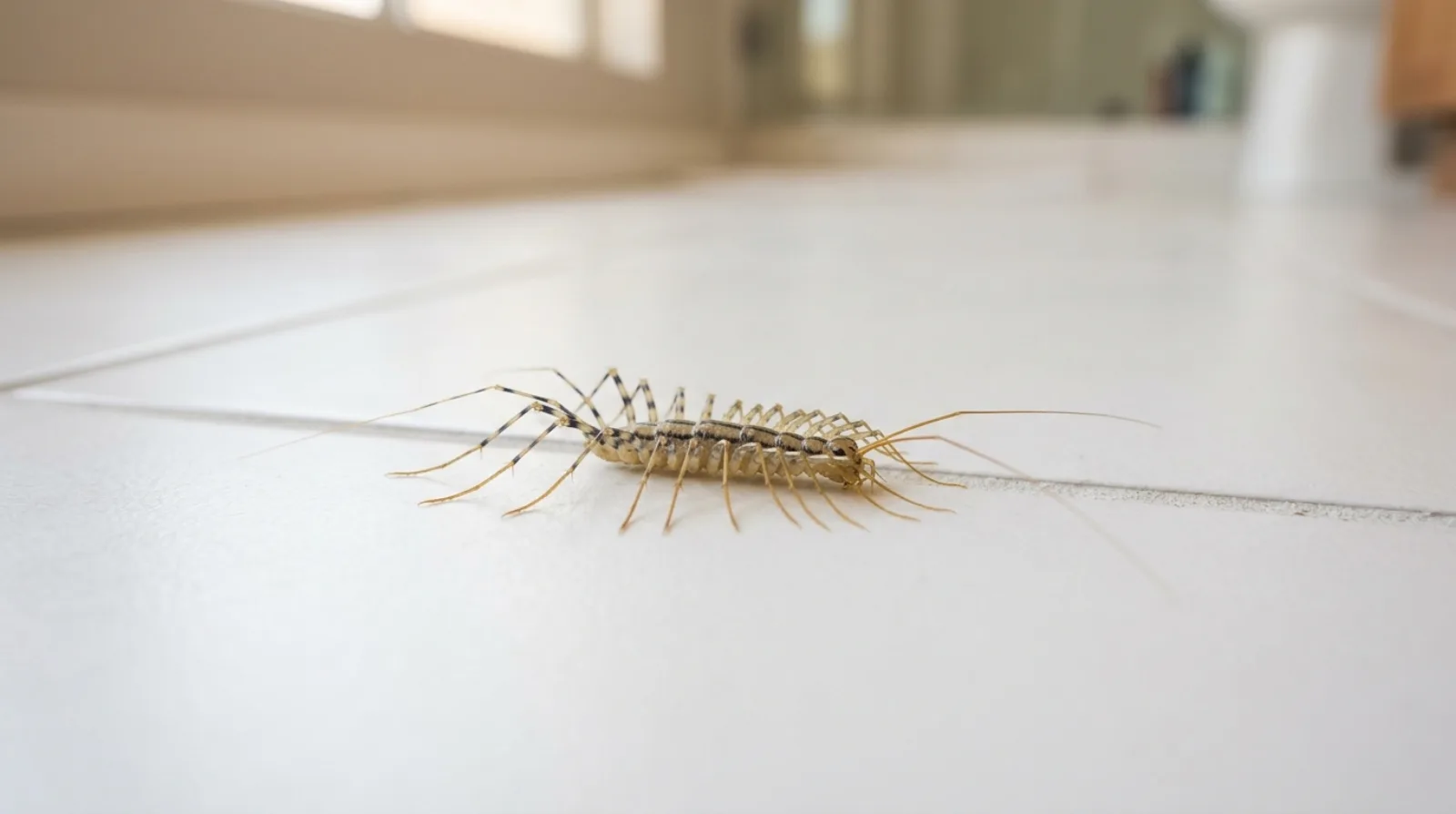
What house centipedes look like (and what they’re not)
UC IPM describes centipedes as elongated, flattened animals bearing one pair of legs per body segment, notes the actual number of legs in most species is closer to 30 than to 100, and says adult centipedes are usually brownish and more than 1 inch long. The house centipede, it adds, is a species that often invades buildings and has long legs that enable it to run rapidly. That speed is the reason one darting across a bathroom floor is so startling.
Two things it is not:
| What you’re looking at | How UC IPM separates it |
|---|---|
| Centipede | One pair of legs per body segment; never coils up when disturbed |
| Millipede | Two, more commonly, or four pairs of tiny legs per body segment; most curl up when prodded or at rest; adults range from 1/2 to 6 1/2 inches |
| Garden symphylan, sometimes called a garden centipede | Not a true centipede: white, less than 1/4 inch long, 12 pairs of legs as adults, lives in damp soil |
If the bug you’re finding is teardrop-shaped and shimmery, that’s a silverfish, not a centipede. See our guide on how to get rid of the silverfish, because silverfish are one of the household pests centipedes hunt.
Why house centipedes show up in San Diego homes
Two conditions do the work, and UC IPM names both.
Damp, dark places. UC IPM says centipedes are usually found in damp, dark places such as under stones, leaf mulch, or logs, and that indoors they may occur in damp areas of basements, closets, or bathrooms. That’s why the bathroom, the laundry, the under-sink cabinet, and the crawlspace are the rooms to check, and why an unnoticed slow leak is worth finding before anything else.
Other insects. UC IPM says centipedes come out at night to search for insects to eat, and that house centipedes capture flies, cockroaches, and other small household pests. If centipedes are hunting inside your house, something is in there to hunt. The earwigs that collect under patio furniture or in damp mulch near the foundation are part of the same picture outdoors.
Ways in. Centipedes come in from outside, so the gaps are worth closing on their own merit. Plumbing penetrations, dryer vents, foundation gaps, and worn door sweeps are where to start.
Are house centipedes dangerous? Do they bite?
Be straight about this one, because the source is. UC IPM says that when provoked, some large centipedes can inflict a painful bite that may cause localized swelling, discoloration, and numbness. So don’t pick one up. Sweep it into a container or let it run, and keep children and pets from handling it.
UC IPM is also clear about what they do to the house: house centipedes are actually beneficial because they capture flies, cockroaches, and other small household pests, and they never damage plants or household items. No wood damage, no fabric damage. What they do is confirm that other pests are around.
How to get rid of house centipedes in San Diego
Start with what UC IPM actually recommends, and note what it recommends against.
Step 1: Dry out the damp spots. UC IPM says airing out damp places may help, and that if there is excessive moisture in sub-floor crawl spaces or basements, take measures to dry out these areas. Find the slow leak under the sink or at the water heater before you buy anything.
Step 2: Take away the food. UC IPM says reductions in the number of household centipedes occur when their food source, other household pests, is reduced. If silverfish or cockroaches are the population underneath this, that’s the problem worth solving. A general pest control referral gets a licensed company looking at the underlying pest rather than at the centipedes.
Step 3: Seal the openings. This is ordinary exclusion work and most of it is cheap. Door sweeps, caulk around plumbing penetrations, dryer vent seals, crawlspace screens.
Step 4: Clear the harborage outside. UC IPM says outdoor centipede control is aided by removing debris, and for the same damp conditions it advises removing rotting wood and decaying grass and leaves from around the house’s foundation. Firewood and leaf litter against the wall hold moisture and shelter the insects centipedes are hunting.
Step 5: Know when spraying isn’t the answer. UC IPM puts it bluntly: although some pesticides are labeled for controlling centipedes, the use of such products is rarely justified for centipede or millipede control. It also says centipedes seldom need to be controlled unless they become a nuisance in the home. If a proposal is built around spraying centipedes rather than finding the moisture and the prey, ask why.
Frequently asked questions
Are house centipedes a sign of an infestation?
They point at other insects. UC IPM says centipedes come out at night to search for insects to eat, that indoors they occur anywhere in the home where insects occur, and that house centipedes capture flies, cockroaches, and other small household pests. So the useful question isn’t how to kill centipedes, it’s what they’re finding to eat.
Why do I keep finding centipedes in my bathroom?
UC IPM names bathrooms directly: indoors, centipedes may occur in damp areas of basements, closets, or bathrooms, or anywhere in the home where insects occur. A bathroom is damp and it’s where other small insects gather, so it checks both boxes. Repeated sightings in one room is a reason to look for a leak in that room.
Do house centipedes go away on their own?
UC IPM ties their numbers to conditions rather than to time: reductions in the number of household centipedes occur when their food source, other household pests, is reduced, and airing out damp places may help. Change the dampness and the prey and the numbers change. Leave both in place and there’s no reason for them to.
Should I spray for centipedes?
UC IPM says although some pesticides are labeled for controlling centipedes, the use of such products is rarely justified for centipede or millipede control, and that centipedes seldom need to be controlled unless they become a nuisance in the home. Killing the ones you see does nothing about the dampness or the insects they came in for. If a company proposes a spray program aimed at centipedes, ask what it plans to do about those two things instead.
What should I ask a company before booking?
Ask what they’ll inspect for moisture and which pest they think the centipedes are hunting. Ask for the findings and the scope in writing. Ask which pests the visit covers and which it excludes. And verify the license: general household pest work in California is Branch 2, the practice relating to the control of household pests excluding fumigation with poisonous or lethal gases. Look the company up at pestboard.ca.gov; cancelled licenses don’t show in those results, so contact the Board directly if a record comes up empty.
When to call a pro
If you’re seeing centipedes regularly, there’s something underneath worth finding. We don’t inspect or treat anything. We match San Diego County homeowners with licensed local companies, from pest control in San Diego to East County and the South Bay, and the matched company inspects and quotes in writing before any treatment begins. Call (858) 400-6561 to get matched with a local pro.