
To get rid of clothes moths, pull every wool, hair, fur, and feather item out of the closet and check it for holes and silken webbing, then treat what’s infested. Purdue Extension says drycleaning, or washing and pressing the garments with a hot iron, will kill moth larvae and eggs. Vacuum the emptied closet, then store the cleaned items in a container tight enough to keep adult moths out. Skipping the items themselves and treating only the closet is the mistake, because the larva lives inside a silken case or web on the fabric it is eating.
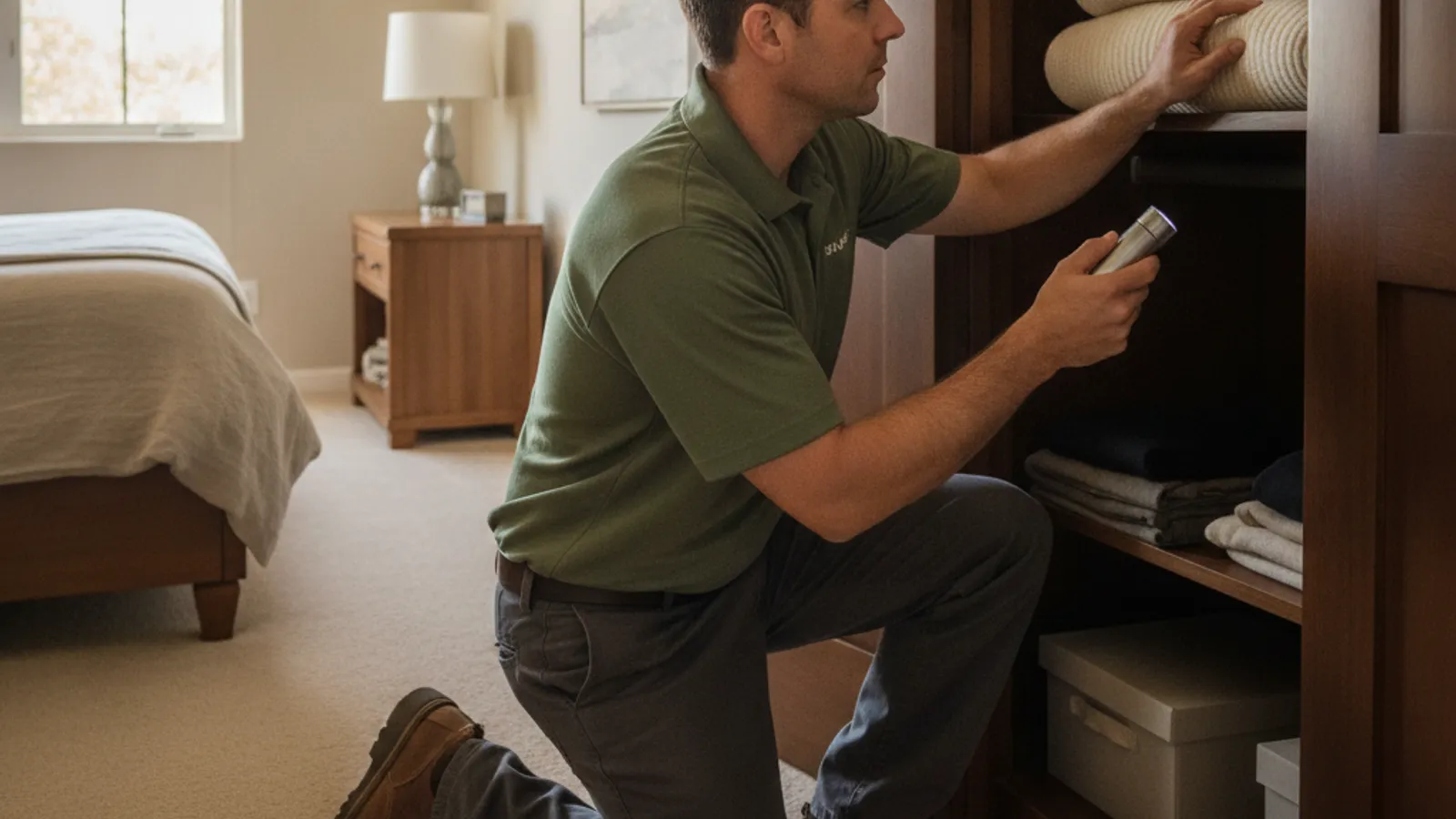
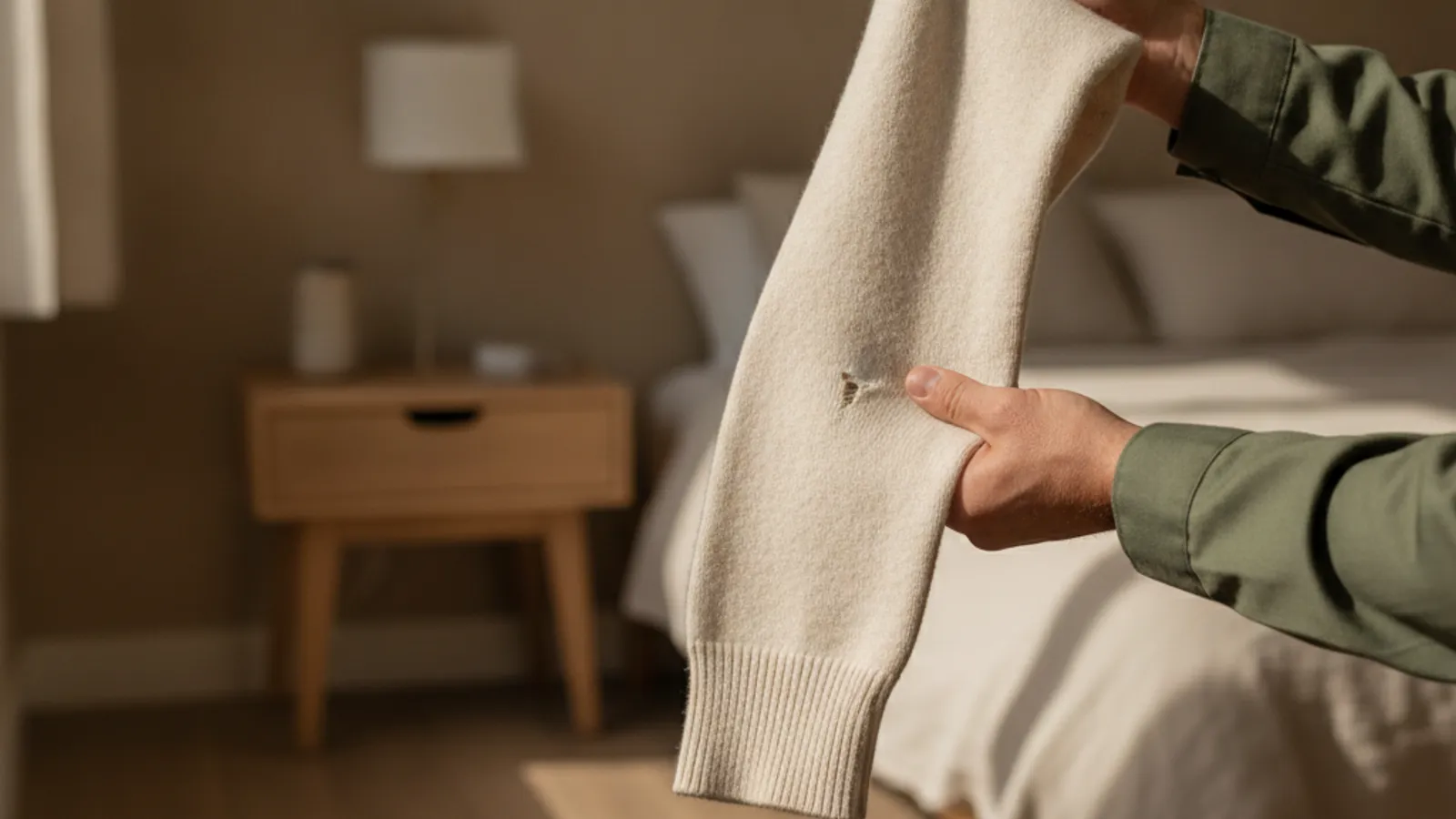
Clothes moths are one of the quietest pest problems a home can have. Nobody sees them circling the kitchen light. Instead, someone pulls a wool sweater out of storage and finds a hole they can’t explain. By the time the damage is visible, the feeding has already happened, which is why this guide starts with inspecting the fabric rather than with a spray can.
What are clothes moths?
Purdue Extension describes the clothes moth larva as a small white caterpillar that lives inside a silken case or web and feeds on wool, hair, fur and feathers. That list is the practical one for a homeowner: it tells you which items in the closet are worth pulling out and inspecting first.
The adult is not what damages the garment. Purdue describes the adult as a tiny, buff-colored “miller” that avoids light, and says adults do not feed, but their presence does indicate a moth infestation. So a moth fluttering out of a dark closet is a signal to go looking, not the thing to chase.
Where to look first
Purdue Extension lists the likely spots to look for infestations around the home: boxes of old clothing, furs, feather pillows, piano felts, old over-stuffed furniture, carpets, and even lint that collects along baseboards or in corners. Work that list before you buy anything.
The tell is silk. Purdue’s description of the larva is a small white caterpillar living inside a silken case or web on the material it is feeding on, so webbing on or in the fabric is the sign that points at moths rather than at something else. Purdue also warns never to store soiled garments, since perspiration and food stains favor moth development.
Clothes moths or carpet beetles: which pest do you actually have?
These two get confused constantly because they damage the same closets and the same wool. UC IPM and Purdue Extension both give you a way to tell them apart without a microscope.
| What to check | Clothes moths | Carpet beetles |
|---|---|---|
| Webbing on the item | Larva lives inside a silken case or web (Purdue) | Larvae do not make webs as clothes moths do (UC IPM) |
| What the larva looks like | A small white caterpillar (Purdue) | A fuzzy, slow-moving, light brown or blackish worm about 1/4-inch long (Purdue) |
| What it leaves behind | Silk case or webbing on the fabric | Shed skins and fecal pellets about the size of a grain of salt (UC IPM) |
| Pattern of damage | Scattered holes (UC IPM) | More likely to damage a large area on one portion of a garment or carpet (UC IPM) |
| Where the adult turns up | Avoids light (Purdue) | Adults seek pollen and nectar, fly in from flowers, and are typically seen near windows (UC IPM) |
UC IPM puts the damage test plainly: it’s not always possible to tell from damage whether clothes moths or carpet beetles caused it, but in general carpet beetles are more likely to damage a large area on one portion of a garment or carpet while moth damage more often appears as scattered holes. If you’re finding a bristly larva and no webbing, read our guide on getting rid of carpet beetles in San Diego instead. Silverfish get mixed in with both; our silverfish guide covers that one separately.
What makes a closet worth checking
The difference between the two pests shows up in how they arrive. UC IPM says carpet beetles frequently fly into homes from flowers in the landscape and are also brought inside accidentally on items such as cut flowers, and that the adults are attracted to sunlight and turn up on sills, drapes, and window panes. Purdue’s clothes moth adult does the opposite: it avoids light.
For clothes moths the practical question is which items sit undisturbed. Purdue’s own trigger for mothproofing is not a season on the calendar but a condition: do it as a precautionary measure when any of those items are going into winter or long-term storage, or when the items will not be routinely cleaned. A San Diego closet full of wool that never gets a hard seasonal rotation fits that description, which is a good reason to open the storage bins even in a year when nothing looks wrong.
How do you get rid of clothes moths, step by step?
Work through these in order. Treating the closet without treating the infested items leaves the larvae feeding inside the fabric.
| Step | What to do | Source for it |
|---|---|---|
| 1. Empty the closet | Remove all garments, brush them beneath the folds, and hang them outdoors in the sun for several hours | Purdue Extension, moth-proofing closets |
| 2. Work Purdue’s list | Check boxes of old clothing, furs, feather pillows, piano felts, old over-stuffed furniture, carpets, and lint along baseboards or in corners | Purdue Extension |
| 3. Kill what’s on the items | Drycleaning, or washing and pressing the garments with a hot iron, will kill moth larvae and eggs | Purdue Extension |
| 4. Cold or heat as an alternative | Heat the object in an oven for at least 30 minutes at 120°F or higher, or seal it in a plastic bag and freeze it for 2 weeks at temperatures below 18°F, after checking whether heat or cold will damage it | UC IPM, stored-item methods for fabric pests |
| 5. Clean the empty space | Vacuum the closet clean while it’s empty | Purdue Extension |
| 6. Store so moths can’t get in | Almost any box or bag works as a storage container if it is tight enough, or taped, to keep out adult moths, and only after the items are cleaned | Purdue Extension |
Will a cedar chest fix it?
A cedar chest is a storage container, and the extension guidance treats storage as the step that comes after the items are already clean, never as the treatment. Purdue’s sequence is explicit: before storing clothing or blankets, first rid them of any insects by dry-cleaning, washing, or brushing and sunning, and only then place them in the container. Purdue’s own closet recommendation is a tight-fitting door plus a labelled mothball product used strictly per its label directions, not a scent alone. If a cedar chest is what you own, clean the garments first and make sure the chest closes tightly enough to keep adult moths out.
When to call a professional in San Diego
Purdue Extension’s own advice is worth quoting: since satisfactory prevention and control require a good understanding of these pests and how to properly use insecticides, most homeowners would be best advised to contact a professional. UC IPM adds that certain resin-strip products used to treat infested objects in airtight containers are label-restricted to licensed pest management professionals only.
Fabric pests are household pests, which in California is Branch 2 work: the practice relating to the control of household pests excluding fumigation with poisonous or lethal gases. We don’t inspect, treat, or apply anything. We match San Diego County homeowners with licensed local companies who cover San Diego and the rest of the county, and that company inspects and quotes in writing before treatment begins. Clothes moths fall under our general pest control referral service; our pest control cost guide covers how visit pricing is usually structured.
Frequently asked questions
Do the adult moths eat my clothes?
No. Purdue Extension says adults do not feed, but their presence does indicate a moth infestation. The damage comes from the larva, which Purdue describes as a small white caterpillar living inside a silken case or web and feeding on wool, hair, fur and feathers.
What attracts clothes moths to a closet?
Wool, hair, fur and feathers are what the larva feeds on, per Purdue Extension. Purdue also says never to store soiled garments, since perspiration and food stains favor moth development. That’s the one habit worth changing first.
How can you tell clothes moth damage from carpet beetle damage?
Look for webbing. UC IPM notes that carpet beetle larvae do not make webs as clothes moths do, and that carpet beetles are more likely to damage a large area on one portion of a garment or carpet while moth damage more often appears as scattered holes. UC IPM is also honest that it’s not always possible to tell from the damage alone.
Can freezing kill them?
Freezing is one of the alternative methods UC IPM lists for controlling fabric pests in stored items: enclose the object in a plastic bag and place it in a freezer for 2 weeks at temperatures below 18°F. The heat version is at least 30 minutes in an oven at 120°F or higher. UC IPM says to consider first whether cold or heat will damage the object.
Will mothballs or a cedar chest solve it?
Purdue’s guidance is a tight-fitting closet door plus PDB or naphthalene balls, crystals or flakes in an open container on the top shelf, used exactly per the label’s directions for the closet’s cubic footage. That’s a storage protection for already-cleaned items, not a way to clear an infestation out of a garment. Read and follow the product label.
When should I call a pest control company?
Purdue Extension’s own answer: since satisfactory prevention and control require a good understanding of these pests and how to properly use insecticides, most homeowners would be best advised to contact a professional. Ask the company what it inspects, what it will treat, and to put the scope in writing.
If clothes moths keep coming back no matter how much you vacuum and launder, call (858) 400-6561 and we’ll match you with a licensed local company that inspects first and quotes in writing.