
To get rid of carpet beetles in San Diego, find and remove the wool, fur, feathers, silk, or lint the larvae are feeding on, deep-vacuum closet edges, rug borders, and vents, then launder, freeze, or dry-clean the infested items. Adult beetles can fly in from flowers. Eggs get laid on the fiber. Spraying a residual or dusting diatomaceous earth is not the first step, and this page doesn’t prescribe either one.
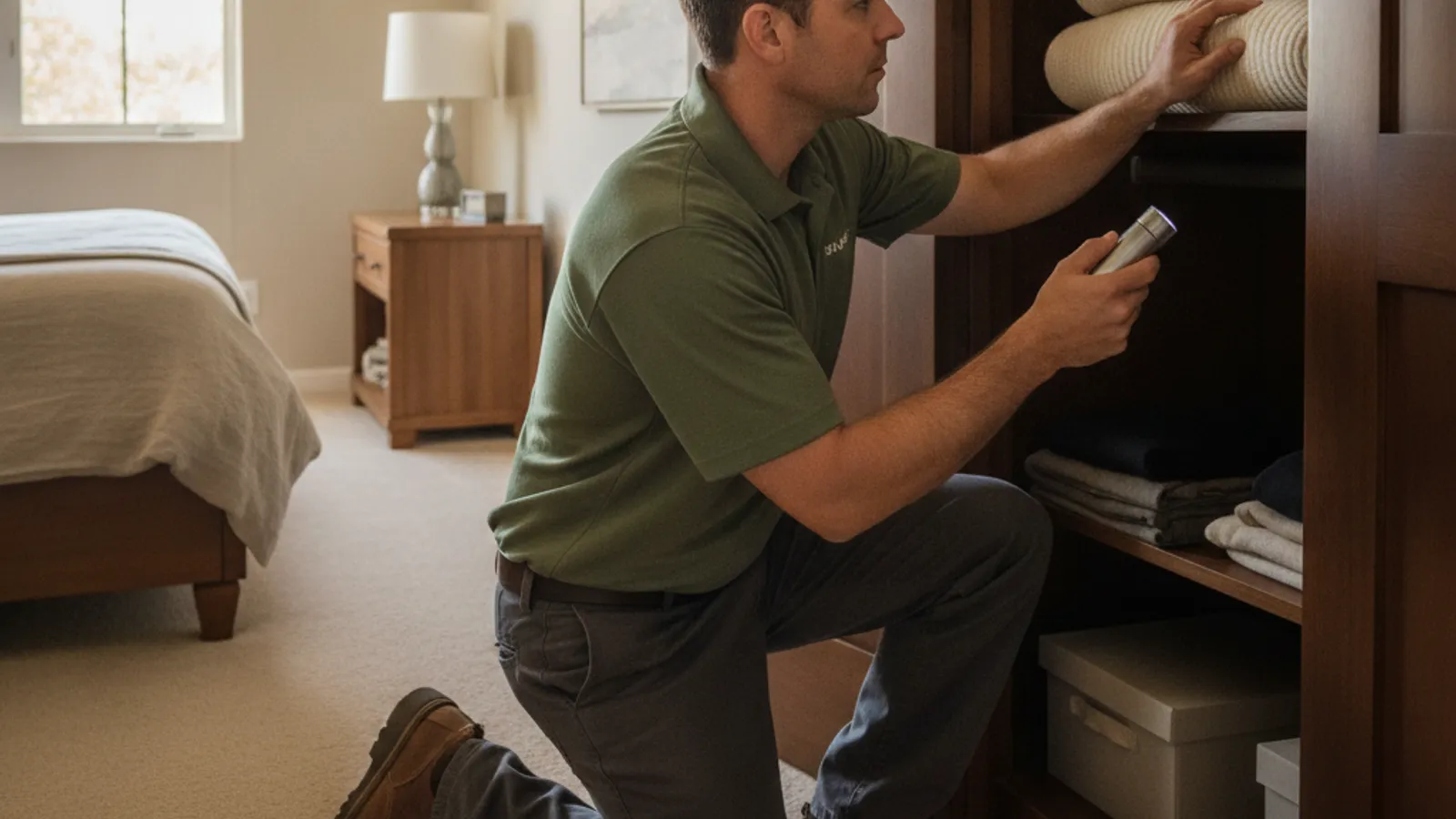
Carpet beetles are easy to mix up with bed bugs. San Diego’s mild winters mean wool rugs and wool clothing stay in closets year-round, which is larval food. If you started this search because of “bites” with no bug on the mattress, read the comparison table before you buy a bed-bug kit.
What are carpet beetles?
Carpet beetles are dermestid beetles. Larvae feed on animal products: wool, leather, silk, fur, feathers, pet hair, and lint that holds those fibers. UC IPM lists three common California species: the varied carpet beetle (Anthrenus verbasci), the furniture carpet beetle (Anthrenus flavipes), and the black carpet beetle. Adults are interested in nectar and pollen. The larvae do the damage.
What do carpet beetles look like?
UC IPM: adults are small, about 1/8 to 1/10 inch long, round, with short antennae. Color runs from black to a mix of white, brown, and yellow. Varied carpet beetles are about 1/10 inch, black with an irregular pattern of white, brown, and dark yellow scales. Black carpet beetle adults are 1/8 to 3/16 inch, shiny black to dark brown. Full-sized black carpet beetle larvae can reach 5/16 inch. Varied carpet beetle larvae are slightly longer than the adults, hairy, striped, and broader at the rear. Shed skins and salt-grain fecal pellets mark feeding sites. Adults often show up near windows in spring or early summer.
Carpet beetles vs bed bugs: how to tell them apart
Carpet beetles don’t bite or feed on blood. Bed bugs are flattened, oval, rusty red, and feed on blood at night. UC IPM describes carpet beetle larvae as hairy and notes bristly-looking cast skins after they molt. Those skins help tell them from clothes moths. They are not a bed-bug bite line. If you’re still unsure, see what bed bugs actually look like.
| Trait | Carpet beetle | Bed bug |
|---|---|---|
| Shape | Round to oval, humped back | Flattened, oval |
| Color | Mottled white/brown/yellow (varied) or shiny black (black carpet beetle) | Rusty red, darker after feeding |
| Size | UC: about 1/10 to 3/16 inch as adults, depending on species | UC: about 1/5 inch as adults |
| Feeds on | Wool, fur, feathers, lint, pet hair | Human and animal blood only |
| Bites people | No | Yes, night feeding |
| Found near | Closets, rugs, vents, stored fabric | Mattress seams, bed frame, headboard |
| Active time | Adults often at windows in daylight | Night, while you sleep |
If what you’re finding is flat, reddish, and clustered near the bed with overnight bites, that’s a bed bug path: bed bug treatment and the cost guide.
How to get rid of carpet beetles in San Diego, step by step
Work in this order. Treating without removing the food source is how larvae return.
| Step | What to do | Why |
|---|---|---|
| 1. Find the source | Inspect wool rugs, closets, vents, pet bedding, and stored clothing for larvae or shed skins | Eggs are laid on the fiber |
| 2. Deep-vacuum | Vacuum rug edges, baseboards, closet floors, and vents, then discard the bag | UC IPM: vacuuming removes eggs, larvae, and adults |
| 3. Launder, freeze, or dry-clean | Wash what can take heat, or dry-clean wool that can’t | Heat and dry cleaning kill larvae in fabric |
| 4. Store clean items sealed | Airtight containers after the item is pest-free | Stops re-infestation from a window adult |
| 5. Monitor | Recheck closets and rug edges, especially in spring | Adults fly in from landscape flowers |
This page doesn’t tell you to put residual insecticide or diatomaceous earth on baseboards. If a licensed company proposes a labeled product after the fiber is gone, that’s their scope, not a blog protocol. There’s no sourced two-to-three-week clearance clock.
Where do carpet beetles come from?
UC IPM: adults fly in from flowers. Females also use outdoor spider webs, bee or wasp nests, and bird nests. Indoors they lay eggs on wool, skins, feathers, and similar goods. A few adults at a window aren’t an infestation. Management starts when larvae are developing in fabric.
Are carpet beetles a sign of a dirty house?
Not by themselves. Wool, down, and pet hair exist in clean homes. Undisturbed rug corners and stored clothing are enough. Lint in vents supports more larvae, so vacuuming helps. Finding them doesn’t mean the house is filthy.
When to call a professional in San Diego
Vacuuming and laundering clear many small finds. A licensed look is more useful when larvae span several rooms, reach padding you can’t wash, or keep returning after the obvious fiber is gone. Pest Pros San Diego matches you with licensed companies that cover the city of San Diego. We don’t inspect closets ourselves. If the issue is broader household pests, see general pest control. Closet damage can also be clothes moths; see getting rid of silverfish only if the insect actually matches silverfish, or the clothes-moth guide if the holes look moth-like.
Frequently asked questions
Do carpet beetles bite?
No. They don’t feed on blood. Bite lines near the bed point to bed bugs instead.
Where do carpet beetles come from?
Adults fly in from flowers, or from outdoor nests and webs. Larvae stay with the fiber indoors.
Are carpet beetles a sign of a dirty house?
No. They need natural fiber they can reach undisturbed.
How long does it take to get rid of carpet beetles?
There’s no sourced two-to-three-week clearance. Varied carpet beetle larvae can live many months (UC IPM: 220 to 630 days). Removing the food and the insects you can vacuum is the work. Hidden padding can take longer.
What kills carpet beetle larvae?
Hot washing, a hot dryer, or dry cleaning on items that can take it. Vacuuming removes them from cracks. Don’t treat diatomaceous earth or a residual spray as the plan on this page.
Do I need a professional for carpet beetles in San Diego?
Not always. One closet or rug corner is often a cleaning job. Call when it spans rooms, hits wall-to-wall padding, or returns after cleaning.
If vacuuming and laundering aren’t keeping up, call (858) 400-6561 to get matched with a licensed local pro.