
San Diego County does not publish a homeowner calendar that says you must book a termite inspection every twelve months. Timing usually follows new evidence, a change to the house or yard, or a lender asking for a Wood Destroying Organisms report. A licensed Branch 3 company then documents what is visible and accessible, not a promise that the whole structure is clear.
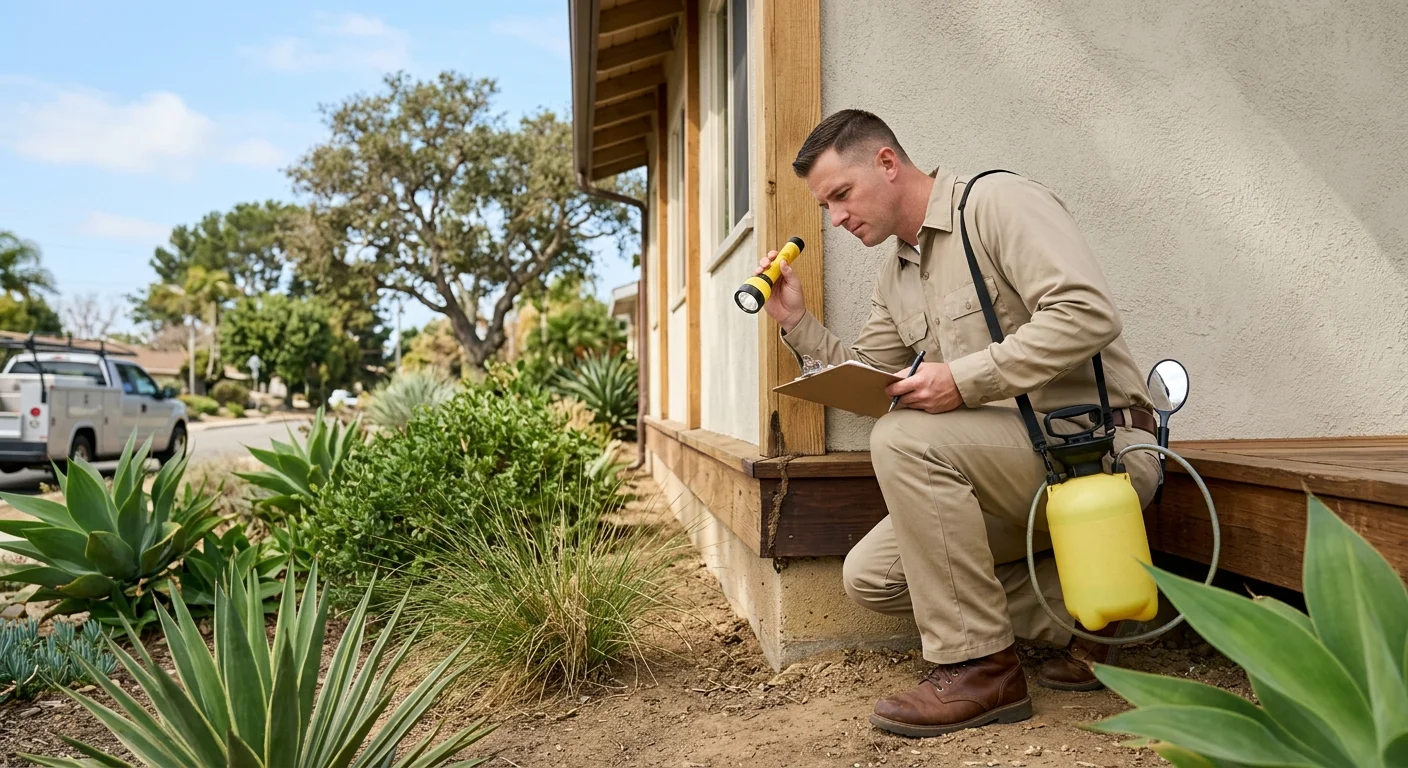
What a licensed termite inspection can document
A termite inspection in this county is a written look at wood-destroying pests in areas the inspector can actually reach. California Structural Pest Control Board Branch 3 companies issue that report. The form is the Wood Destroying Pests and Organisms Inspection Report, often called a WDO.
The report states whether there is evidence of wood-destroying pests or organisms in visible and accessible areas. It also lists recommendations for correcting infestations the inspector found. It does not cover sealed wall cavities, finished rooms the company cannot open, or soil under a slab nobody can see. Hidden framing stays hidden until someone opens it.
Western drywood termites (Incisitermes minor) are California’s second most important termite pest, per UC IPM. They are common along the Pacific coast and into Southern California deserts. Inspectors look for kickout holes less than 2mm across. They also look for fecal pellets with six hexagonal sides. Those pellets are diagnostic for drywood termites. Colonies typically contain fewer than 1,000 individuals. Flying adults show in summer and fall during the day.
Subterranean termites in the genus Reticulitermes occur in nearly all regions of the state, from coastal dunes to mountain elevations. They nest in soil, sometimes many feet down. They need soil moisture. They build shelter tubes between soil and wood. They do not leave those hexagonal pellets. UC IPM describes colonies with hundreds of thousands of foragers. They can forage year-round in California. Activity is usually lowest from November to February and highest in summer.
That split shows up on real lots. A 1920s bungalow in North Park or Mission Hills often has a crawl space, old plumbing penetrations, and original framing a Branch 3 inspector can probe. A slab ranch in Chula Vista or Mira Mesa hides more of the mudsill. The inspector still works the garage, door frames, fence returns, and any wood that touches soil. Encinitas and Pacific Beach pick up marine moisture on fascia and attic wood. El Cajon and Lakeside add watering against the foundation and hotter soil. Coastal north county and East County are not the same house. The report should read like the house that was walked.
Formosan termites (Coptotermes formosanus) are currently restricted to a small area near San Diego. Do not treat that as a countywide infestation. Ask the inspector which species the evidence supports.
Ask for the written findings, not a hallway summary. Photos help. Termite treatment is a later decision by the licensed company. The inspection itself does not treat anything.
Which visible changes justify another inspection
A round-number anniversary is a reminder, not a legal trigger. New evidence is a trigger. So is work that opens wood or keeps it wet.
Watch for the signs of termites that UC IPM treats as diagnostic or strongly suggestive. Hexagonal pellets under a windowsill, in an attic, or along fascia. Kickout holes smaller than 2mm. Shelter tubes on a foundation, chimney, or stem wall. Daytime swarmers in summer or fall, especially drywood. Shed wings on a sill after a flight. Soft or hollow wood at a door frame. None of those prove the whole house is infested. All of them justify a licensed look instead of waiting for next January.
Property work counts too. A new deck, patio cover, or room addition introduces untreated wood and new soil contact. Raised planters against stucco in Vista or San Marcos keep moisture on the stem wall. Yard watering that soaks a mudsill in Escondido or Alpine is a subterranean invitation. Firewood stacked against a garage in Ramona, or a wood fence tied into the house in La Mesa, is a bridge. After a leak, a slab leak, or a wet crawl space, moisture is the condition subterranean termites need. Book the inspection around the change, not around the calendar.
Season still matters, without turning into a fake best month to treat. UC IPM says subterranean foraging continues year-round here, with the lowest intensity from November through February and the highest in summer. Drywood swarmers are a summer and fall daytime event. If you see a swarm in July in Ocean Beach, or a tube after a hot inland week in August, do not park that on a we-inspect-in-January list. Treatment timing belongs to the licensed company after it identifies species and extent. UC IPM does not recommend do-it-yourself drywood treatments. For subterranean termites, it states that all effective products are for professional use only.
An extra inspection is also reasonable after a major remodel, or when a neighbor’s tent goes up on your block. The tent next door is not proof you have termites. It is a reason to ask a Branch 3 company to look at your accessible wood while the question is in front of you.
How maintenance checks differ from sale reports
People searching for an annual termite inspection San Diego often want a yearly maintenance habit. That can be a sound personal rule. It is not a statute we could confirm for an occupied house. California does not, in the sources on file, order every homeowner to inspect on a twelve-month clock. Many people still book once a year because drywood and subterranean termites stay active in this climate, and because last year’s report only covered what was visible then.
A sale is a different paper trail. Most lending institutions require a Wood Destroying Pests and Organisms Inspection Report before they finance a home loan in California. That is a lender practice. It is not a promise that every deal uses the same form, the same company, or the same clearance. Do not assume every buyer, cash sale, or refinance will demand one. Ask the escrow officer what the loan file actually needs. Our explainer on a termite inspection before a San Diego home sale walks through that moment. For what the document itself contains, see what a WDO report is.
Only a properly registered Branch 3 company may issue that report. California Business and Professions Code 8516 governs inspection and report scope, including a second-opinion notice. Civil Code 1099 ties report delivery to contract and financing conditions. Reports cover visible and accessible areas. They are valid for a limited time, and that window is set by the lender. No statutory number of days is on file here, so do not treat a 90-day rumor as law.
You can search Structural Pest Control Board records for a California address to see if a WDO inspection was completed in the last two years, through the Board’s WDO system search. A public hit means a report was filed. It does not mean the house is clear today.
A maintenance check can be the same walk and the same form. The difference is who asked for it and who will rely on it. A seller’s report is written for a transaction. Your own yearly visit is written for you. If you are buying, get your own Branch 3 report rather than borrowing someone else’s comfort. If findings later call for work, the matched company still quotes treatment in writing. Fumigation, if recommended, is Branch 1 work only. That is a different license than the inspection.
What to ask before booking an inspection
Confirm the company is a registered Branch 3 firm before anyone walks the house. The California Structural Pest Control Board explains how licensing works. Public lookup runs through the Department of Consumer Affairs search. Check the business name and status. Pest Pros San Diego matches you with licensed, insured local companies. We do not hold an SPCB license, and we do not inspect.
Ask whether you will receive a WDO report or only a conversation. Ask which areas they can reach: attic, crawl, garage, exterior, fence attachments. Ask how they will describe inaccessible areas. Ask whether findings will name drywood, subterranean, or both, because the treatment path changes with the species.
Ask for a written inspection quote. If treatment is later recommended, ask for a separate written treatment quote. Fixr puts a one-time termite inspection at $150 to $350 as of 2026. That is a national cost-guide range, not a San Diego survey, and not a California average we could confirm. This brand has no price list. The company you’re matched with inspects first and quotes in writing before any treatment begins.
Ask what happens if they recommend fumigation. Only Branch 1 licensees may fumigate. Occupants follow that licensee’s written checklist. Re-entry is not a homeowner guess. The California Department of Pesticide Regulation clearance standard is 1 ppm sulfuryl fluoride or less, posted by the fumigator after aeration.
Ask about a second opinion if the first report will drive a sale or a large repair. You are not stuck with one company’s reading of accessible wood.
A yearly visit earns its keep when you want a dated written record and this climate does not shut termites down in winter. It is not a legal annual requirement we could confirm. If you only inspect when you sell, you may be looking at years of feeding in a North Park crawl or along an El Cajon slab edge. If you inspect on a rigid January date and ignore pellets in September, the calendar did not help. A termite inspection in San Diego is timed to evidence, to property changes, and to paperwork a lender actually requested.
When to call us
Call when you have new pellets, tubes, or swarmers, when a lender asks for a WDO, or when you want a licensed Branch 3 company to document accessible wood. We match homeowners and businesses with licensed, insured local pest pros. Call us at (858) 400-6561 and we’ll match you with a licensed local pro.