
The western drywood termite is common along California’s Pacific coast, and Del Mar homes sit right in that band. Swarmers fly in summer and fall and infest exposed dry lumber. Protecting a Del Mar home starts with knowing the local risk and picking the right treatment.
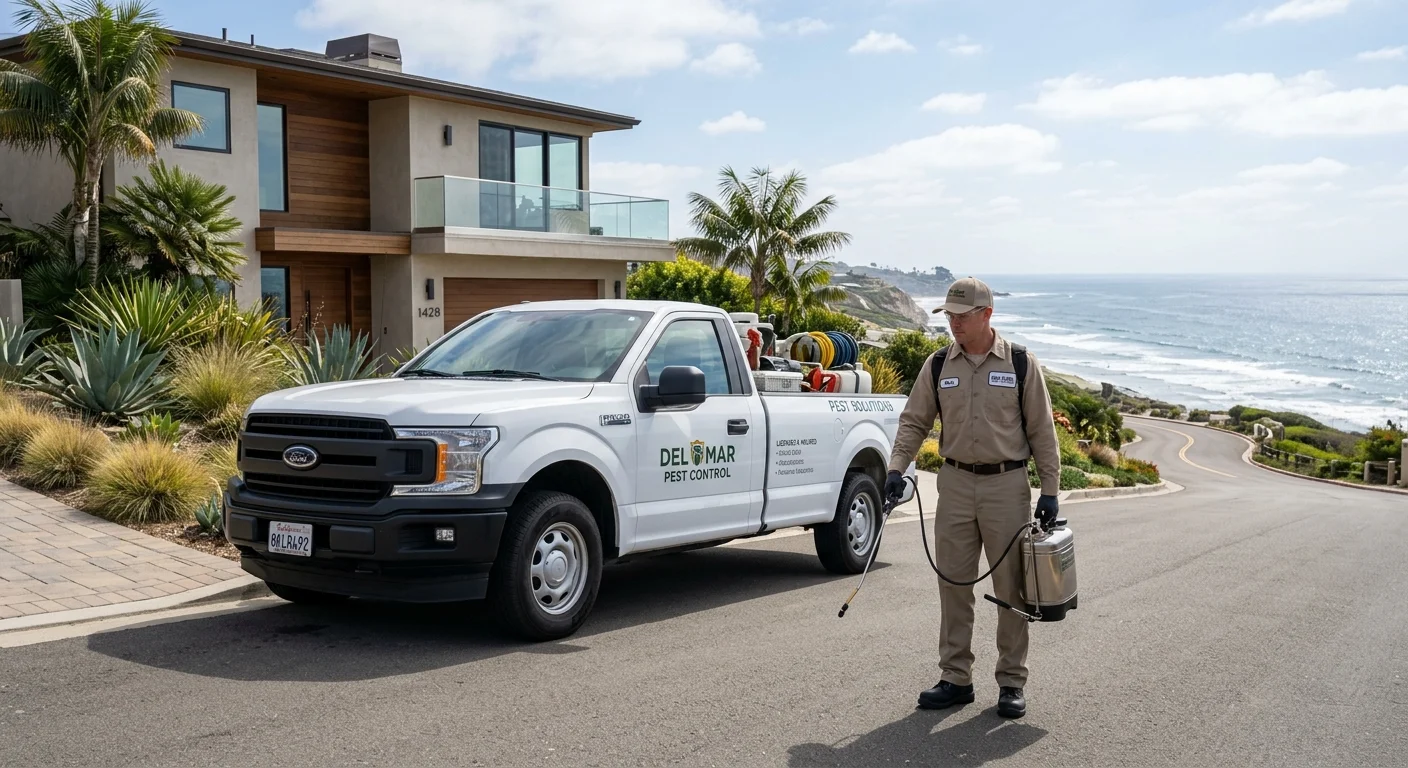
How Del Mar’s coastal climate increases termite pressure
Coastal Del Mar has real drywood termite pressure, but not for the reason people usually assume. Damp wood attracts dampwood termites, not drywood ones. UC IPM is direct about this: drywood termites infest dry, sound wood, they nest above ground, and their nests do not connect to the soil. What they need is access, not moisture. The western drywood termite is a native insect commonly found along the Pacific coastal region of California, and winged reproductives, called swarmers, fly during daytime hours in summer and fall to infest additional nearby wood. On a Del Mar property that means exposed eaves, fascia, trim, beams, decking and any other accessible dry structural lumber. Once in, they live entirely within the wood they infest, often in attics, eaves, and wall voids, which makes early detection a challenge.
Because they need no soil contact and no water source from the ground, a dry, well-drained lot is no protection at all. Furthermore, older Del Mar homes, often built with exposed wood beams or intricate timber work, can be particularly vulnerable. These properties often feature hidden spaces that allow infestations to go unnoticed for years, leading to significant structural damage before any signs become visible. Regular, thorough termite inspection becomes not just a recommendation, but a critical safeguard for your property’s value and integrity. Understanding these local pressures helps inform the most effective strategies for long-term termite control in Del Mar.
Choosing between fumigation and local treatment for your home
Deciding on the best termite treatment for your Del Mar home involves weighing several factors, especially when considering the value of your property and the need for discretion. There are two primary approaches: fumigation and localized spot treatments. Each has distinct advantages and disadvantages.
Fumigation, also known as tenting, is the whole-structure option. The building is sealed and a gas is introduced that penetrates the wood throughout. UC IPM says sulfuryl fluoride treats all infestations simultaneously and has high levels of efficacy if correctly applied, and that its advantage over localized treatment is that it should eliminate infestations hidden from view. It also warns that a monitored fumigation, with gas monitoring lines installed inside the structure, has the highest rate of treatment success, while a nonmonitored one may not reach a high enough concentration and failures may occur. Ask any quote whether the job is monitored. The downsides, in UC IPM’s own list: occupants, pets and plants must vacate for several days while the structure is fumigated and then aerated, and roofs could be damaged as a result of having tarpaulins dragged across them.
Localized spot treatments are less intrusive. UC IPM describes insecticidal liquids, dusts, or foams injected directly into drywood termite galleries, and lists heat and termite electrocution devices among the non-fumigant options. Spot work suits smaller, contained infestations. The trade-off is reach: if the infestation runs further than the inspection found, localized treatment may not clear it, which is the exact gap whole-structure work closes. A licensed inspector decides which applies through a termite inspection before recommending a termite treatment plan.
How to prepare your property for a termite treatment service
Preparing your Del Mar property for a termite treatment depends heavily on the chosen method. The preparation checklist is what protects your home and belongings during the work, and skipped steps can compromise the treatment. Your pest control company will provide a detailed checklist, but here’s a general overview.
If fumigation is necessary, the preparation is more extensive, and the fumigant manufacturer’s California planning guide sets out what it involves. Remove or double-bag unsealed food and medicines, using the special Nylofume bags available from your pest management professional. Move indoor and outdoor potted plants away from your home, and prune any plants or trees touching or encroaching the outside of the house. Evacuate all people, pets and plants from the structure. Extinguish all pilot lights, and turn off electrical heating elements such as those in heaters, computers, pianos, organs and pet habitats. Open operable internal doors, cabinets, drawers, closets and appliances so the gas can circulate. In California the gas utility handles the shut-off and the restoration appointment. Follow the company’s own written checklist item by item, because a missed item can delay the job.
For localized treatments, the preparation is much simpler. Typically you’ll need to clear access to the specific areas being treated: moving furniture away from walls, clearing cabinets, or opening up an attic or crawl space. Remove items in the treatment zone you don’t want exposed. Ask the licensed company that’s doing the work for its own written instructions, including how long to keep children and pets away from the treated area, since that depends on the product label it applies.
What to look for in a termite company serving the 92014
Choosing the right termite company for your Del Mar property is a critical decision, and it starts with credentials rather than impressions. California requires termite work to be done by a registered structural pest control company, and Business and Professions Code 8516 bars any company from issuing a statement about the presence or absence of wood destroying pests until a licensed Branch 3 field representative or operator employed by that registered company has made the inspection. Check the company’s license, branch and current status with the California Structural Pest Control Board at pestboard.ca.gov, and confirm the name on the record matches the name on your proposal.
Beyond licensing, ask for references and read reviews. Ask how the company manages the work on an occupied property, what the termite inspection covers, and which termite treatment method the report calls for and why. Get the scope, the timeline and the price in writing before anything starts. Ask what any warranty or guarantee actually covers, how long it runs, and whether a callback is included or billed: Business and Professions Code 8516 requires the report and any contract to state specifically when a guarantee is made, its specific terms, and the period of time for which it stays in effect, so there is no reason to accept a verbal version.
Frequently asked questions
Why is termite risk higher in Del Mar?
Older coastal housing stock gives drywood termites what they actually want, which is dry, sound, accessible wood: original framing, exposed eaves, fascia and trim. UC IPM reports the western drywood termite is commonly found along the Pacific coastal region, and that its nests stay above ground with no connection to the soil, so a well-drained property is no protection.
How often should a Del Mar home be inspected?
UC IPM’s guidance is a professional inspection every 3 to 5 years, which it says helps detect infestations before they become damaging. If you already hold an inspection report, that report sets your own recheck. Anything sooner is driven by what you see rather than by the calendar: swarmers indoors, fresh pellet piles, or shelter tubes on the foundation mean call now.
Does treatment always mean tenting the house?
No. Tenting is for activity spread through the structure. Contained drywood infestations can often be handled with localised injection or heat, quoted separately. The inspection report decides which applies.
How do I check that a pest control company is licensed in California?
Look the company up with the California Structural Pest Control Board at pestboard.ca.gov before signing anything. The record shows license status and the branch held: Branch 1 is the control of household and wood-destroying pests by fumigation with poisonous or lethal gases, Branch 2 is household pests excluding that fumigation, and Branch 3 is wood-destroying pests and organisms by insecticide or structural repairs and corrections, also excluding fumigation. Termite work sits in Branch 3, or Branch 1 when the proposal is a whole-structure fumigation. The name on the record should match the name on your proposal.
When to call us
Discovering termites in your Del Mar home can be alarming, but acting quickly can prevent extensive damage. UC IPM notes that while a homeowner may first spot drywood termites when they swarm or when fecal pellets appear, inspecting and determining the extent of an infestation requires experience and is best done by a professional. A licensed inspector identifies the species, works out how far the accessible evidence extends, and recommends what to do about it. We don’t perform inspections or treatments ourselves.
Call us at (858) 400-6561 to get matched with a licensed local pro.