
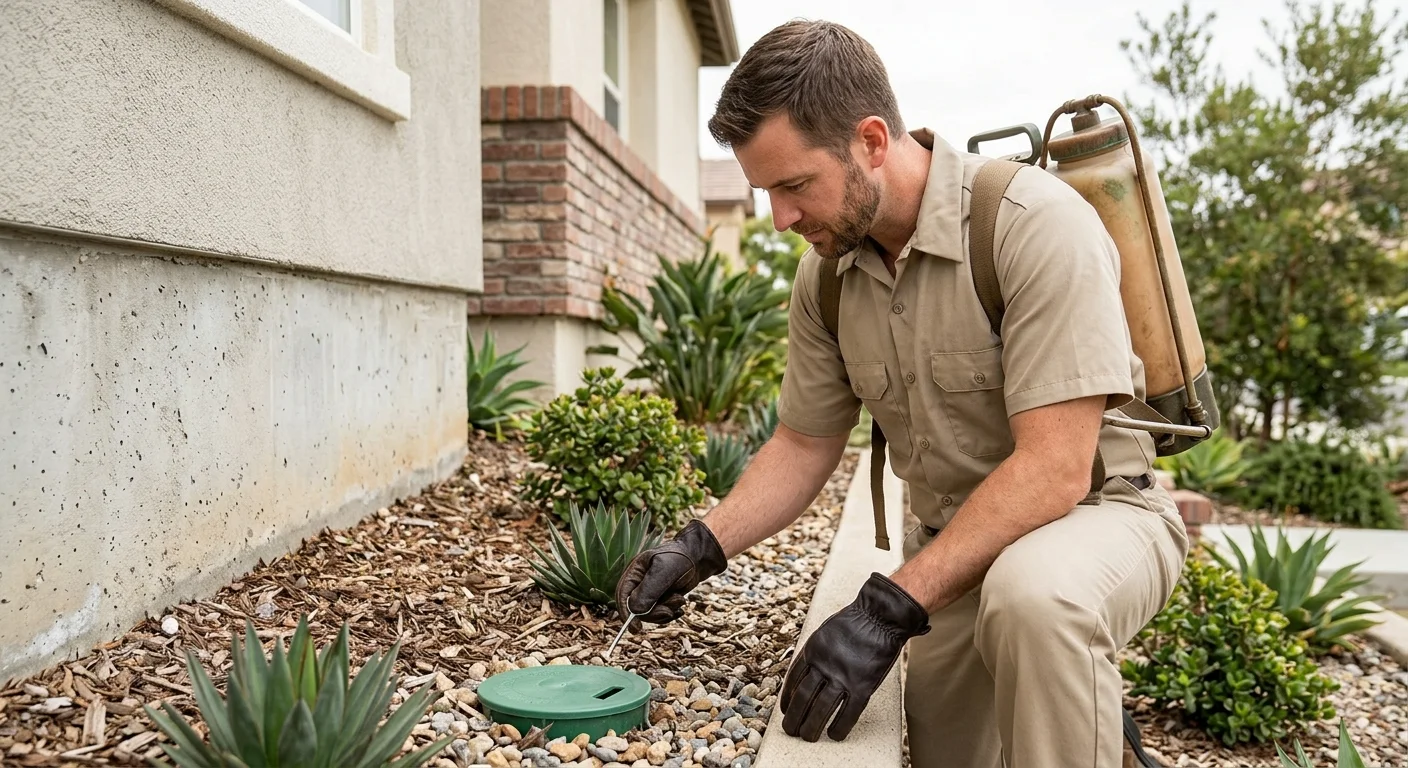
Those plastic caps at the soil line are termite bait stations. They are a soil tool for subterranean termites, not a tent and not a drywood fix. Before you approve a bait program in San Diego County, you need the species in writing and a clear account of what those stations can never show.
Which termites bait stations are meant to address
Termite bait stations are in-ground housings. Soil-foraging workers may find them while they hunt cellulose. UC IPM describes baiting systems as slow-acting insecticides that termites eat and share inside the colony. That model only fits termites that nest in soil and travel through it.
In San Diego County that usually means subterranean termites in the genus Reticulitermes. UC IPM says Reticulitermes occurs in nearly all regions of the state, from coastal dunes to mountain elevations. They need soil moisture. They nest in soil, sometimes many feet down. They build shelter tubes between soil and wood. Colonies can hold hundreds of thousands of foragers. They do not dump the six-sided fecal pellets that mark drywood work.
The soil story is not the same from the coast to East County. Lots in Oceanside, Encinitas, and Carlsbad stay damp from marine air and year-round irrigation. Foragers can keep moving along a wet slab edge through a mild winter. Inland yards in Escondido and Poway heat harder in summer. UC IPM notes that subterranean termites in California can forage year-round, with the least activity from November to February and the most in summer. East County properties in El Cajon, Lakeside, and Alpine often mix slab wings with hillside crawl space, wood-to-soil contact, and leftover stumps. South Bay yards in Chula Vista and National City push irrigation against stucco and expansion joints. A bait plan that ignores those site facts is just a ring of plastic.
Formosan termites (Coptotermes formosanus) are a subterranean species too. UC IPM currently limits them to a small area near San Diego. That is not a countywide infestation. If a company names Formosan on your address, ask what evidence they have and get it in the written report.
Western drywood termites (Incisitermes minor) are a different pest. UC IPM calls them California’s second most important termite pest, common along the Pacific coast into Southern California deserts and the Central Valley. They live in dry wood. They do not need soil contact. Their colonies typically hold fewer than 1,000 individuals. Kickout holes and hexagonal pellets are the diagnostic signs. In-ground bait stations are not a drywood treatment. Pellets in a La Jolla attic or a Coronado window frame point to a different decision, often localized work or fumigation by the right licensee. Read our drywood versus subterranean termite guide before you sign anything labeled bait.
Stations in the lawn also do not identify the insect in the fascia. That starts with a licensed Branch 3 inspection and a Wood Destroying Pests and Organisms report for visible, accessible areas.
What monitoring can and cannot show
A bait station is not a trap. Nothing snaps shut. Workers that find the cellulose feed and go back to the colony. Later checks look for feeding, carton, live insects, or an empty matrix. A hit means foragers used that station. It does not map every gallery in the house.
A quiet station does not mean the lot is clear. Termites find food by foraging, not by reading a lid. They may be in a neighbor’s eucalyptus stump, under a patio, or already in a mud tube on the stem wall. UC IPM is plain that infestations can stay hidden in soil and wood. Empty plastic around a Clairemont slab is not a clearance.
Monitoring also cannot name the species in the rafters. Drywood pellets, kickout holes, and swarmers inside a closed room are a wood problem. In-ground stations will not intercept that colony. Flying insects at a window still need a person who can tell termite swarmers from ants. The report should say which insect, which evidence, and which areas were not accessible.
What monitoring can do is document change over time at the stations a licensed company installed. Hits can support a decision to place bait instead of a monitor. Continued hits after baiting can show that foragers are still using that spot. A company may also use indoor signs, such as shelter tubes on a garage stem wall, to decide that soil treatment, bait, or both belong on the same job. None of that replaces a full look at the structure.
Store kits do not close that gap. UC IPM states that all effective products for subterranean termites are for professional use only. Homeowners cannot manage an infestation on their own with a bag from the hardware aisle. Opening a station also does not create a Wood Destroying Organisms report. Lenders and buyers in California look to a registered Branch 3 company for that paperwork. You can confirm a company’s license through the California Structural Pest Control Board before you approve a program.
If you already see tubes, damaged wood, or swarmers, say so on the call. Monitoring is a soil record. It is not a substitute for termite treatment when a licensed inspector finds an active infestation in the building.
How bait plans differ from liquid or fumigation work
Bait, liquid soil treatment, and fumigation answer different questions. Mixing them in your head is how people buy the wrong plan.
A bait plan puts a small amount of slow-acting product where subterranean foragers may feed, then shares that dose through the colony. It does not soak the soil in a continuous band. It does not tent the house. It does not reach drywood colonies living in furniture, fascia, or attic framing. It also leaves no residual soil barrier if foragers later arrive from a new direction. Habitat work still matters. UC IPM lists removing wood-soil contact and moisture sources alongside baiting and soil insecticides.
Liquid work is a soil-applied insecticide around and under the structure. UC IPM names nonrepellent materials such as fipronil and imidacloprid as products licensed companies commonly use for subterranean termites. That approach is about treated soil, not about workers carrying food home. It can mean drilling slabs, porios, and walkways. A tight Mission Hills patio, a finished basement wall, or a hillside home with limited soil access can make that conversation longer. Bait is sometimes discussed when liquid access is poor. That is a site call after inspection, not a rule you can pick from a product page.
Fumigation is a different license and a different pest problem. Only an SPCB Branch 1 company may fumigate. The fumigant used for drywood tenting is sulfuryl fluoride, with chloropicrin as the warning agent. Occupants, pets, and plants are usually out for two to three days. Re-entry is not a homeowner guess. The licensee tests during aeration and posts the notice. California’s Department of Pesticide Regulation sets the clearance standard at 1 ppm sulfuryl fluoride or less. In-ground bait stations do not do any of that work.
San Diego housing stock makes the split practical. A 1960s Chula Vista slab with irrigation against the stucco is a subterranean conversation. A 1920s North Park bungalow with drywood pellets in a window stool is not. A Rancho Santa Fe estate with a well, a guest house, and eucalyptus along the drive may need more than one method on the same property. Our liquid versus bait comparison walks through those two soil options. For the wider menu, including tenting and localized drywood work, use the termite treatment plan comparison.
No method on this list is a percentage promise. UC IPM describes baiting as a professional subterranean method. It does not publish a success rate you can print on a yard sign. Anyone quoting a guaranteed kill number is selling past the science we can cite.
What to ask before approving a bait program
Approve the inspection first. Approve the written findings second. Approve the bait program last. Pest Pros San Diego matches you with licensed, insured local companies. We do not install stations, set a fee schedule, or hold an SPCB license. The matched company inspects, quotes in writing, and owns the work.
Fixr puts a one-time termite inspection at $150 to $350 as of 2026. That is a national guide figure, not a San Diego quote and not a bait-program price. Bait service pricing varies by company, lot, and whether monitoring or active bait is on the contract. Ask for a written number after the inspection. Our termite treatment cost page covers the cost factors we can source. It does not replace the quote in your hand.
Ask these questions before you sign:
- Which species did you find, and what evidence is in the report?
- Are the stations for subterranean foragers only, or is drywood also on this job?
- Is this monitoring, active bait, liquid soil treatment, fumigation, or a mix?
- Who holds the Branch 3 registration for the termite work, and Branch 1 if tenting is proposed?
- What will you write down when a station shows activity, and what will you write when it does not?
- If tubes or damage continue inside the house, what is the next licensed step?
- What re-treatment terms sit in your contract, not in a sales script?
- How will you keep stations away from kids, pets, and mowers after they are in the ground?
Skip any pitch that ranks a consumer brand as the most effective station. Skip a plan that tells you to set, drill, or refill the system yourself. Skip a schedule copied from a box. Labels and companies differ. The licensed operator sets the monitoring interval in writing for your property. Do not treat a blog, including this one, as that interval.
If the answers are vague, pause. A bait program is a long watch on soil-foraging termites. It is the wrong buy for a drywood attic and a thin buy if no one has looked under the house.
When to call us
Call when you see shelter tubes, damaged wood, swarmers, or a proposed bait layout you do not yet understand. A licensed Branch 3 company should identify the insect and put the plan in writing before any stations go in. Call us at (858) 400-6561 and we’ll match you with a licensed local pro.