
A professional termite treatment should match the termite species, evidence, and affected structure. The written plan should explain what gets treated, which method is proposed, what remains excluded, and who holds the required license. That matters more than a vague promise to eliminate termites.
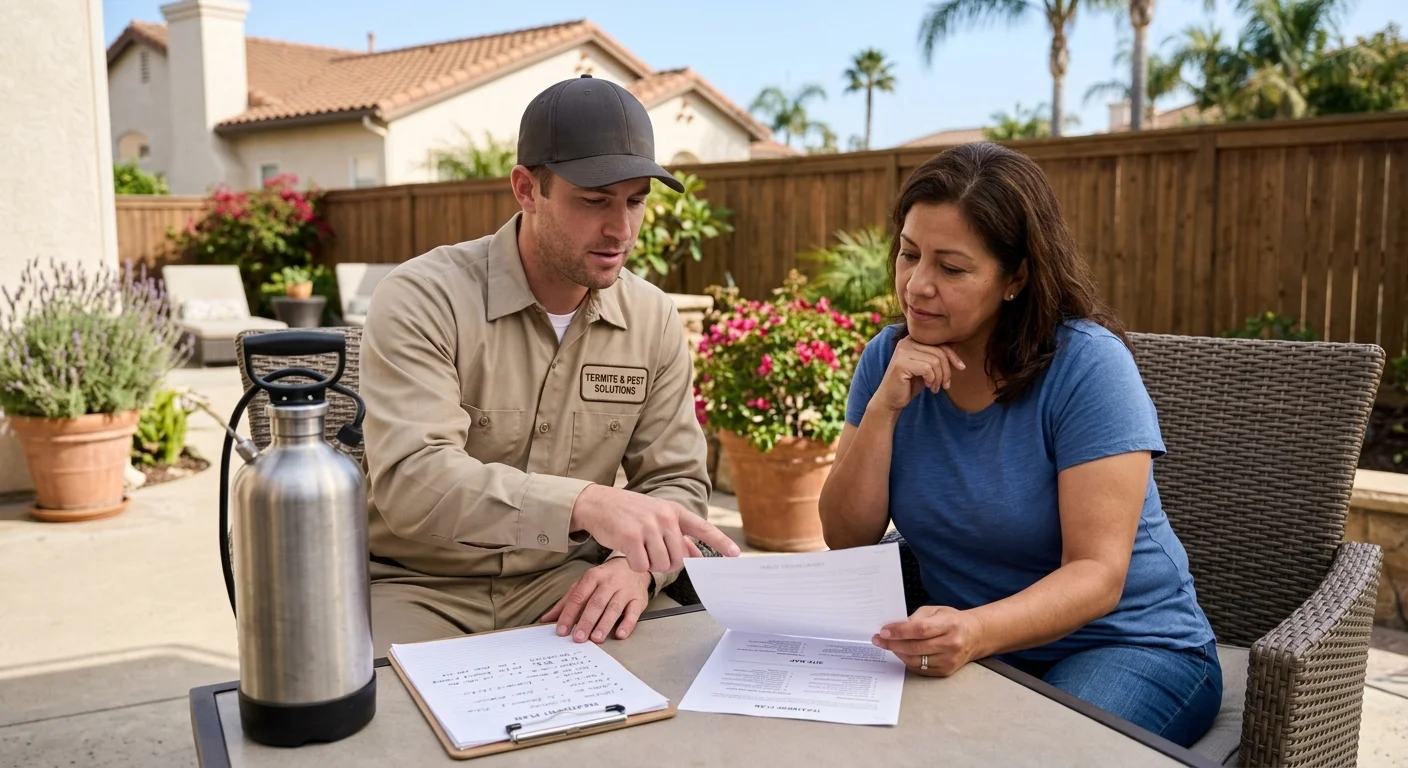
Why termite identification changes the treatment plan
Termite treatment starts with identification because drywood and subterranean termites live differently. A quote that only says “termite treatment” leaves out the central decision. The inspection should connect visible evidence to a named termite type and proposed method.
Western drywood termites live within wood rather than maintaining soil contact. According to UC IPM’s drywood termite guidance, their fecal pellets have six hexagonal sides. Small kickout holes may appear where those pellets leave the wood. Swarmers can also appear during summer and fall daytime hours.
Subterranean termites nest in soil and build shelter tubes toward wood. They don’t produce the diagnostic drywood pellets. UC IPM’s subterranean termite guidance says these termites occur across nearly all regions of California. That includes coastal, inland, and elevated settings.
Property layout changes what an inspector can reach. A Point Loma house may present evidence near a roof eave. An El Cajon property may show shelter tubes near a slab edge. A Chula Vista townhome may add shared-wall access questions. These scenarios shouldn’t receive interchangeable proposals.
Start by asking where the evidence was found and photographed. Then ask what supports the species identification. Our termite inspection service connects property owners with licensed local companies that can evaluate visible and accessible areas.
UC IPM doesn’t recommend do-it-yourself drywood termite treatments. It also says effective subterranean termite products are for professional use. Professional identification prevents a narrow treatment from being chosen for evidence that suggests a broader problem.
How localized work, soil treatment, and fumigation differ
Localized work treats identified drywood termite activity without enclosing the entire building. UC IPM lists liquids, dusts, foams, microwave devices, electrocution, and wood replacement among localized approaches. The proposal should identify the selected method without turning the agreement into application instructions. It should also define each treated board, opening, room, or structural area.
The main limitation is reach. Hidden drywood activity can be difficult to map from visible evidence alone. UC IPM says whole-structure fumigation has an advantage because it addresses accessible and inaccessible sites together. That doesn’t make every drywood finding a fumigation job. It means a localized proposal should explain why its boundaries are defensible.
Subterranean termite plans address the connection between soil and the structure. Professional options include soil-applied products and baiting systems. UC IPM describes baits as slow-acting insecticides shared through termite feeding. Moisture correction and removing wood-to-soil contact may also appear in the plan. Our comparison of liquid and bait termite treatment explains the questions each option raises.
Fumigation is a whole-structure drywood termite approach. Only an SPCB Branch 1 licensee may perform it. California structural fumigation uses sulfuryl fluoride, with chloropicrin as the warning agent. Occupants, pets, and plants must leave. Food and medicine must be removed or sealed as directed by the fumigator.
Re-entry isn’t based on a homeowner’s timer. The licensed fumigation company tests during aeration and posts the re-entry notice. The fumigant label and the EPA requirement put that clearance level at 1 ppm or less in all breathing zones, measured with an approved clearance device before anyone reoccupies the structure. Follow the fumigator’s written checklist wherever instructions differ. Read our fumigation overview before comparing that option.
A proposal may also recommend termite treatment without tenting. Compare that recommendation by species, evidence, access, and treatment boundaries. Don’t treat “no tent” as proof that the plan is less disruptive or equally broad. The written scope must show what the method can actually reach.
What should appear in a written treatment scope
A verbal explanation can sound complete while leaving major gaps. Ask each company to put its findings, treatment boundaries, responsibilities, and exclusions in writing. That creates a fair comparison between proposals.
A useful written scope should cover:
- The termite type and evidence supporting that identification
- Every structure, room, board, soil area, or exterior zone included
- Areas that weren’t accessible during the inspection
- The proposed method and company responsible for performing it
- Required preparation, vacancy, access, and re-entry instructions
- Recommended moisture corrections, wood repairs, or access work
- Follow-up visits and warranty terms, if the company offers them
- Conditions that could change the quote before work begins
Descriptions should be precise enough to mark on a floor plan or photograph. “Treat garage framing” is clearer than “spot treatment.” “Inspect inaccessible wall void after access opens” is clearer than assuming those voids are covered.
A proposal should separate treatment from structural repair. Branch 3 includes termite and wood-destroying organism work using insecticides or structural repairs and corrections, excluding fumigation. Still, the written plan should identify who handles each part. Don’t assume one company, crew, or agreement covers both.
For a property sale, ask whether the document is a treatment proposal or a formal Wood Destroying Pests and Organisms report. A properly registered Branch 3 company issues a WDO report. That report covers findings in visible and accessible areas. It also includes recommendations for correcting infestations when found.
Compare exclusions with the same care as included work. A detached garage, deck, fence, crawlspace, attic, condo common area, or adjoining unit may sit outside the proposed boundary. Those details matter across San Diego County, where detached buildings, shared walls, slabs, and hillside access can occur within the same neighborhood.
Our termite treatment referral service can connect you with licensed local companies. The matched company inspects first and provides its quote in writing before treatment begins.
Which license and warranty claims need verification
Licensing should match the work described. Branch 1 covers structural fumigation with poisonous or lethal gases. Branch 3 covers wood-destroying pests through insecticides, repairs, and corrections, excluding fumigation. Branch 2 concerns general household pest control and excludes fumigation.
Use the California Structural Pest Control Board license page before signing. Follow its link to the Department of Consumer Affairs search. Check the business name, individual name, license type, license number, location, and current status. Don’t rely only on a logo, badge, truck, or verbal assurance.
The person discussing findings may hold a different license type from another person performing work. California identifies applicators, field representatives, and operators with different roles. A field representative can inspect, identify infestations, submit bids, contract on behalf of a registered company, and perform covered work while employed there. An operator can also own a company or act as its qualifying manager.
Fumigation needs an additional check. The company actually performing that portion must hold Branch 1 authority. If one proposal names a separate fumigation company, verify that business too. Don’t assume the company presenting the proposal will perform every listed service.
There’s no single San Diego termite warranty to assume. Warranty and re-treatment terms belong to the company offering them. Ask for the complete terms before comparing coverage.
Check whether the agreement answers these points:
- Which treated areas and termite types are covered
- When inspections or follow-up visits may occur
- What evidence can trigger additional treatment
- Which inaccessible areas, repairs, or conditions are excluded
- Whether coverage transfers after a property sale
- When the term ends and how cancellation works
- Whether any renewal has a separately stated price
Avoid treating “warranty included” as a complete answer. One agreement may cover only the named treatment sites. Another may require access or property corrections before coverage applies. Those aren’t equivalent promises.
Finally, compare the diagnosis, scope, license, and written obligations together. A low total doesn’t resolve an unclear species finding or missing treatment boundary. The matched company should inspect first and quote in writing before any professional termite treatment begins.
When to call us
Call when termite evidence is active, the species is unclear, or competing plans cover different areas. Licensed local pros can inspect the property and explain the proposed scope. Call us at (858) 400-6561 and we’ll match you with a licensed local pro.