
A gray paper globe under a Mission Hills eave, or a stream of insects into a Lakeside soffit, is what most San Diego searches mean by hornet nest removal. The nest shape, the entrance, and whether anything is still flying in and out decide the job more than the name on the insect. True hornets are a different animal from the yellow jackets and paper wasps that actually nest on county properties.
How hornet nests differ from paper wasp and yellow jacket nests
People use “hornet” for almost any large stinging wasp. That mix-up is why wasp nest vs hornet nest ID matters before anyone touches the structure. Hornets are wasps. They sit inside the same broad group as paper wasps and yellow jackets. A true hornet belongs to the genus Vespa. The bald-faced insect many national pages call a hornet is a yellow jacket relative, not a Vespa.
UC Statewide IPM is the authority to check for California social wasps. This brand’s verified claims file does not confirm a true Vespa hornet as an established San Diego County pest. If a neighbor, a hardware-store clerk, or a photo app labeled it a hornet, treat that as a guess. Ask the licensed inspector to name the insect on site.
What you can sort from the sidewalk is the nest, not a species ID at ten feet.
Paper wasp nests are open. The comb hangs like a small umbrella. You can see the cells from below. They show up under eaves, patio covers, play structures, and garage rafters from Encinitas to Chula Vista. Traffic is usually light compared with a yellow jacket hole. For a side-by-side on the insects themselves, use paper wasp or yellow jacket.
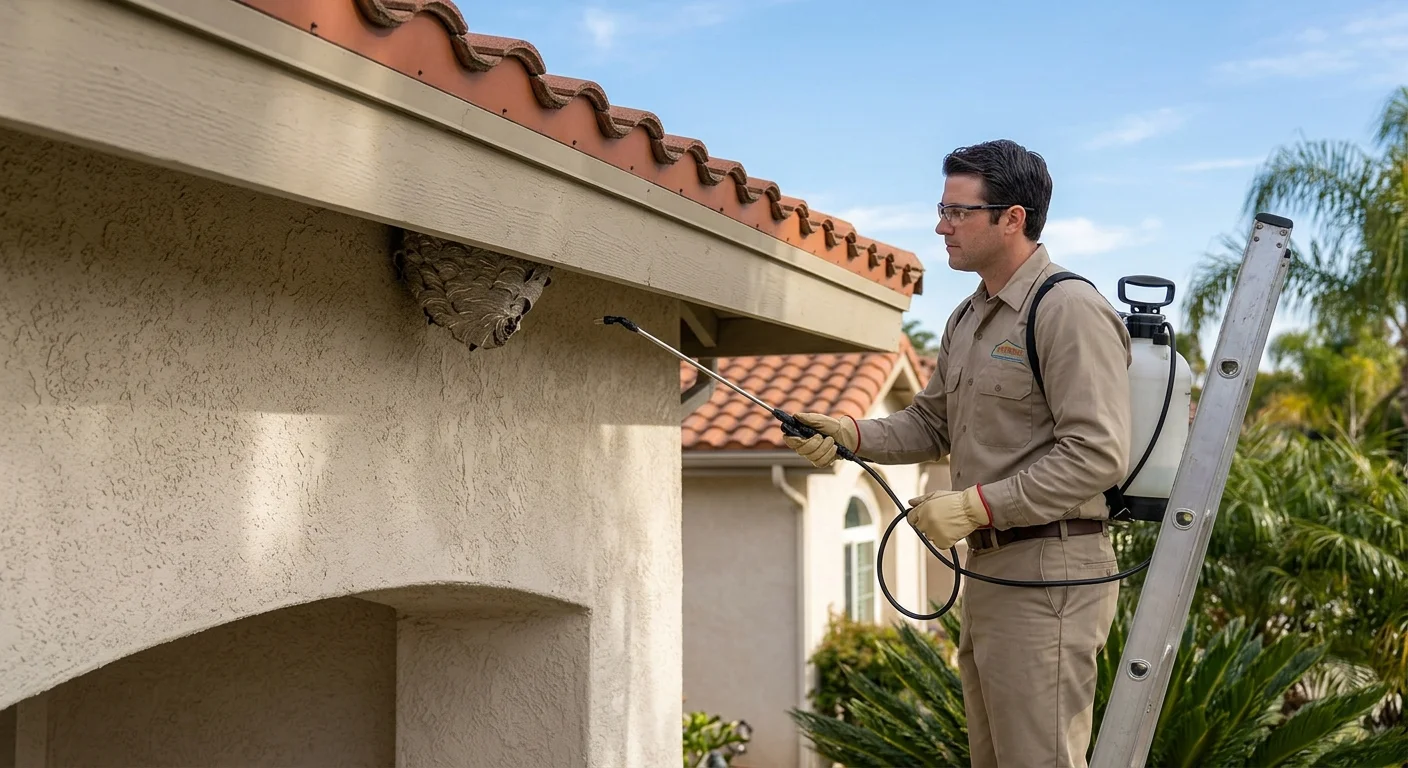
Enclosed aerial nests are the ones people mean by “hornet nest.” They are gray or tan paper, with a wrapped outer shell and a single entrance, often near the bottom. You cannot see the comb from the ground. They hang from eaves, tree limbs, shed rafters, and dense shrubs. Coastal houses with deep patio covers give them shade. Inland tile roofs and stucco soffits give them a protected lip.
Yellow jacket nests are often hidden. The “nest” you see may only be a hole. In East County yards that can be an old rodent burrow in hard dirt. In older central-city bungalows it can be a gap at a soffit, a dryer vent, or a crack in the wall. Heavy in-and-out traffic at one small opening is the tell. That is yellow jacket nest work, even when the search was for hornets.
Wax comb is a different job. If the structure looks waxy, not papery, you may be looking at bees. Don’t knock it down. Don’t spray it. Say that to the company you’re matched with so they send the right kind of crew.
A published lifespan number for hornets in San Diego County could not be confirmed from UC IPM in a form we can cite here. Skip blog figures about days, weeks, or colony counts. Watch this year’s traffic instead. An enclosed nest in October is this season’s paper, not a permanent hive.
Where San Diego properties actually see enclosed nests
San Diego County is not one nesting map. Housing stock, heat, and irrigation change where an enclosed nest can sit without you noticing it until fall.
Coastal north county, from Oceanside through Carlsbad and Encinitas, stays milder at night. Patio covers, second-story eaves, and constantly watered planting strips hide paper globes until someone uses the outdoor table. Salt air and wind push colonies onto the leeward side of a house, not the ocean face.
Inland north county is hotter. Escondido, San Marcos, Vista, and Poway attics and wall voids run warm. An enclosed colony may start on an eave, then expand into a soffit gap. You see foragers at a vent or a light fixture, not a neat globe. Tile roofs and stucco make that path easy.
The central city mixes old wood bungalows with tight lots. North Park, Normal Heights, and similar streets have shallow eaves, shared fences, and trash storage close to the house. A nest over a back door or under a stair soffit is a people problem even when it is still small.
East County is drier and more open. El Cajon, Lakeside, Alpine, and Ramona yards hold oaks, eucalyptus, and unused burrows. Enclosed aerial nests show in trees and under shed eaves. Ground traffic at a single hole in the dirt is the other pattern, and it is easy to miss until a mower or a dog passes it.
South Bay lots in Chula Vista, National City, and Imperial Beach sit closer together. Alley garages, stucco patio covers, and play yards put nests next to daily routes. A globe over a side gate matters more here than the same nest on a five-acre Alpine slope.
Look from the ground, in daylight, without climbing. Common holds: the shady eave over a door, the back of a patio cover, a dense hedge against a wall, a shed rafter, a tree limb over a walk, and any hole that keeps drawing the same flight line. Early October is still nest season on this coast. Warm afternoons keep foragers moving. Don’t wait for a frost that may not come.
If the only sign is a hole in the lawn, stay off that patch. That is not a paper-wasp umbrella, and it is not a job for a broom.
What active traffic means for the removal decision
The removal decision is about live traffic, location, and access. It is not about winning an argument over the word hornet.
Stand well back and watch. Steady in-and-out at one entrance means the colony is active. A few stragglers on a torn, weathered shell may mean the nest is spent, but “quiet” is not the same as safe. Cool mornings look calmer than they are. Afternoon sun on a coastal eave can wake the same nest.
An enclosed nest over a door, patio, play set, or pet run is a different call than one high in a tree at the back of a lot. Wall-void and ground nests are hidden. You cannot see how large the paper is. You cannot see how many insects are inside. Those stay with a licensed company. Don’t seal a live wall entrance. Trapped wasps can chew toward the room you live in.
Don’t spray. Don’t bag. Don’t hit the nest with a hose or a pole. Those are the steps ranking national pages still teach, and they are how people get swarmed on a ladder. This page will not walk you through night raids, jet sprays, or homemade soaps. EPA advice on safer pest control is about reading labels and reducing risk, not turning a homeowner into an applicator on a second-story eave.
If the nest is an open paper comb with only a few wasps, the matched company may still treat it as a wasp job. That is closer to ordinary wasp nest removal in San Diego than to a hidden yellow jacket colony. If the nest is enclosed, high, or feeding a hole in a wall or the ground, say that on the call. The company you’re matched with inspects first. They decide the method after they see the site.
Allergies, kids, and pets change the urgency of the decision, not the method you should try yourself. This page does not rank stings or guess medical outcomes. If someone is having trouble after a sting, that is a medical call, not a pest-control one.
Late-season nests still count. A mild October in La Jolla is not a freeze in the mountains. Foragers still defend the paper. Leaving a quiet, unused nest in a far tree until winter is a site-specific call for the inspector, not a rule you should apply to a nest over the kitchen door.
How to compare licensed removal companies
Pest Pros San Diego matches you with licensed, insured local companies. We don’t treat, spray, or pull nests. We don’t employ technicians, and we don’t set a fee schedule. The company you’re matched with does the work.
Wasp and hornet nest work is general household pest control in California. That sits under Structural Pest Control Board Branch 2, not fumigation (Branch 1) and not wood-destroying organisms (Branch 3). Confirm the firm on the California Structural Pest Control Board license search before anyone comes out. Search by business name and make sure the listing is active.
Ask how they handle three different sites: an exposed enclosed nest on an eave, a colony in a wall or soffit, and a ground entrance in the yard. A serious answer names those as different jobs. A vague “we spray wasps” does not. Ask what they do if the insect is a honey bee, not a wasp. Ask whether they leave the dead nest in place or remove it after activity stops. Ask who is allowed on ladders and roofs. Falling during a swarm is a real injury path on two-story stucco.
The matched company inspects first and quotes in writing before any treatment begins. There is no brand price list for hornet nest removal, and no verified San Diego market range we can publish. Ignore round numbers you see on national cost pages unless they name a live guide you can open yourself. A written quote after a look at your eave, wall, or burrow is the number that matters.
If two companies disagree on the insect, that is useful. One may be looking at an open paper comb. The other may be looking at yellow jacket traffic into a void. Take the ID in writing. Then compare the plan, not the nickname.
For the service path itself, start at wasp and bee removal. That is the bucket for social wasps, enclosed aerial nests, and the yellow jacket holes people find while searching for hornets.
After the nest is gone, exclusion is off-season work: screen vents, seal gaps, and fix the soffit hole once the company confirms the colony is dead. Sealing first, while the nest is live, is the mistake.
When to call us
Call when you have an enclosed nest, a hole with steady traffic, or stinging insects using a door, patio, or wall void. Stay on the ground, keep people and pets away from the flight line, and let a licensed Branch 2 company inspect before anyone treats. Call us at (858) 400-6561 and we’ll match you with a licensed local pro.