
A striped insect circling the patio may be a paper wasp or yellow jacket. For a reliable wasp vs yellow jacket comparison, check its body, legs, nest, and repeated flight path. Color alone won’t settle the identification.
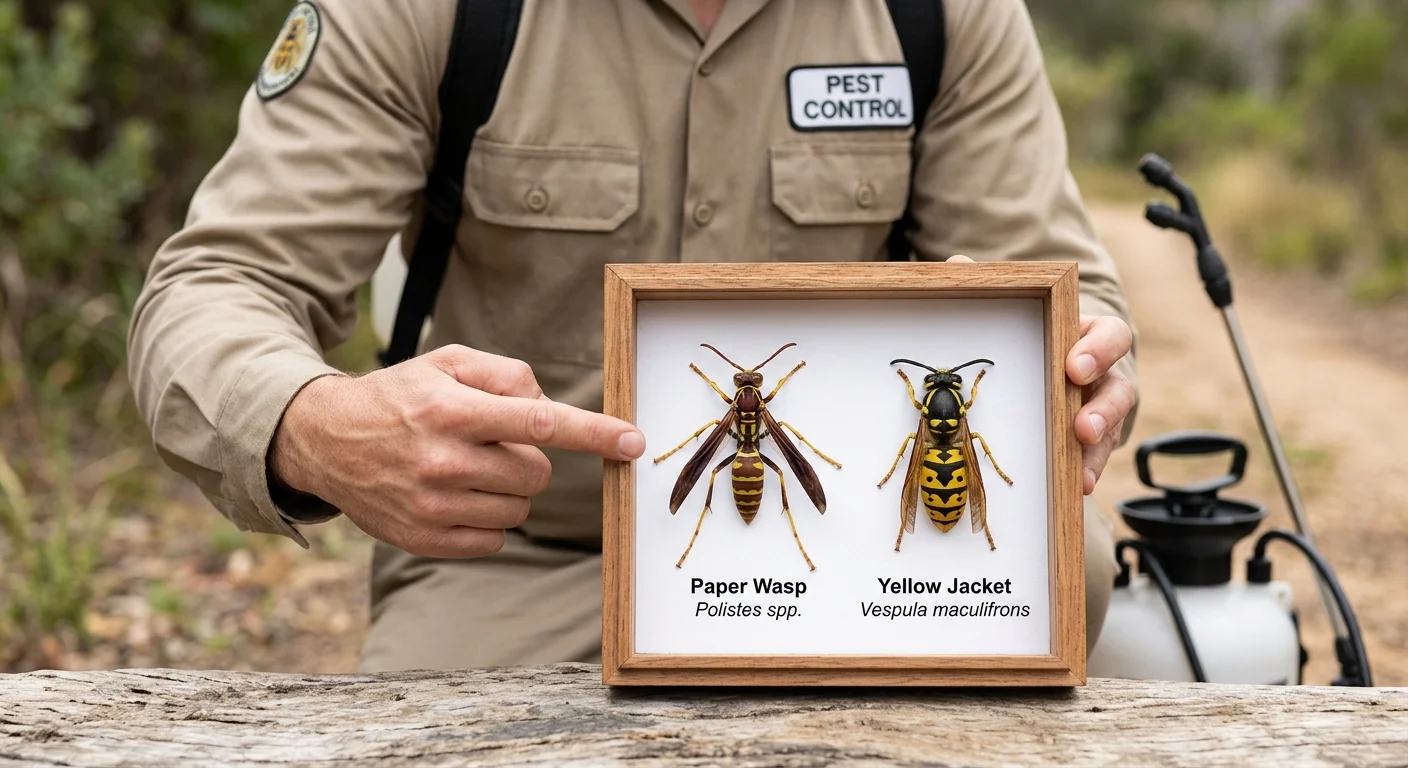
How body shape and markings differ
The phrase “wasp vs yellow jacket” uses everyday shorthand. Yellow jackets are wasps, but they don’t share the same profile as paper wasps.
Start with overall body shape. A paper wasp usually appears slender and elongated. Its narrow waist is easy to see between the middle section and abdomen. The back legs are long and often hang below the insect during flight.
A yellow jacket has a shorter, more compact appearance. Its legs look less prominent against the body. From several feet away, the insect may resemble a fast-moving yellow and black capsule rather than a long-legged wasp.
Markings offer another clue, but they shouldn’t decide the identification alone. Yellow jackets commonly have sharp yellow and black patterns across the abdomen. Paper wasps can also carry yellow markings. Depending on the insect, their remaining color may appear brown, reddish, or dark.
Lighting can make these differences harder to read. A shaded eave in Encinitas produces a different view than a bright block wall in El Cajon. Fast movement, window screens, and distance can also hide the waist and legs.
Use this short visual comparison:
- Long, slim body with dangling legs: more consistent with a paper wasp.
- Compact body with strong yellow and black bands: more consistent with a yellow jacket.
- An insect coated with pollen or showing a fuzzy body: don’t force either identification.
- A blurred photo showing only yellow markings: not enough evidence.
Try to observe without approaching or disturbing the insect. A zoomed photo taken from a comfortable distance may show the waist, legs, and abdominal pattern. UC IPM is a useful authority for comparing California pests without relying on color alone.
What nest shape and location can reveal
The nest often provides a clearer answer than the insect. Paper wasp nests have exposed paper combs. The open cells remain visible from below, giving the nest an umbrella-like appearance. There isn’t a complete paper shell around the comb.
These exposed nests may appear beneath eaves, railings, patio covers, or other sheltered surfaces. Around San Diego County, that can mean a coastal North County balcony, a central San Diego stucco overhang, or the underside of an East County patio roof.
Yellow jacket nests are usually concealed or enclosed. The colony may occupy an underground space, a wall void, or another protected cavity. An aboveground nest can have a paper covering rather than exposed comb.
A ground opening doesn’t prove the insect is a yellow jacket. The useful clue is repeated insect traffic through the same opening. Likewise, insects entering a wall gap may have a concealed nest, but the exterior view won’t reveal its size or exact position.
Don’t touch, cut, shake, open, or spray a nest to identify it. You can note these details from farther away:
- Are the comb cells exposed?
- Does the nest have an outer paper covering?
- Are insects entering a hole in soil?
- Are they using a gap beneath siding, flashing, or stucco?
- Is the structure made from paper or dried mud?
Mud construction points toward a different kind of wasp activity. Our guide to mud wasp nests in San Diego County explains those tubes and mud cells.
Nest vocabulary also causes confusion. “Hornet nest” is often used for any enclosed paper structure. Our wasp nest versus hornet nest guide explains why nest shape and occupant identification should be considered together.
Why active traffic matters more than color alone
A single striped insect doesn’t tell you where it lives. It may be passing through, visiting flowers, searching around outdoor food, or collecting nest material. That brief sighting gives you fewer clues than a repeated route.
Watch for insects entering and leaving the same point. Consistent traffic into soil, a retaining-wall gap, or a building opening suggests a nearby nesting site. The opening itself may be small even when activity is easy to notice.
This matters across San Diego’s varied properties. A La Mesa retaining wall presents different hiding places than an Oceanside balcony. Older central-city buildings may have layered trim and small exterior gaps. South Bay yards may combine sheds, block walls, planted edges, and open soil within a compact area.
You don’t need to stand in the traffic path. Observe from a spot where insects aren’t flying around you. Note the entry point, nearby landmark, and time you observed activity. A photo of the location can be more useful than a blurry close-up of one insect.
Traffic patterns can also prevent a common mistake. An exposed paper comb with several long-legged occupants supports a paper wasp identification. Repeated movement into a hidden opening supports a concealed nest, even when individual markings remain unclear.
Avoid treating yellow as a species label. Several insects can appear yellow and black, especially while moving. Body proportions, visible nest construction, and repeated use of one entrance provide a stronger combined picture.
If the traffic leads into a wall or ground opening, read our guide on yellow jacket nests and when to call a pro. It explains what information to gather before contacting a company. It doesn’t require disturbing the entrance.
When a licensed company should confirm the insect
Some identifications remain uncertain after a careful visual check. The insect may move too quickly. The nest might sit inside a wall, beneath soil, or above a second-story roofline. A photo may also omit the body features needed for comparison.
Professional confirmation makes sense when active traffic enters a structural gap or hidden cavity. It’s also appropriate when the nest can’t be viewed without climbing, opening building materials, or moving objects around it.
Share what you observed with the company:
- Where insects enter and leave
- Whether the opening is in soil or a structure
- Whether any paper comb is visible
- What the body and legs looked like
- Photos taken without approaching the activity
- Nearby doors, walkways, patios, or work areas
Those details help the company begin with the location and identification problem. The company you’re matched with can inspect before recommending any work. Treatment choices and written terms belong to that company, not Pest Pros San Diego.
California places general household pest work within Structural Pest Control Branch 2. You can check a company or individual through the California Structural Pest Control Board license search.
Pest Pros San Diego is a referral service. We don’t inspect nests, apply pesticides, or employ technicians. We match customers across San Diego County with licensed local pest control companies.
Our wasp and bee removal service page explains how the matching process works. Accurate identification comes first because a paper wasp nest, concealed yellow jacket nest, and mud nest aren’t the same problem.
When to call us
Call when repeated traffic points to a nest, the insect remains unclear, or the location can’t be viewed without disturbing it. Call us at (858) 400-6561 and we’ll match you with a licensed local pro.