
A hard little cluster of dried mud under an eave sends a lot of homeowners straight to a spray can. The nest you’re looking at may not be the nest you think it is, and the wrong guess changes the whole removal decision. Start with what the structure is made of, then decide who should touch it.
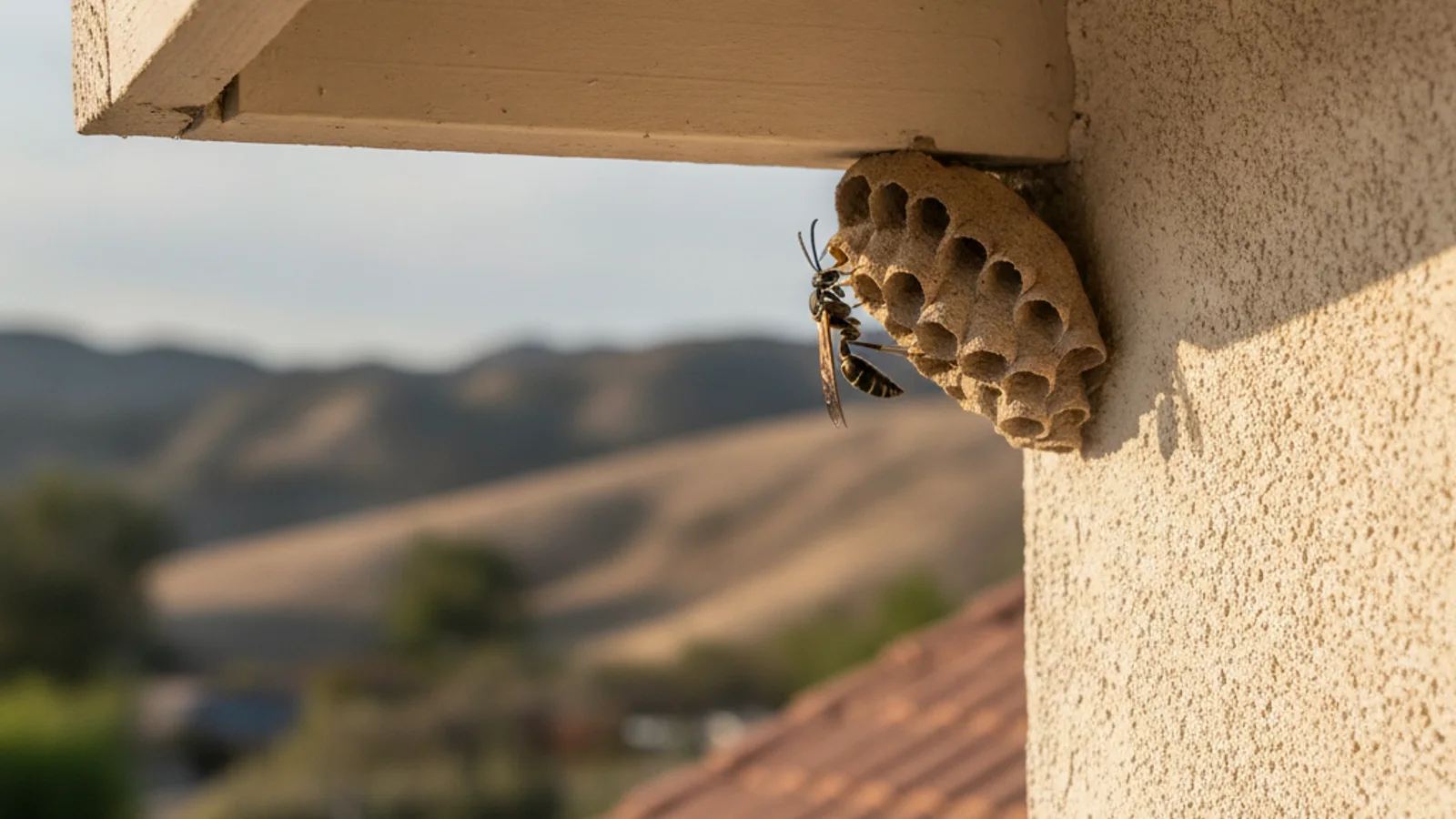
How mud wasp nests differ from yellow jacket nests
Material is the first thing to look at, because it’s the one thing you can judge from a safe distance. A mud nest is exactly that: packed soil, dried hard, often built as short tubes or a lumpy plaster patch stuck flat against a surface. A paper wasp nest looks fibrous and gray, with open cells you can see into from below. A yellow jacket colony frequently has no visible nest at all, just a steady stream of insects going in and out of a hole in the ground, a wall void, or a gap under a step.
Those three things call for three different conversations. Our side-by-side on wasp nests versus hornet nests in San Diego walks through the paper-nest shapes in more detail. If the traffic is heading into soil or a wall rather than onto an exposed nest face, treat that as a separate problem and stop guessing at it.
Honeybees add a fourth possibility, and it’s the one people misread most often. Comb is wax, not mud and not paper, and a bee colony in a wall or chimney is a removal and repair job rather than a pesticide job. Our guide to bee removal in San Diego explains why that distinction matters before anyone sprays anything.
We can’t tell you the species from a photo of a nest, and neither can a product label. Beyond the material, identification comes down to the insect itself: body shape, waist, coloring, and how it moves. UC’s statewide integrated pest management program at ipm.ucanr.edu is the right place to compare an insect you’ve actually seen, rather than a nest you’re guessing about. Don’t collect a specimen by hand to do it.
Where nests appear around coastal and inland homes
San Diego County doesn’t have one building style, so it doesn’t have one nesting pattern either. Mud sticks best to sheltered, sun-shaded, undisturbed surfaces, and every part of the county offers those in a different form.
Along the coast in Encinitas, Carlsbad and Oceanside, the usual spots are stucco soffits, the underside of tile eaves, patio-cover beams, and the recessed frames of sliding doors. Marine layer mornings keep those surfaces cool and shaded, and dense landscaping right up against the wall means nobody looks there for months. Del Mar and Solana Beach homes add exterior stairwells and open carports to the list.
Inland North County is drier and hotter. In Escondido, San Marcos and Vista, expect the sheltered side of a garage, the inside face of a shade structure, well houses, pump housings, and the rafters of detached workshops. East County pushes further in that direction. Alpine, Ramona, Lakeside and Jamul properties tend to have outbuildings, horse facilities, open-rafter sheds and stored equipment, which is more undisturbed square footage than a tract home offers.
The central city and the South Bay change the question again. Older North Park and Golden Hill homes have deep porches, detached garages and basement-level access doors. In Chula Vista, National City and Imperial Beach, attached units and shared corridors mean a nest on your wall may be your neighbor’s wall too. In an apartment, condo, or HOA, ask the manager or association who may authorize exterior work before anyone treats. Do not assume the tenant or the pest company can decide that alone.
One local note worth knowing: a wasp nest on a house is not a mosquito-program job. Compare licensed companies for wasp work rather than waiting on a county mosquito report.
How old nests differ from active insect traffic
An abandoned mud nest and an active one can look identical from the ground. The difference is traffic, and traffic takes patience to read rather than a closer look.
Watch the nest from a distance you’d be comfortable staying at if something flew out. Pick two or three separate times of day, ideally in warm daylight when flying insects are moving. You’re looking for a repeated pattern of insects arriving at and leaving the same point, not a single wasp passing through the yard. One insect near a nest proves nothing. A steady route to and from a fixed opening is the signal.
Mark what you see, with a note or a photo taken from where you’re standing. Write down the date, the time, the surface, and the direction the traffic runs. That record is genuinely useful to the company that eventually looks at it, and it stops the second conversation from starting over from zero.
Then leave it alone. Don’t tap, poke, hose, scrape or seal a nest to test whether it’s occupied, and don’t do it at night on the theory that everything is asleep. Vibration and water are how people find out the hard way that a nest was active. Ladders make it worse, because the reflex to duck arrives at the same moment your feet are on a rung.
This page doesn’t give nest-destruction or pesticide-application instructions, and that’s deliberate. If a nest sits above a doorway, a walkway, a play area, a pool deck, or anywhere someone with a sting allergy passes, the decision isn’t about how to remove it yourself. Our guide on when to call a wasp exterminator in San Diego covers the situations where waiting isn’t the right call.
What a licensed company should confirm before removal
A good visit starts with identification and access, not with a sprayer. Ask what the company believes it’s dealing with and what it saw that told them so. Ask whether the traffic is on an exposed nest face or heading into a void, since a void changes the work and can turn it into a repair conversation.
Ask how they plan to reach it. A nest at gutter height on a two-story stucco wall is a different job than one on a garage jamb. Ask what happens to the mud itself after the insects are addressed, because a dried nest left in place will keep looking like an active problem next spring.
For products, ask for the product name and the labeled use, and ask about people, pets and re-entry to the treated area. Anything they apply is governed by that label, and the general consumer guidance from the EPA on safe pest control is background, not a substitute for it. Get any follow-up terms in writing from the company itself. We don’t set those terms and we don’t hold a license, so the agreement is theirs.
Credentials are checkable in about a minute. California places general household pest work under Branch 2, and you can confirm a company or an individual through the Structural Pest Control Board license search. Note that cancelled licenses don’t show up in that search, so a blank result is worth asking about rather than shrugging at.
We match San Diego County homeowners with licensed local companies. We do not promise a live pickup or a callback time. If you rent or live in a condo, ask the manager or HOA who is responsible for the exterior before anyone treats. Read the wasp and bee removal page for the matching scope.
When to call us
Call when the nest is out of easy reach, when traffic runs into a wall or the ground instead of an exposed nest, or when anyone in the household reacts badly to stings. A licensed company can identify what’s actually nesting there, reach it safely, and explain any product it uses by its label. Call us at (858) 400-6561 and we’ll match you with a licensed local pro.