
You spot a wasp flying near your roofline. Then another. Soon you see it, a gray, papery nest tucked under the eaves. Deciding whether to leave it alone or call a licensed company is a safety call, not a DIY dare.
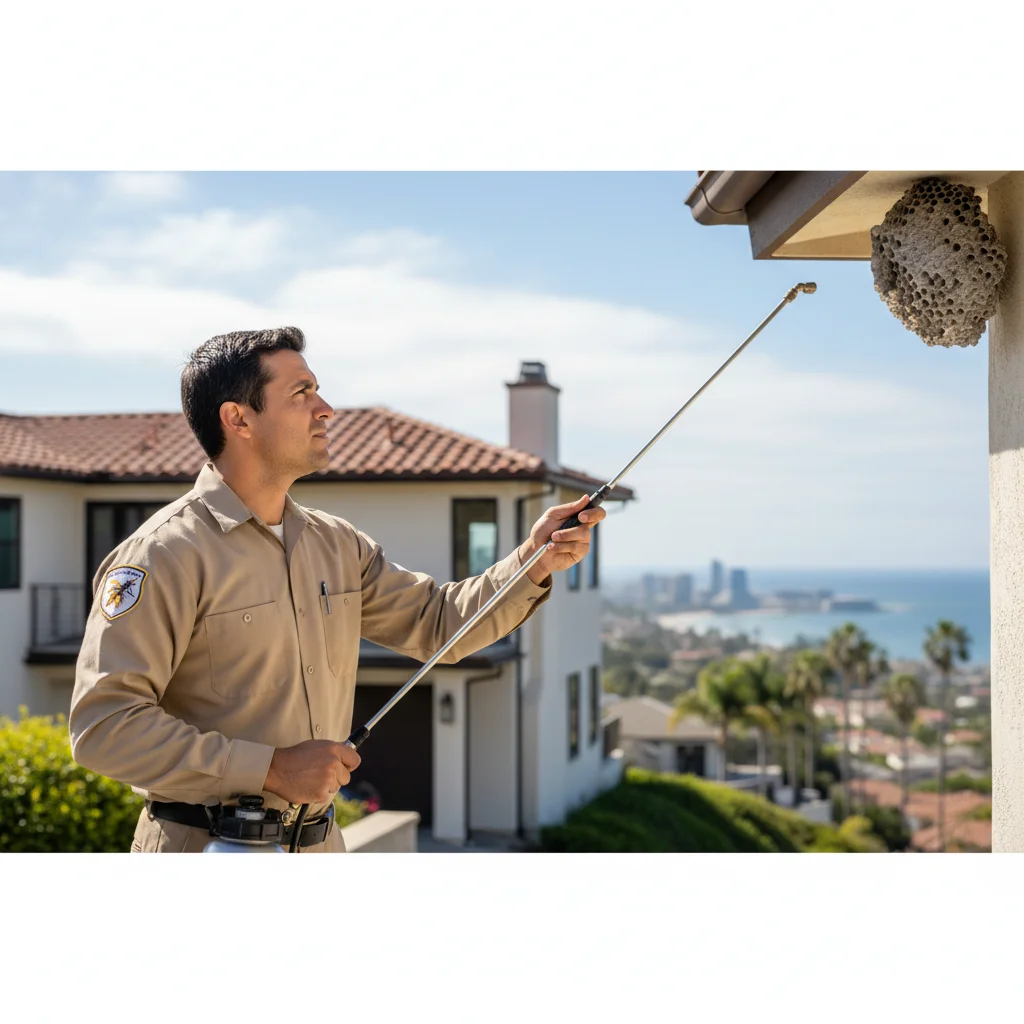
Recognizing San Diego’s common wasps
Not all wasps in San Diego County are created equal. Identifying the type you’re dealing with is the first step in assessing the threat. Their nesting habits and aggression levels vary significantly.
Paper Wasps
These are probably the most common wasps you’ll see building nests on homes. They are slender, with long legs that dangle in flight. Their nests are distinctive: open, umbrella-shaped combs made of a papery material. You’ll find them hanging from eaves, porch ceilings, and inside unused equipment like BBQ grills. While not as aggressive as yellowjackets, they will defend their nest vigorously if disturbed. A sting from a paper wasp is very painful.
Yellowjackets
Yellowjackets are the wasps most people fear, and for good reason. They are stout-bodied, with distinct black and yellow markings. Their behavior is highly aggressive, especially in late summer and fall when their colonies are largest. Unlike paper wasps, their nests are typically enclosed. Many species build them underground in old rodent burrows, but they’ll also nest in wall voids, attics, or dense shrubs. A single disturbance can trigger a swarm attack, and each yellowjacket can sting multiple times.
Mud Daubers
Mud daubers are solitary wasps and look quite different, often with a long, thread-like waist. They build small nests from mud, resembling tubes or clumps, often on the sides of buildings. The good news is that mud daubers are not aggressive and rarely sting humans. They are more of a nuisance than a danger. For more detailed identification, the UC IPM program is an excellent resource for California homeowners.
The DIY risk assessment: when not to spray
A can of wasp spray from the hardware store can seem like a simple solution. But in many cases, it’s the wrong tool for the job and can put you in serious danger. Before you attempt a DIY treatment, run through this checklist. If you answer “yes” to any of these, it’s time to call a professional.
- Is the nest hidden, in the ground, or on a doorway or play path? Those locations are risk triggers. Nest size in inches is not a reliable cutoff, and a “fist-sized” colony count is not a fact we can source.
- Would you need a ladder or a pole you do not have? Height and poor footing are reasons to stop, not a product choice.
- Are the insects entering a hole in the ground, a wall, or a vent? Treat that as possible yellowjackets or a cavity nest. Do not flood, plug, or hose it.
- Has anyone been stung, or does anyone have a sting allergy? That is a medical boundary. Call emergency services for a severe reaction. Removal is a licensed job after people are safe.
Signs your wasp problem is bigger than one nest
Sometimes the most visible nest isn’t the only problem. A large, established wasp population can have multiple nests or a single, massive one hidden from view. Be on the lookout for signs that your issue goes beyond a single, exposed nest.
One of the biggest red flags is seeing a steady stream of wasps flying to and from a specific point on your home, but not seeing a nest. If you notice wasps disappearing into a tiny crack in your stucco, a vent, or a gap under your roof tiles, treat that as a cavity nest until a licensed company says otherwise. Blocking or spraying the entrance does not tell you what is inside.
Finding wasps inside your house is another clear indicator of a serious problem. It means a nest may be located within your home’s structure, and the wasps have found a path into your living space through light fixtures, vents, or interior cracks.
Finally, seeing several nests on the same property is a reason to inspect the whole exterior rather than knock one down and assume the rest will stop. Photograph what you can see from the ground, note the traffic, and use that record on the call.
What to ask a licensed wasp company
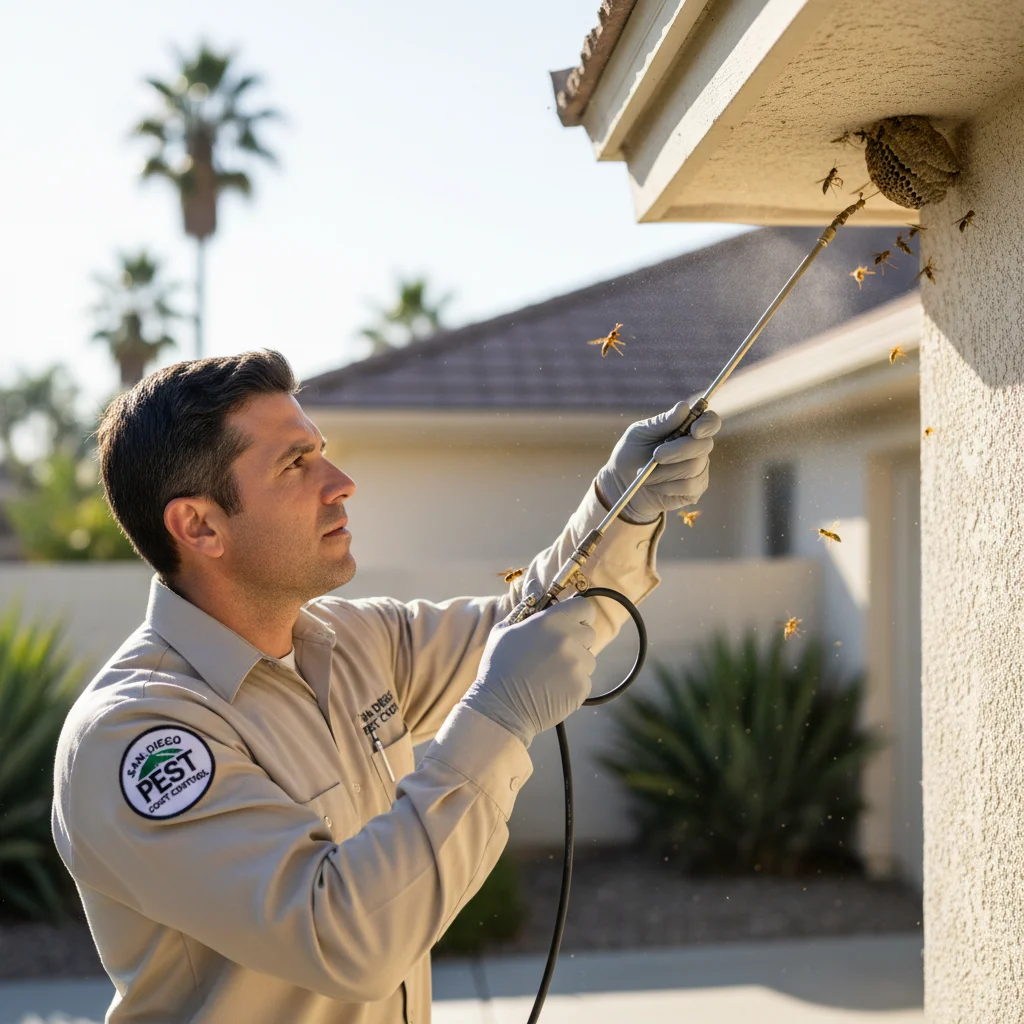
A licensed company can inspect, identify, and propose a labeled method. That is not a guaranteed outcome. Pest Pros matches you with a registered company for wasp and bee removal. The treating company owns the method, the label, and any follow-up terms.
Ask what insect they think it is, and what they saw. Ask whether traffic is on an open comb, into soil, or into a wall. Ask how they will reach a high nest. Ask for the product name and labeled use if a pesticide will be used, plus people, pet, and re-entry instructions from that label. Ask whether nest material will be removed after activity stops. If you want a sense of pricing factors first, here’s what wasp nest removal in San Diego costs and how it works.
You can verify a pest control operator’s license on the California Structural Pest Control Board website. Pesticide work on household pests is Branch 2. Live capture of wasps without pesticides is treated separately under Business and Professions Code section 8555(g).
The dangers of aggressive wasp species
While any wasp sting is painful, the behavior of social wasps like yellowjackets and paper wasps poses a significant health risk. Unlike honeybees, which can only sting once, wasps can sting repeatedly.
When a yellowjacket or paper wasp feels its colony is threatened, other wasps at the nest can join a defensive attack. This is why a single person attempting to knock down a nest can suddenly find themselves under attack by many wasps at once. Multiple stings can lead to severe pain, swelling, and in some cases, a toxic reaction, even in people who aren’t allergic.
UC IPM notes that yellowjackets commonly scavenge around picnic areas and outdoor food. Their scavenging nature brings them into frequent contact with people, increasing the chance of negative encounters. This defensive swarming is why an established nest on a route people use, or a nest you cannot identify from the ground, is a licensed visit rather than a spray can. While dealing with other dangerous pests in your yard, like those discussed in our black widow control guide, requires caution, the swarming behavior of wasps presents a unique and immediate danger.
Prevention: how to make your yard less attractive to wasps
After a nest has been removed, the last thing you want is for a new one to appear next season. Taking a few proactive steps can make your property a less inviting place for queen wasps looking to build a new home in the spring.
Start by inspecting the exterior of your house. Use caulk to seal any small cracks or holes in your siding, around utility entry points, and along the roofline. Repair any damaged window screens or vents. Wasps, especially yellowjackets, are opportunistic and will happily build a nest in a protected wall void.
Manage your outdoor sanitation. Keep trash cans and recycling bins tightly sealed and located away from doorways. If you have fruit trees, be sure to clean up any fallen fruit promptly, as the sugars attract foraging wasps. Avoid leaving pet food or sugary drinks unattended outside for long periods.
Do not hose eaves or porch ceilings to knock down or test a nest. Water and vibration are how people find out a nest was active. Seal gaps and manage trash instead, then leave nest decisions to a licensed look. These sanitation steps are part of a good general pest control plan.
Frequently asked questions
When should I call a wasp exterminator instead of handling it myself?
Call when the nest is hidden in a wall or the ground, sits on a doorway or daily path, needs a ladder, or anyone has a sting allergy. Size in inches is not the test.
Can I just spray the nest with a store-bought can?
It’s the most common way people get stung. Yellow jackets respond to disturbance in numbers, and an underground or wall-void nest can’t be reached from the entrance. If you already have a consumer product, the label is the only application instruction that counts.
How do I know if it’s yellow jackets, wasps, or bees?
Yellow jackets are bright yellow and black, fast, and often nest underground or in wall voids. Paper wasps build the open umbrella-shaped nest under eaves. Honey bees are fuzzier, browner, and cluster in numbers. Species decides the approach. Honey bees are a live-removal or licensed pesticide question, not an automatic relocation.
How long until the nest is inactive after treatment?
There is no honest universal clock. Ask the company what the label and their written plan say about when the site can be approached, and whether they will remove nest material. Do not disturb a recently treated nest to check.
When to call us
If you see a nest that is hidden, hard to reach, on a daily route, or you suspect yellowjackets, don’t risk your safety. Pest Pros San Diego matches you with a licensed local company that can identify what it can see and explain any product by its label. We do not prioritize jobs or promise a timeline.
Call us at (858) 400-6561 to get matched with a licensed local pro.