
Keep your distance from the bees and don’t disturb the cluster. Bring children and pets inside until the area is clear. Watch from a protected location for steady traffic into one opening. Call a licensed San Diego bee removal company for bees entering a structure. Also call if the cluster stays put or the bees act aggressively.
Swarm, hive, or aggressive bees: telling them apart
Discovering bees on your property requires careful observation to determine the best course of action. Start by noting whether you see a resting swarm, an established hive, or aggressive behavior.
- Bee Swarm: A swarm typically appears as a large, temporary cluster of bees, often clinging to a tree branch, fence post, or even a vehicle. These bees are in transit, having recently left an old hive to find a new permanent home. Despite their daunting appearance, swarms are generally docile because they aren’t protecting a hive, honey, or brood. They simply rest while scout bees search for a suitable new location. A swarm usually moves on its own within a few hours to a few days. The safest approach is to maintain a respectful distance and avoid disturbing them. A swarm pickup is a different job from removing an established colony in a wall or roof. Do not assume a swarm call is free, or that the same person who collects a hanging cluster will open a structure.
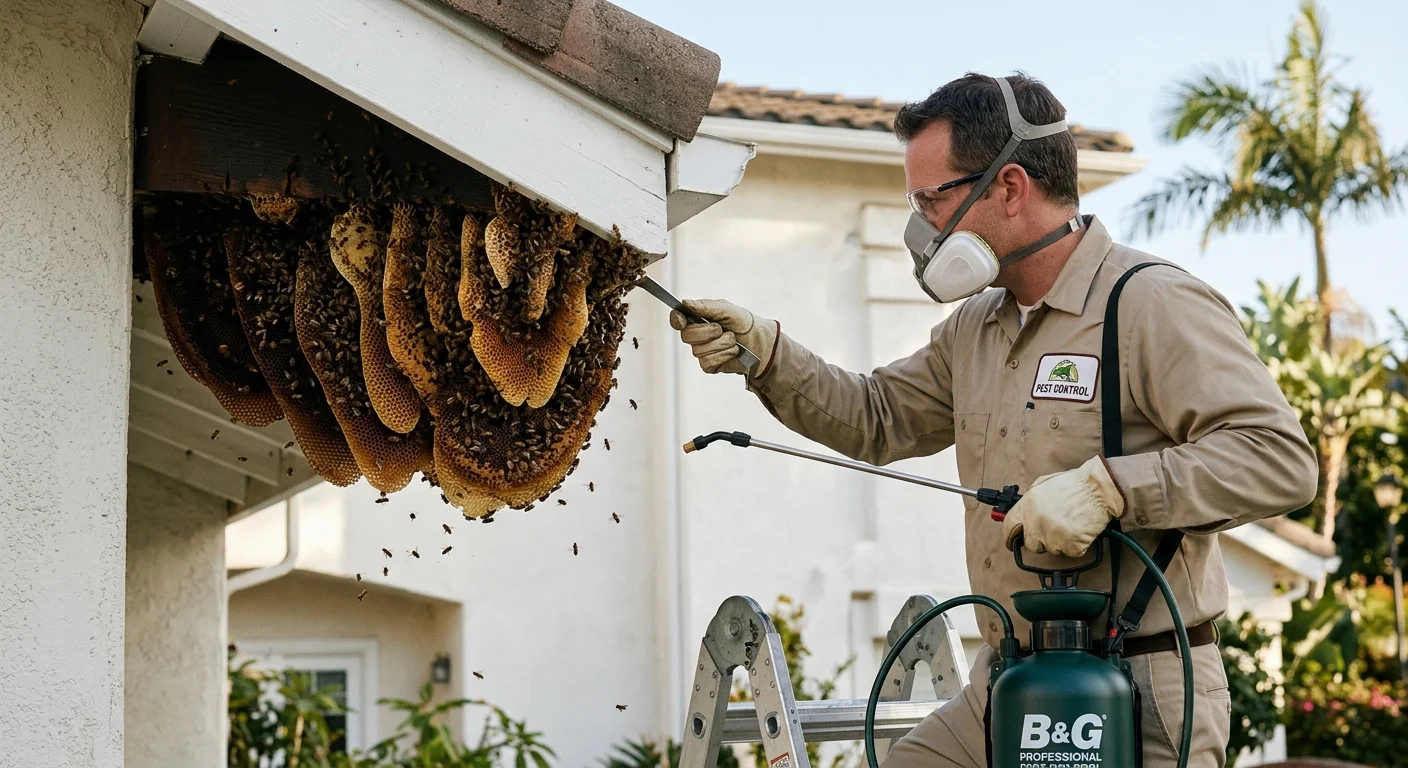
- Established Hive: An established hive signifies a permanent colony with visible honeycomb, filled with honey, pollen, and developing young. You’ll notice consistent, focused bee traffic entering and exiting a specific opening on your property, this could be a gap in a wall, a vent, under eaves, or within an irrigation box. Unlike swarms, bees defending an established hive are highly protective of their queen and resources, making them much more likely to sting if threatened. Indicators of an active hive include buzzing sounds emanating from within structures, new sticky residue from melting honey on exterior walls, or a concentrated, routine presence of bees at a single entry point. An established colony in a structure is a live-removal and cleanup question, not a wait-and-see swarm. The County of San Diego cannot remove feral honey bees from private property and does not recommend that you try to remove them yourself.
- Aggressive (Africanized) Bees: These bees are often called “killer bees” in popular writing. They are not genetically identical to European honey bees. University of Florida IFAS describes African and European honey bees as the same species, Apis mellifera, classified as different subspecies, with Africanized bees as hybrids; they look so similar that it is nearly impossible to tell them apart without measurements or laboratory testing. USDA ARS photo records make the same practical point: they normally can’t be identified by eye. Behavior is the field signal. UF/IFAS reports that a European colony may send out 10 to 20 guard bees in response to a disturbance up to 20 feet away, and usually calms within one to two hours. An Africanized colony may send out several hundred guard bees in response to a disturbance up to 120 feet away, pursues for a longer distance, and may stay defensive for days. The County advises avoiding excessive motion near a colony, since bees respond to an object in motion more than a stationary one, and not running mowers, line trimmers, or chain saws near a nest. San Diego County treats the entire county as colonized by Africanized honey bees, so defensive activity can show up from desert to coast. If bees are actively chasing or stinging without clear provocation, get to enclosed shelter. The County says to call 911 if you are attacked. For a persistent colony on private property, contacting Pest Pros San Diego for wasp and bee removal services is a way to get matched with a company that can look at the site.
Why you should not remove a hive yourself
Attempting to remove a bee hive or an aggressive swarm on your own might seem like a way to save money, but it carries substantial risks and can lead to more significant, costly problems down the line. The primary concern is personal safety. Bee stings are painful, and for individuals with bee venom allergies, even a single sting can trigger a severe, life-threatening anaphylactic shock requiring immediate medical intervention. Even without allergies, confronting a large colony, particularly if it’s Africanized, can result in numerous stings that could warrant emergency care. Most DIY attempts lack the necessary specialized protective gear, leaving you exposed to hundreds, or even thousands, of defensive bees.
Beyond the immediate danger to yourself, improper bee removal can cause extensive damage to your property. Bees frequently build hives in difficult-to-reach locations like wall voids, attics, chimneys, or beneath floorboards. Without the proper tools and expertise, attempting to extract a hive can result in significant damage to drywall, insulation, electrical wiring, or even structural components of your home. A partial or incomplete removal, where dead bees, honey, and wax are left behind, creates a host of secondary issues. Residual honey can melt and seep into building materials, leading to unsightly stains, persistent foul odors, and attracting other pests like ants, cockroaches, and rodents. This can also lead to mold growth and wood rot, with expensive repairs that far outweigh the cost of professional bee removal.
A referral service like Pest Pros San Diego matches you with pros who can assess bee biology, access, and the license that actually covers the work. Always verify a California Structural Pest Control Board license when pesticides will be used, at pestboard.ca.gov. Live capture without pesticides follows different rules, described below.
Swarm pickup, colony work, pesticides, and repair
These are separate tasks. Mixing them is how homeowners get the wrong company, or a quote that doesn’t cover comb, honey, or the hole in the wall.
- Emergency safety. If bees are stinging or chasing people, the first job is getting people and pets indoors or into a vehicle. County guidance is to call 911 during an attack. That is not a removal appointment.
- Temporary swarm pickup. A cluster hanging in the open, with no comb, may leave on its own. A beekeeper or live-removal company may collect it. That visit does not include opening a wall, removing comb, or rebuilding finishes. Do not treat a swarm flyer as a structural-colony bid.
- Established colony removal. Steady traffic into a vent, irrigation box, chimney, or wall void means comb is likely present. Ask whether the company will remove live bees, comb, and honey, or only treat insects and leave material behind.
- Pesticide work. If a company will apply a pesticide, California structural pest licensing applies. The Structural Pest Control Board defines Branch 2 as household-pest control excluding fumigation with poisonous gases. Confirm the Branch 2 company registration and the individual license before any pesticide is used.
- Live capture without pesticides. California Business and Professions Code section 8555(g) says the structural pest control chapter does not apply to persons engaged only in the live capture and removal or exclusion of bees or wasps from a structure without pesticides, if they maintain the insurance described in section 8692. That exemption is not a pesticide license, and it is not a construction license.
- Structural repair. Cutting into stucco, drywall, or framing, then closing the opening, is repair work. The Contractors State License Board states that only a Branch 3 structural pest control operator may contract and pull permits for repair or replacement of wood damaged by wood-destroying pests, and is not required to hold a contractor license when operating inside that pest-control scope. Bee comb in a wall is not automatically wood-destroying-organism damage. Ask which license covers the opening and rebuild on your job, and get that scope in writing.
Relocation of a honey bee colony is a company-by-company decision after they see access, species behavior, and whether comb can be removed intact. It is not the default, and Pest Pros San Diego does not promise that bees will be moved, killed, or saved. Wasps, yellow jackets, and similar social wasps are a different identification problem; see when to call a wasp exterminator in San Diego and wasp nest removal in San Diego. The licensed company we match you with assesses the site and identifies the insect. It then recommends an approach for that situation.
How San Diego’s climate affects bee activity
San Diego County’s mild weather keeps bees active across much of the year. The County of San Diego says bees are most active in the spring and fall, and tells residents to be especially careful during those times. A warm stretch outside those months can still put a cluster on a branch or a vent, so judge what you see rather than the calendar.
Bees nest in cavities. The County lists holes in the ground, crevices in rocks, hollow trees, discarded tires, and water meter boxes, and says homeowners commonly run into colonies while doing yard work. Around a house the same logic points at attics, wall voids, chimneys, vents, and irrigation boxes. To avoid walking up on one, listen for the steady buzz of a colony and watch for flying insects before you climb a tree, kick over a log, or roll a rock.
The County treats the whole county, desert to coast, as colonized by Africanized honey bees, so a cavity anywhere in the region can hold a defensive colony. If you do find one, don’t stand in front of the entrance or in the flight path, and move away slowly rather than swatting. Steady two-way traffic into one opening is the sign that matters; a few bees at a pool edge or a pet bowl is not a hive.
Frequently asked questions
Will you kill the honey bees?
Pest Pros San Diego does not treat bees. The matched company decides, after seeing the site, whether live removal without pesticides is feasible, whether pesticides will be used, and what happens to comb. Relocation is not automatic. Wasps and yellow jackets are a different insect and a different job.
What’s the difference between a swarm and an established hive?
A swarm is a cluster of bees resting in the open, often on a branch or wall, while scouts look for a permanent home. It may move on within a day or two on its own. An established hive means comb has been built, usually inside a structure such as a wall void, chimney, or vent, and that needs colony removal and cleanup rather than waiting out.
How do I know if they’re Africanized bees?
You generally can’t tell by looking. University of Florida IFAS and USDA ARS both treat visual ID as unreliable for a lay observer. Behavior is the practical signal. UF/IFAS describes an Africanized colony sending out several hundred guard bees rather than 10 to 20, reacting to a disturbance as far off as 120 feet, pursuing for a longer distance, and staying defensive for days instead of calming within an hour or two. Treat any highly defensive colony as one to stay away from and call about.
Is it safe to spray a hive myself?
No. Spraying an established colony provokes defensive behavior without reliably ending the problem, and stings scale badly if the colony is defensive or if anyone present is allergic. Bees inside a wall also leave comb and honey behind, which draws other pests and can stain and damage the structure if it isn’t removed properly. Pesticide application on a structure is licensed Branch 2 work when it is structural pest control.
When to call us
Dealing with bees, especially an established hive or an aggressive swarm, is not a task for the untrained. People’s safety comes first. When you notice a persistent bee presence, an active hive, or any signs of aggressive behavior, it’s time to get a licensed look at the site. Pest Pros San Diego connects you with bee and wasp removal companies throughout San Diego County. The matched company assesses access, identifies the insect as far as a field visit allows, and tells you whether the work is swarm pickup, live colony removal, pesticide application, comb cleanup, structural repair, or some combination.
Call us at (858) 400-6561 to get matched with a licensed local pro.