
UC IPM groups California’s pest social wasps as yellowjackets (Vespula and Dolichovespula) and paper wasps, not as a separate Vespa hornet problem. What many people call a hornet nest is often an enclosed aerial yellowjacket nest, including the white-banded species Dolichovespula maculata. The nest shape and location are the fastest field clues. Pest Pros San Diego does not remove nests. A licensed company inspects and quotes that work.
Why “hornet” is a confusing word here
UC IPM’s yellowjackets and other social wasps note describes the western yellowjacket and related Vespula species, plus aerial-nesting Dolichovespula species, as the yellowjackets people run into in the West. D. maculata is the white-banded aerial nester often called a bald-faced hornet. That name is common English, not a separate genus. UC IPM does not treat Vespa true hornets as California’s household wasp problem. If someone says they found a hornet nest, start with nest form: open cells, enclosed hanging paper, or insects flying in and out of a hole you cannot see into.
The three nests you’re actually choosing between
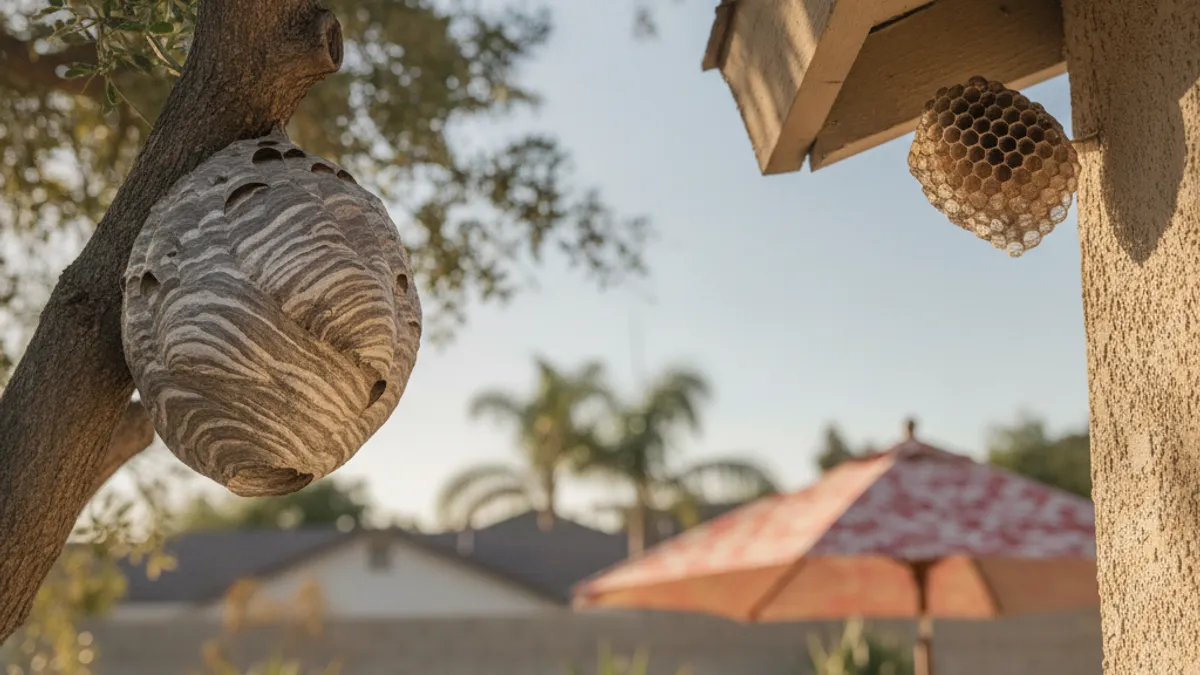
Aerial yellowjacket nest, including D. maculata: UC IPM says aerial-nesting yellowjackets D. arenaria and D. maculata build paper nests attached to eaves or hanging from a tree limb, with the entrance normally a hole at the bottom. Ground- and cavity-nesting yellowjackets use a gray paper envelope with a single entrance, often in a rodent burrow or a wall void. Aerial nesters are extremely defensive when the nest is disturbed. Wasp stingers have no barbs and can be used repeatedly.
Paper wasp nest: UC IPM describes an open umbrella hanging from a pedicel, with open cells visible from below. Nests rarely exceed the size of an outstretched hand, with about 15 to 200 wasps. Most species are relatively unaggressive unless the nest sits over a doorway or other traffic. Paper wasp nests shouldn’t require treatment unless they are near people.
Hidden yellowjacket entrance: Wasps flying from a hole in the ground or a building indicate a probable nest. UC IPM notes that subterranean or cavity nests are often impractical to remove because they are underground or otherwise inaccessible. Defensive behavior increases later in the season as colonies grow and food gets scarcer.
| Trait | Aerial yellowjacket (Dolichovespula, including D. maculata) | Paper wasp | Ground or cavity yellowjacket (Vespula) |
|---|---|---|---|
| Nest shape | Enclosed paper envelope; entrance usually at the bottom | Open umbrella, cells visible from below | Enclosed; nest often out of sight |
| Typical location | Eaves or a tree limb | Eaves, attics, tree branches, or vines | Rodent burrows, wall or ceiling voids |
| Nest size | Enclosed hanging paper nest; size varies | Rarely larger than an outstretched hand | Colony size varies by species; some become quite large |
| Defense | Extremely defensive if the nest is disturbed | Lower unless the nest is near people | Vigorous nest defense, stronger later in the season |
| Color | D. maculata has white (not yellow) abdominal bands | Varies by species | Jagged yellow and black stripes on many Vespula |
Why the location of the nest is your fastest clue
If you can see individual hexagonal cells from below with no outer covering, UC IPM’s paper wasp nest is the match. If it is a hanging enclosed paper nest with a hole at the bottom, that is an aerial yellowjacket nest. If you cannot find a visible nest but insects fly in and out of one hole in the ground, siding, or brick, treat that as a probable yellowjacket nest you should not probe.
Why this identification actually matters
Each of these three changes what you should not do next. UC IPM says the safest way to eliminate a nest, when it must go, is professional help, and that paper wasp nests often do not need treatment unless they sit near people. Aerial yellowjackets defend the nest hard. A hidden ground or wall nest is easy to disturb with a mower or a foot because you never see the comb.
Our wasp nest removal guide covers what to ask once nest type is confirmed. When to call a wasp exterminator in San Diego is the decision page. If the colony is honey bees, that is a different insect; see bee removal. Pest Pros San Diego matches you with a licensed company. That company inspects, decides whether treatment is needed, and quotes in writing.
Frequently asked questions
Are there real hornets in San Diego?
UC IPM’s California pest notes on this topic cover yellowjackets and paper wasps. D. maculata is a yellowjacket with white bands that people often call a bald-faced hornet. That is a common name, not proof that Vespa hornets nest on the property.
Which is more dangerous, a wasp nest or a hornet nest?
Aerial yellowjackets and many Vespula yellowjackets defend nests more vigorously than paper wasps, which UC IPM describes as much less defensive and rarely stinging unless the nest is near activity. A hidden nest is easy to walk into because the comb is out of sight.
How can I tell if a hidden nest is yellow jackets without seeing it?
Watch the flight pattern. A steady line of insects flying in and out of a single hole in the ground, a gap in siding, or a weep hole in brick, especially with increased traffic in late summer, is the classic sign of a yellow jacket colony even when the nest itself stays completely out of sight.
Can I remove a baldfaced hornet nest myself?
It’s riskier than a small paper wasp nest that is not near people. UC IPM says if wasp nests must be eliminated, it is easiest and safest to call for professional help. Pest Pros San Diego does not do that work. Ask the matched company what it proposes after it sees the nest. Our wasp and bee removal page explains how a referral request works in the San Diego County service area.
If you’ve found a nest and aren’t sure which form it is, call (858) 400-6561 to get matched with a licensed local pro. The company inspects first and quotes in writing. We do not give a removal estimate on the phone.