
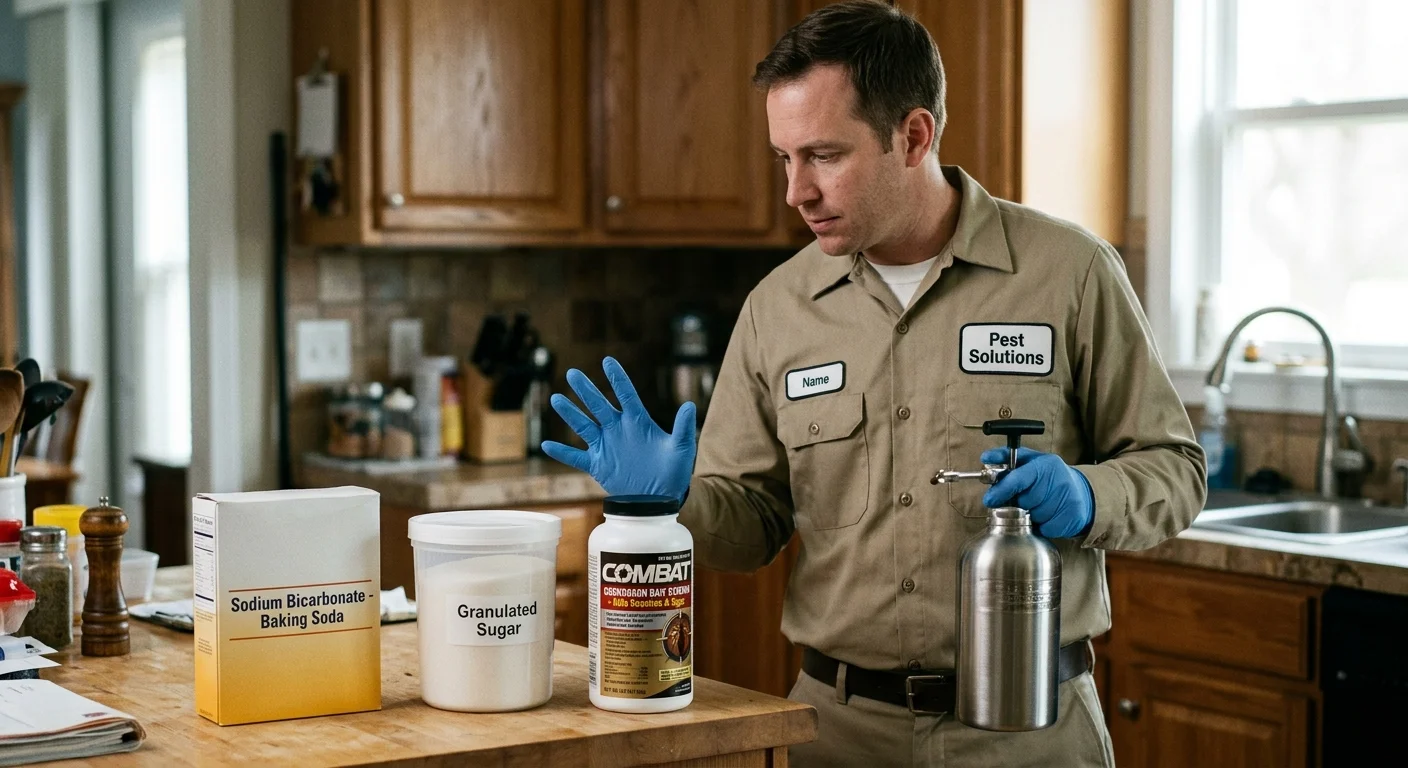
People already have both boxes in a San Diego kitchen. That search for baking soda and sugar for roaches starts after one insect crosses the kickplate at night. The mix still cannot name the species, reach the harborage, or prove the unit is clear.
What homemade mixtures cannot establish
A homemade mix cannot identify what is living in the unit. It cannot map harborages behind the stove, inside a dishwasher kickspace, or in a shared plumbing chase. It cannot confirm that every insect that tasted sugar is gone. You only see the ones that walk into the open.
Baking soda is a kitchen ingredient. Sugar is food. Neither is a registered insecticide for roaches. There is no pest-control label for that combination. No mix rate, no indoor site, no re-treatment interval, and no child-and-pet precaution printed for this use. Without a label, there is also no verified kill time. People ask how long baking soda takes to kill roaches. UC IPM Pest Notes: Cockroaches, Publication 7467, does not list baking soda as a control method. It does not publish a wait time for it. That figure could not be confirmed from the primary source this page uses.
Fewer insects on the floor after a few nights still proves little. German cockroaches hide in warm, dark spots close to food and water. UC IPM points to kitchens, bathrooms, and other food-prep areas. The ones you notice at night are a fraction of the population. A pile in a dish only meets insects that walk up to it. It does not inspect cardboard under a City Heights sink. It does not reach the gap where a range meets the counter in an older Chula Vista kitchen.
The mix also cannot show that the rest of the building is clean. UC IPM flags multi-unit housing as a common setting for German cockroaches in California. Shared walls and pipe voids can keep feeding your kitchen.
People also ask for the best homemade roach killer. There is no verified homemade recipe in the sources this page can use. UC IPM’s cockroach guidance is sanitation, exclusion, monitoring, and labeled products used as a supplement. For the limits of store sprays, read whether roach killer works in San Diego homes. For another powder people treat like a standalone fix, read diatomaceous earth and what the label will not cover. Cleaning still matters. Crumbs, pet food left out, and standing water give cockroaches a reason to stay. Sanitation is part of control. It is not proof an infestation is gone.
Why cockroach species and hiding places still matter
San Diego County is not one kitchen. A German cockroach in a National City apartment is a different job than an outdoor species walking into an East County garage after a warm night. Pantry ingredients treat every sighting as the same insect.
UC IPM names the German cockroach (Blattella germanica) as the most common indoor species in California, and perhaps worldwide, especially in multi-unit housing. Adults are about 0.5 inches long and light brown, with two dark stripes on the pronotum, the shield behind the head. They thrive in warm rooms around 70° to 75°F, with humidity, food, water, and dark harborage. That describes year-round San Diego interiors: tight condos near the bay, older courts in Logan Heights, and apartments where bathrooms stay damp under the marine layer.
An Encinitas condo and an El Cajon kitchen can both hold German cockroaches for the same reason. Indoor heat, indoor food, and indoor water do not follow the coastline. What does change is the building. South Bay and central-city multi-unit stock shares plumbing chases and wall voids. A detached inland house may still pick up wanderers from the yard, the garage, or a floor drain. Species and harborage still have to be read on site.
Reproduction is why a kitchen mix does not keep up. UC IPM states that a German cockroach egg case incubates about 30 days. A case holds about 30 young. This species has the fastest reproductive cycle of the common pest cockroaches. One female and her offspring can produce over 30,000 individuals in a year. Those figures are from UC Statewide IPM Program, Pest Notes 7467.
Other species show up here too. Identification still comes first. Start with our cockroach types in San Diego guide when you are looking at size, color, and where the insect was found. A large roach near a floor drain is a different problem than a German cockroach in a toaster. Baking soda and sugar do not make that distinction.
Hiding places decide whether any product ever contacts the insect. Indoor harborages sit behind refrigerators, under dishwashers, inside cabinet hinges, around pipe penetrations, and in wall voids. In stacked housing, those voids connect. UC IPM is direct: pesticides alone will not solve cockroach problems. Sanitation, sealing, and monitoring have to travel with any chemical work.
Nothing in a mixing bowl is a forever fix. That is the honest answer to what gets rid of roaches permanently. German cockroaches return when food, water, and harborages stay in place, and when a neighboring unit is untreated. A licensed company writes a plan after it sees the structure. Follow-up belongs to that company, in writing. We do not set that schedule.
How registered labels differ from kitchen ingredients
An insecticide for roaches is a product with an EPA registration and a label. The label names the pests, the indoor sites, and the precautions. The EPA’s consumer pesticide-safety pages exist for that reason. Baking soda and sugar have grocery labels. They do not have pest-control directions.
That gap matters when people ask whether boric acid or baking soda kills roaches faster. UC IPM names boric acid as the most common active ingredient used against cockroaches in insecticidal dusts. It also says gel baits are very effective when placed in or near where cockroaches harbor or forage. It may take 7 days or longer before you see fewer cockroaches after baiting. Those statements are about labeled insecticidal products inside an integrated plan. They are not a speed contest with a kitchen mix. They are not directions for you to mix anything at home.
If a product is an insecticide, the person applying it follows that product’s label. If the job is structural pest control in California, the company doing the work needs the right Structural Pest Control Board credential. General household pests, including cockroaches, fall under Branch 2. You can confirm a company on the California Structural Pest Control Board license search.
Kitchen ingredients also do not carry the same child and pet instructions as a registered insecticide. That is not a claim that baking soda is harmless in every use. It is not a claim that it is toxic. The point is narrower. A homemade mix is not a labeled control method, so it does not print the precautions a registered insecticide for roaches is required to carry. Keep food as food. Keep insecticides in their original containers, used only as the label allows.
UC IPM’s cockroach guidance is the public science to read before any cupboard experiment. The page on cockroach control in San Diego walks through how a licensed plan is built around identification, sanitation, and monitoring, not a single powder.
When a licensed cockroach inspection should come first
An inspection should come first when you see cockroaches in the light, find droppings in cabinet corners, or spot egg cases in a kitchen or bathroom. Daytime movement often means the hiding spots are already crowded. In a condo or apartment, assume the problem may not stop at your walls.
It should also come first when pantry mixes have not changed the sightings. Delay works against you in a German cockroach kitchen because of the reproductive rate UC IPM documents. A licensed Branch 2 company looks for harborage, moisture, food, and the species in front of them. The pros we match can set monitors and explain what a gel bait or a labeled dust is for. They can also tell you what sanitation you still have to do.
Pest Pros San Diego does not spray, dust, or bait. We match you with licensed, insured local pest control companies that hold the appropriate California credentials for the work. The company you are matched with inspects first and quotes in writing before any treatment begins. Cockroach control is the service page for that match when the job is roaches.
Roach infestation control in this county is a structure problem as much as an insect problem. Older South Bay stucco, mid-century Clairemont kitchens, and downtown apartments fail in different places: pipe gaps, appliance voids, shared laundry rooms, dumpsters in the alley. A licensed inspector names those places. A sugar mix does not.
If kids or pets use the kitchen, say so when you book. The matched company chooses products and placements that fit the label and the household. That decision is theirs, on paper, after they see the rooms.
When to call us
When cockroaches keep showing up in a San Diego kitchen or bathroom, a licensed inspection should come before another pantry experiment. We match you with licensed, insured local companies that can identify the species and write a plan. Call us at (858) 400-6561 and we’ll match you with a licensed local pro.