
Yes. San Diego County’s Vector Control Program names two common local tick species in its tick guide: the western blacklegged tick, which can spread Lyme disease, and the Pacific Coast tick, which can spread tularemia and spotted fevers. The county also says those diseases are rare in San Diego County. A third tick, the brown dog tick, arrives with dogs and can complete its whole life cycle indoors.
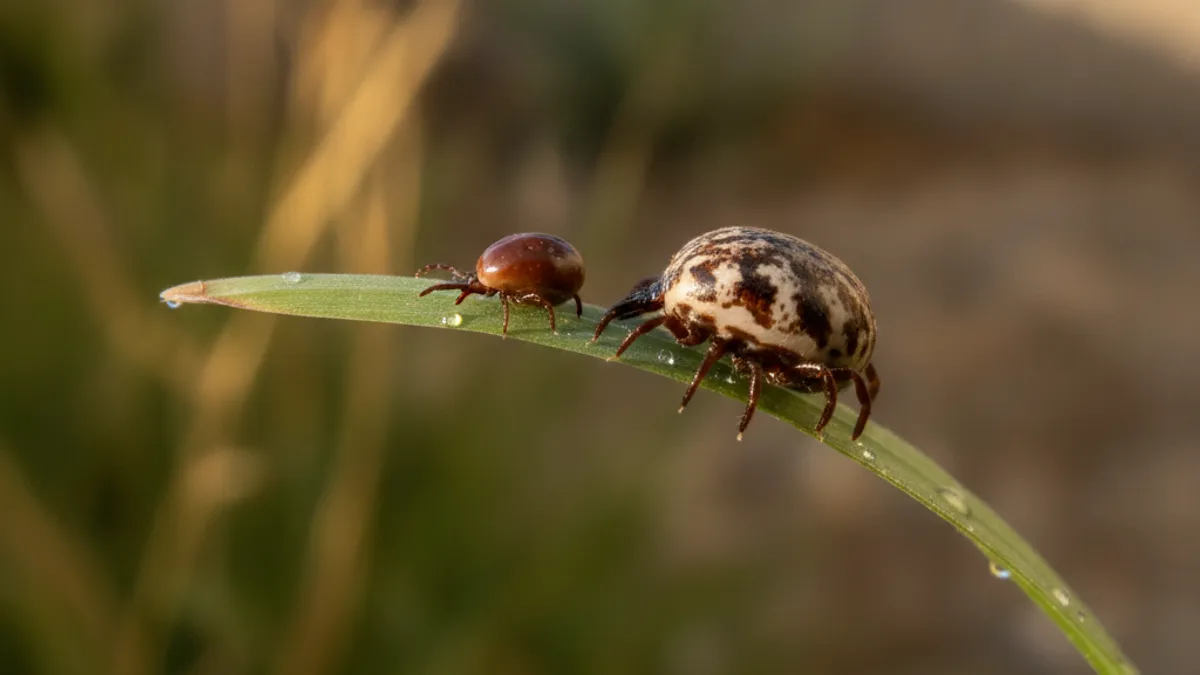
Knowing which species you are dealing with, where you are likely to pick one up, and how to remove it correctly are the practical things that matter. This guide covers all three.
The three tick species you will actually encounter in San Diego
The county’s tick page lists the western blacklegged tick and the Pacific Coast tick as common types you might find here. The brown dog tick is the one that turns up indoors, because it is the tick that can finish its entire life cycle inside a house.
| Species | Where it is found | What it can spread | Notes |
|---|---|---|---|
| Western blacklegged tick (Ixodes pacificus) | Nymphs in leaf litter and on rocks, logs and fallen branches in oak woodlands and other shaded natural areas; adults on the tips of tall grasses and shrubs, often along trails | Lyme disease | Nymphs are about the size of a poppy seed. Nymphs are more active in spring and early summer; adults from fall through early spring |
| Pacific Coast tick (Dermacentor occidentalis) | Grassy and brushy areas and plants that line trails, per the county’s general tick guidance | Tularemia and spotted fevers | The county posts positive pathogen results from ticks it collects along county hiking trails |
| Brown dog tick (Rhipicephalus sanguineus) | On dogs, in kennels and in houses, and occasionally on wildlife | Canine ehrlichiosis and canine babesiosis; these rarely cause disease in people | Unusual among ticks in that it can complete its entire life cycle both indoors and outdoors. It will bite humans, though that is uncommon in the US |
The western blacklegged tick gets the most attention because it is one of the two US ticks that can transmit Lyme disease, and the one found in California. It is also easy to miss: nymphs are about the size of a poppy seed, which is exactly why they pose a greater risk, since they may not be noticed and removed promptly.
Brown dog tick infestations usually start with a few ticks brought inside on a dog that has been away from home. The first sign an owner often gets is ticks crawling up the walls or on the curtains.
Where you are most likely to pick up a tick in San Diego
Ticks do not jump or fly. When a potential host passes by, the ticks climb onto them. That is why where you walk matters more than what you do.
Trails and brushy ground. The county says ticks are common in grassy, brushy areas and on plants that line trails, and its advice is to stay on trails and keep pets leashed and on the trail while hiking. The CDC’s version is the same idea: avoid wooded and brushy areas with high grass and leaf litter, and walk in the center of trails.
Across the county, not just the backcountry. The Vector Control Program routinely collects ticks along hiking trails throughout the county, batches them, and tests them for disease-causing pathogens. Between January 8 and July 14, 2026, it posted 38 positive results, every one of them Pacific Coast tick fever, in communities including San Diego, Escondido, Poway, Ramona, San Marcos, Alpine, Lakeside, Santa Ysabel, Descanso, La Jolla, Julian, Palomar Mountain and San Clemente.
Your own yard. The CDC notes that many people get ticks in their own yard or neighborhood, so a tick check after yard work counts.
Your dog. Ticks can ride into the home on clothing and pets, then attach to a person later. For the brown dog tick specifically, likely places a dog picks one up include grooming facilities, kennels, veterinary clinics and already-infested residences.
Lyme disease risk in San Diego: the honest answer
An infected western blacklegged tick must be attached to a person and feed for at least 24 hours before it can transmit the bacteria that cause Lyme disease, so removing any attached tick as soon as possible can prevent transmission. Only nymphs and adult female blacklegged ticks can transmit the bacteria.
The county’s own framing is that tularemia, Lyme disease and spotted fevers are rare in San Diego County. The state health department lists the higher-risk parts of California as the northern coastal region, the northern foothills of the Sierra Nevada, and the San Francisco Bay Area and Central Coast. It also notes that about 1 in 3 Lyme disease cases in California are in people who were infected while traveling outside the state.
Rare is not never. The protective steps that the county and CDC both give are to stay on trails, use an EPA-registered repellent, check your whole body after being outdoors, and remove any attached tick right away.
How to remove a tick safely
- Use clean, fine-tipped tweezers to grasp the tick as close to your skin as possible.
- Pull the tick upward using a firm, steady motion. Do not twist, squish or burn an attached tick. That can cause the mouthparts to break off and stay in the skin. If it happens, remove the mouthparts with tweezers.
- After removing the tick, thoroughly clean the bite area and your hands with soap and water or rubbing alcohol.
- Never crush a tick with your fingers. Dispose of a live tick by putting it in alcohol, placing it in a sealed bag or container, wrapping it tightly in tape, or flushing it down the toilet.
- You may want to save the tick or take a picture for identification. The county’s Vector Control Program does not test ticks that have bitten people, but it can help identify ticks you have found on yourself or your pet. Its number is 858-694-2888.
Do not use petroleum jelly, heat, nail polish, or other substances to try to make the tick detach. The CDC’s reason is specific: this may agitate the tick and force infected fluid from the tick into the skin.
If you develop a rash or fever within several days to weeks after removing a tick, see your doctor.
Preventing tick bites on your body and in your yard
On the trail or in the field:
- Wear long-sleeved shirts and long pants to cover your skin.
- Wear light-colored clothing that will help you spot ticks crawling on you.
- Use an EPA-registered insect repellent containing DEET, picaridin, IR3535, oil of lemon eucalyptus (OLE) or para-menthane-diol (PMD), applied to clothing and exposed skin. In areas with a lot of ticks, consider clothing pre-treated with 0.5% permethrin, which will kill or repel ticks. Never apply permethrin to skin.
- Walk in the center of trails and keep pets leashed and on the trail.
- Take a shower within 2 hours after returning indoors, and do a full body check. Check behind the knees, under the arms, and in the hairline, belt line and groin area.
- Putting your clothing in a hot dryer for 10 minutes can help kill any ticks on your clothing.
For your dog:
- Talk to your veterinarian about flea and tick prevention for your pets.
- Check your dog when it comes back from kennels, groomers, dog parks or other places dogs gather.
- The preferred attachment sites on a dog are the head, ears, back, between the toes, and the area directly under the joint where the legs connect to the body.
In your yard:
- Mow the lawn frequently and remove leaf litter.
- Clear tall grasses and brush around the home and at the edge of lawns.
- Place a 3-foot wide barrier of wood chips or gravel between lawns and wooded areas to restrict tick migration into recreational areas.
- Pesticides can reduce the number of ticks in treated areas of a yard. The CDC’s caution is worth repeating: do not rely on spraying to reduce your risk of infection.
The flea and tick treatment we match you with is outdoor pesticide work of exactly that kind, which means it belongs alongside the habitat steps above rather than instead of them. If you are also dealing with fleas, our guide to flea treatment in San Diego covers how the two pests overlap.
Tick control in San Diego, CA: when to call a pro
For a brown dog tick problem indoors, the UF/IFAS guidance is direct: once an infestation has started, thorough treatment of the infested areas by a professional pest control operator is critical, repeated treatment may be needed, and in heavily infested residences or kennels it is recommended that a professional be hired.
For the yard, the honest version is that a pesticide application is one layer. Sealing cracks and crevices, keeping grass and weeds short, and washing and drying dog bedding on high heat are the steps the sources put alongside it.
Pest Pros San Diego doesn’t spray anything. We match the job to a licensed local company and stay out of the way.
For full San Diego County coverage, see our pest control services in San Diego page or call us at (858) 400-6561 and we’ll match you with a licensed local pro.
Frequently asked questions
Are there ticks in San Diego?
Yes. San Diego County’s Vector Control Program lists the western blacklegged tick and the Pacific Coast tick as common types you might find here, and the brown dog tick lives with dogs and can complete its life cycle indoors. The county says tularemia, Lyme disease and spotted fevers are rare in San Diego County, and it collects and tests ticks from county hiking trails year round.
Is there an exterminator for ticks in San Diego?
Yes, and it is usually booked alongside flea work. Ask the company what it proposes for the yard and what it proposes indoors, because those are different jobs. For an indoor brown dog tick infestation, UF/IFAS recommends hiring a professional pest control operator and notes that repeated treatment may be needed. Pest Pros San Diego performs no treatments; we match you with a licensed local company.
What ticks carry Lyme disease in California?
The western blacklegged tick (Ixodes pacificus) is the tick found in California that can transmit Lyme disease. Only its nymphs and adult females can pass on the bacteria. Nymphs are more active in spring and early summer, adults from fall through early spring, and the state puts California’s overall risk highest from late fall through early summer.
How do I know if a tick bit me in San Diego?
Ticks attached to the skin can be tiny, so it may not be easy to tell if a bump on the skin is a tick. Early Lyme disease signs appear 3 to 30 days after a tick bite and include fever, chills, headache, fatigue, muscle and joint pain, swollen lymph nodes, and a rash that expands over time, sometimes with a central clearing giving a bullseye appearance. Not everyone who has Lyme disease gets a rash. Anyone concerned about Lyme disease should talk to a healthcare provider and mention recent outdoor activity or a tick bite.
What is the best way to remove a tick?
Use clean, fine-tipped tweezers to grasp the tick as close to your skin as possible, then pull upward with a firm, steady motion. Do not twist, squish or burn an attached tick, because the mouthparts can break off and remain in the skin. Clean the bite area and your hands with soap and water or rubbing alcohol afterward. Do not use petroleum jelly, heat or nail polish to make it detach, since that may force infected fluid into the skin.
How do I keep ticks out of my San Diego yard?
Mow frequently, remove leaf litter, and clear tall grasses and brush around the home and at the edge of lawns. Place a 3-foot wide barrier of wood chips or gravel between lawns and wooded areas to restrict tick migration into recreational areas. Talk to your veterinarian about flea and tick prevention for your pets. Pesticides can reduce tick numbers in treated areas, but the CDC’s advice is not to rely on spraying to reduce your risk of infection.
Do I need professional tick treatment for my yard?
That is a question to put to a licensed company after an inspection, and the answer depends on which tick you have. Many people get ticks in their own yard or neighborhood, so a find after gardening is not by itself evidence of an established population. Ticks seen crawling on walls, curtains or dog bedding point to the brown dog tick indoors, and that is the case where UF/IFAS recommends hiring a professional pest control operator.