
One confirmed report in unit 12 is rarely a one-unit problem. Bed bugs move along shared walls, floor penetrations and the belongings people carry between rooms, so the scope of the inspection decides whether the plan works. Getting that scope right, in writing, is the part a property manager controls.
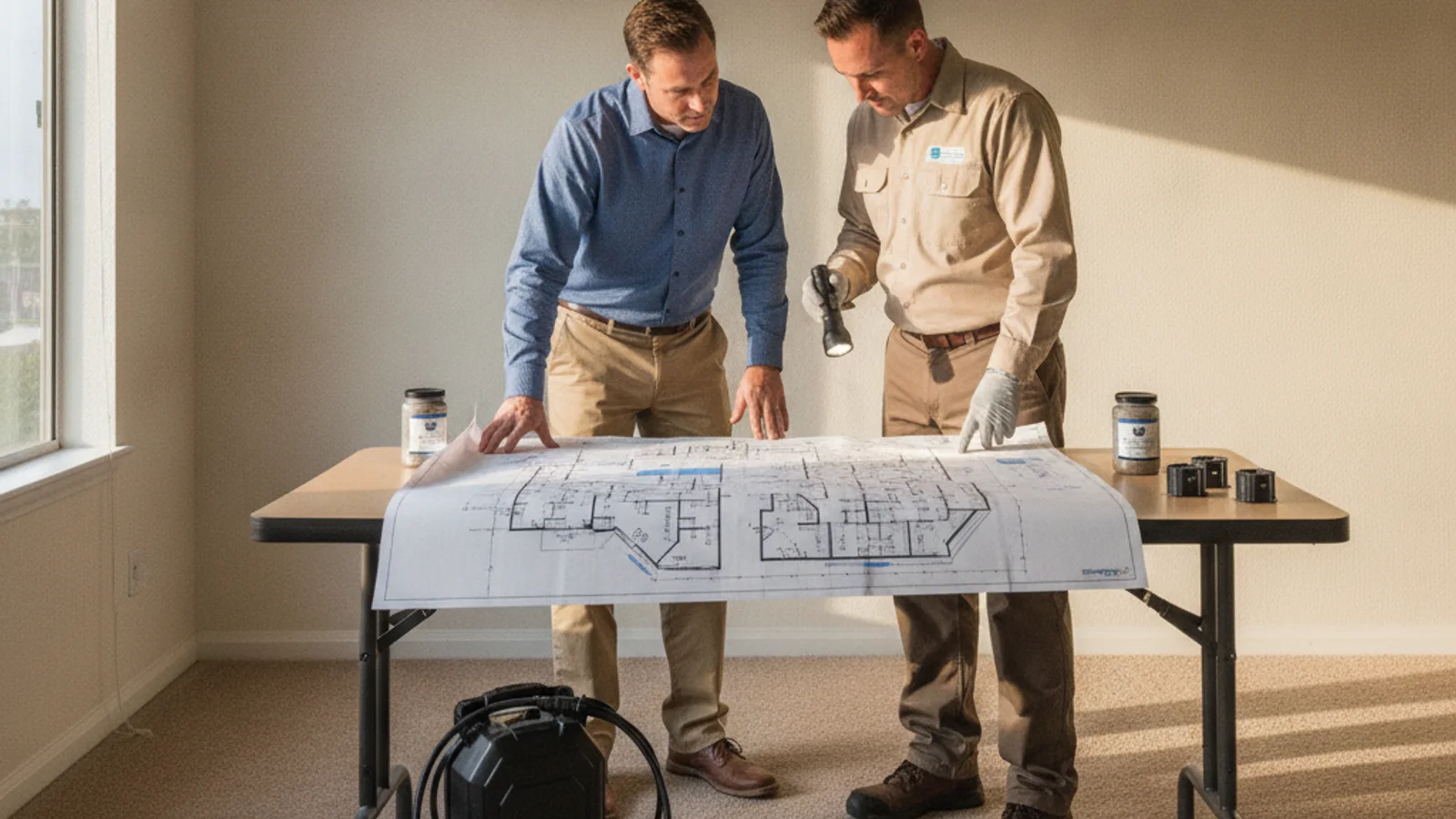
Why evidence from one unit can change the inspection scope
A single verified finding is a starting point, not a boundary. The licensed company you hire decides how far to inspect based on what it finds, the building’s construction and how the units connect. Your job is to give it enough information to draw that line honestly.
Building type drives most of that judgment in San Diego County. A three-story garden complex in El Cajon with separate exterior entries connects differently than a downtown mid-rise with interior corridors, shared laundry and stacked plumbing chases. Coastal North County properties in Oceanside and Vista often mix long-term tenants with short-term renters, which changes how often belongings move in and out. South Bay buildings in National City and Chula Vista frequently house multiple generations in one unit, so a bedroom-only inspection can miss where people actually sleep.
California law gives you one firm anchor here. Under Civil Code Section 1954.602(a), added by AB 551, “A landlord shall not show, rent, or lease to a prospective tenant any vacant dwelling unit that the landlord knows has a current bed bug infestation.” That means a vacancy inside an active inspection area needs a documented answer before it turns over.
AB 551 also set the tenant information duty. Landlords have had to give written bed bug information to new tenants before creating a tenancy since July 1, 2017, and to all existing tenants since January 1, 2018. That notice covers identification, bed bug behavior, prompt reporting, and the importance of cooperation between landlords, tenants and pest control operators.
That cooperation clause is the practical reason scope matters. A tenant who was told what to look for and how to report it gives the inspector better information than a tenant who found out from a neighbor. If you want the reader-facing version of that conversation, our bed bugs guide for San Diego renters covers what tenants are usually asked to do and why.
How IPM connects inspection, monitoring, and treatment
Integrated pest management is not a product. It is a sequence: identify what you have, find where it lives, reduce the conditions that support it, then apply treatment where evidence supports it, and verify the result.For bed bugs, the sequence usually runs in this order. Inspection confirms live insects, cast skins or eggs and marks the units involved. Monitoring keeps watching the units nobody treated, because those are where a missed pocket shows up next. Treatment follows the licensed company’s own plan. Verification is a second visit, not an assumption.
That last point matters for scheduling and for tenant communication. Bed bug work usually takes more than one visit, and the interval between visits depends on the method and the product label. There is no standard follow-up interval to plan a building around. Ask the company you hire to put its own follow-up schedule in writing, because that schedule belongs to its plan and its products, and tenants need dates you can hold to.
Ask the same question about what happens between visits. Who confirms the unit was prepared. Who checks the monitors in the neighboring units. Who signs off that a unit is clear. A plan that names a person for each of those steps survives staff turnover. A plan that only names a treatment date does not.
Pesticide selection sits entirely on the licensed side of the line. We do not apply products, set application rates, or choose actives, and neither should you. The EPA’s pest control guidance is a reasonable orientation for managers who want to understand what they are reading on a service ticket. Our bed bug treatment referral service explains where we fit, which is matching you with the licensed company, not directing its work.
What records property managers should request
Records are what turn a vendor’s visit into something you can rely on months later. Ask for them in the contract, not after the first complaint.
Start with the inspection record. It should name the units inspected, the date, what evidence was found in each, and what was not found. A report that only lists the treated units leaves you unable to prove you looked at the rest.
California gives you a deadline attached to that record. Under Civil Code Section 1954.605, after a pest control operator inspects units, the landlord must notify the tenants of those units inspected of the findings in writing within two business days of receiving the operator’s findings. Two business days is short. Build the notice template before you need it, and make sure your vendor’s reporting turnaround leaves you time to send it.
Then ask for the treatment record for each unit: date, areas treated, method used, and any preparation the tenant was asked to complete. Ask for the follow-up record separately, because a follow-up that is only a line in an invoice is hard to defend. Ask for the monitoring record for untreated units too.
Keep licensing documentation on file alongside those records. California structural pest control is split into three branches. Branch 1 is fumigation with poisonous or lethal gases, Branch 2 is household pest control excluding that fumigation, and Branch 3 is wood-destroying pests and organisms. Bed bug work sits in Branch 2. You can verify a company’s registration and a field representative’s license through the Structural Pest Control Board license search, and cancelled licenses do not show up in that search, so check status rather than assuming.
One more record class is worth naming: retaliation exposure. Civil Code Section 1942.5(a)(1) bars retaliatory action for 180 days after a tenant provides notice of a suspected bed bug infestation or complains about tenantability. Prohibited actions include recovering possession, causing the tenant to quit involuntarily, raising rent or reducing services. Date-stamped reports protect you here as much as they protect the tenant, because they show what you knew and when you acted.
How to compare licensed companies for multi-unit work
Multi-unit bed bug work is a different purchase than a single-family callout, and the comparison should reflect that. Price per unit tells you very little on its own. What you are buying is inspection discipline, documentation and a company that will still answer the phone at visit three.
Ask each bidder the same set of questions and write the answers down.
- Scope method. How do they decide which adjacent units get inspected, and does that decision appear in the report?
- Method options. Do they offer heat, chemical, or both, and what makes them choose one for a given building?
- Documentation. What exactly do you receive after each visit, and how fast? Compare that turnaround against your two-business-day notification duty.
- Tenant preparation. What are tenants asked to do, and do they provide written instructions in the languages your residents actually speak?
- Follow-up and warranty. What re-treatment terms are in their own written agreement? Those terms belong to them, not to us.
- Licensing. Company registration number and the branch, verified in the state search rather than taken from a business card.
On cost, treat published figures as orientation only. HomeGuide puts bed bug heat treatment at $1 to $3 per square foot, with whole-job spans running $2,000 to $6,000 for a 2,000 sq ft home (HomeGuide national benchmark)
Language capacity deserves real weight in the South Bay and in central-city neighborhoods where Spanish is the household language for many residents. A tenant who cannot read the preparation sheet cannot follow it, and unprepared units are one of the most common reasons a second visit finds live insects. Our commercial pest control referral service covers properties across San Diego County, and the practical treatment sequence is laid out in our guide on how to get rid of bed bugs in San Diego.
When to call us
Multi-unit bed bug work needs a licensed Branch 2 company from the first inspection, because scoping a building and choosing between heat and chemical treatment is not a judgment a manager should make alone. If you have one confirmed unit and no plan for the units around it, that is the moment to bring a professional in. Call us at (858) 400-6561 and we’ll match you with a licensed local pro.