
Discovering bed bugs in your San Diego home is unsettling, and the first instinct is usually to make them disappear today. UC IPM is blunt about that: eliminating an infestation is best done by a professional pest control company. This guide covers how to confirm what you have, what the store-bought options actually do, and what the professional methods involve.
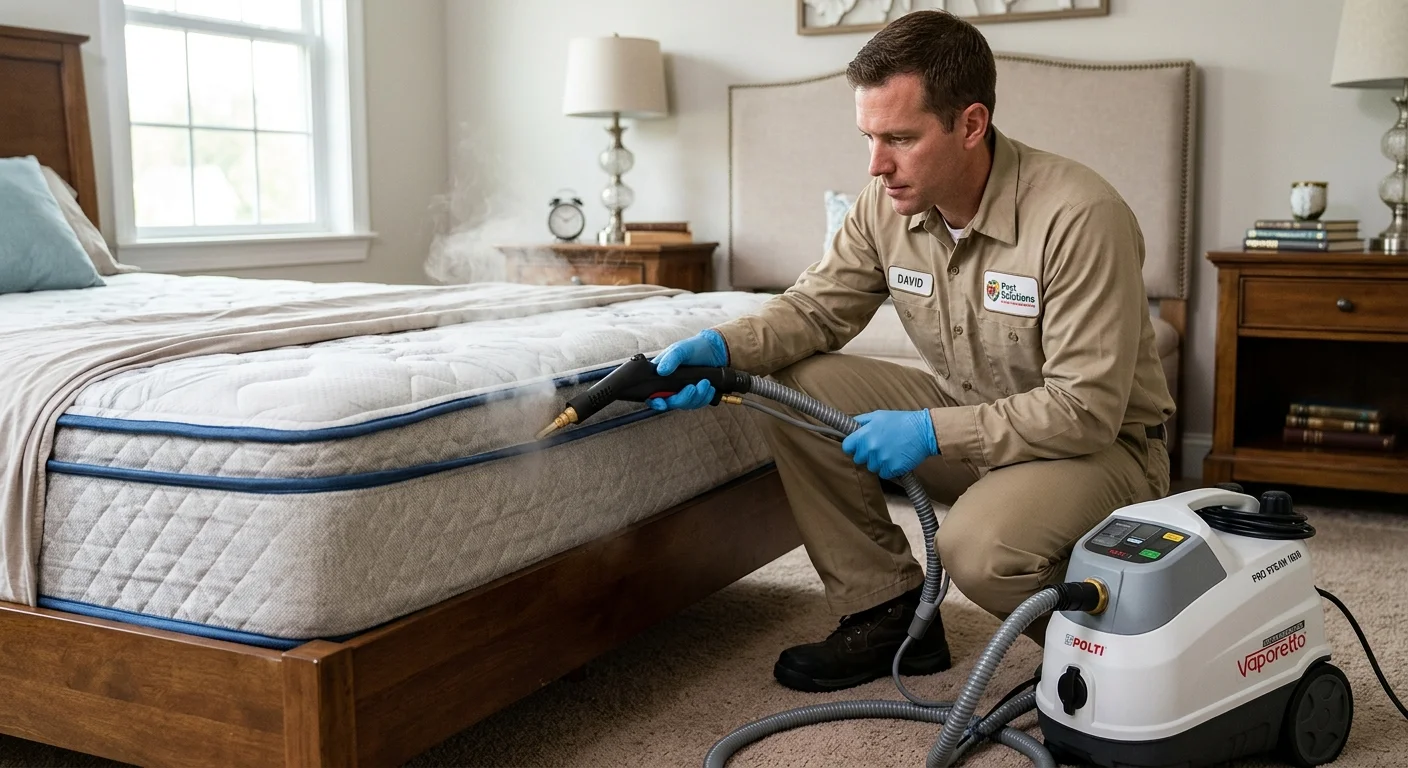
First steps: how to be sure it’s actually bed bugs
Before you tackle any pest problem, accurate identification matters. Many tiny insects bite, and a rash can come from any number of causes. UC IPM says a raised welt, blister or rash should never be used for diagnosis on its own, because several household pests bite people and reactions vary widely. You confirm bed bugs only by finding the insects or their signs.
Here’s what to look for if you suspect bed bugs:
- Bites: Bed bug feeding is usually painless and sleeping people are typically unaware of it. UC IPM notes the area around a bite might redden, swell and itch several days later, and some people have no reaction at all. That delay is why bites alone are not proof.
- Blood spots: Look for small rust-colored or reddish-brown spots on sheets, pillowcases or the mattress, left where an engorged bug was crushed.
- Fecal spots: Dark brown to black spots, sometimes yellowish, roughly round or in streaks, on mattresses, box springs, bed frames and nearby surfaces. UC IPM describes these as the insects’ excrement and lists them as one of the confirming signs.
- Shed skins: Bed bugs pass through five progressively larger nymphal stages, each needing at least one blood meal before it molts to the next. The light-colored cast skins left behind stay in the hiding places.
- Actual bed bugs: UC IPM describes adults as about 1/5 inch long, oval, wingless, flattened and rusty red or mahogany. Nymphs look identical apart from their size, 1/20 to 1/5 inch, and their lighter yellowish-white color. Eggs are about 1/20 inch, white, and seeing them takes a hand lens. To help confirm what you’re seeing, read our guide on what do bed bugs look like.
Start the search where the bugs are. UC IPM says current research puts 85% of bed bugs in or near the bed, so inspect the mattress seams, box spring, bed frame and headboard first, and keep in mind that common hiding places sit within six or fewer feet of where people sleep or rest. Bed bugs use cracks and crevices as small as the width of a credit card, so a flashlight and a small mirror earn their place. If you catch a specimen, seal it in a bag or tape it to paper so a licensed inspector can confirm the identification.
What not to do: why bug bombs and DIY sprays make it worse
When faced with bed bugs it’s natural to reach for whatever is on the shelf at the hardware store. The evidence on those products is not encouraging.
Here’s what UC IPM says about the common DIY routes:
- Total-release foggers, the “bug bombs”: Using over-the-counter total-release aerosol foggers has been shown to be ineffective for bed bug control and potentially harmful to residents, so UC IPM does not recommend them. That finding traces to a 2012 study by Jones and Bryant in the Journal of Economic Entomology testing over-the-counter foggers against bed bugs. The EPA gives the reason: the spray will not reach the cracks and crevices where bed bugs hide, so a fogger should never be your only method of control, and it warns that improper use can harm your health or cause a fire or explosion.
- Over-the-counter sprays: Several active ingredients are federally registered for bed bugs for over-the-counter use, but UC IPM says few have been demonstrated as effective, and insecticide resistance among bed bug populations is increasingly common. The most effective bed bug pesticides are available to commercial applicators only, and UC IPM adds that insecticide applications alone will not control an infestation in any case. They have to be combined with removing and cleaning infested items and with nonchemical work such as steam, heat and sealing up hiding places.
- Where product belongs, and where it does not: Insecticides may be applied as liquids directly into cracks, crevices, bed frames and baseboards, or as dusts in cracks and crevices. UC IPM notes pesticides are not generally applied to mattresses or bedding because of the potential risk to people. A homeowner soaking a mattress with a retail product is doing the one thing the guidance warns against.
Bed bugs are resilient, and UC IPM’s position is that confirmed infestations should be managed by trained professionals. Time spent on retail products is usually time the population spends growing.
Professional heat treatment vs. chemical treatments for San Diego homes
Once an infestation is confirmed, the practical question is which professional method fits your home. Pest Pros San Diego matches you with a licensed local company, and that company chooses and performs the treatment. Pest Pros does not inspect, treat or price the work.
Heat treatment: no residual pesticide
Commercial heating services treat entire rooms. UC IPM’s current recommendation for effective commercial heating calls for at least 140°F for two hours, or 130°F for three hours, with 113°F as the minimum lethal temperature. In California, providers of heat services must be licensed and bonded by the Structural Pest Control Board, so ask to see that before anyone brings equipment into your house.
What heat offers:
- Reaches all life stages: UC IPM says those time and temperature combinations kill most bed bugs and eggs.
- No residual pesticide: Nothing is left behind on surfaces afterward, which matters to households that want to avoid that.
- Room-scale: The treatment is applied to the whole room rather than to the spots someone thought to check.
Considerations: Heat treatment needs extensive preparation, including removing heat-sensitive items, aerosols and certain plastics, and the company will give you that list. Cost depends on the company and the job; for how quotes are built, read our guide on bed bug treatment cost in San Diego.
Chemical treatment: targeted applications by a licensed company
Chemical treatment means the precise application of registered insecticides by a licensed applicator. UC IPM notes professionals have access to a wide range of effective registered products, plus the equipment and expertise for a more precise application. Product goes into cracks, crevices, bed frames and baseboards as a liquid, or into cracks and crevices as a dust, and generally not onto mattresses or bedding.
What chemical treatment offers:
- Professional-only products: The most effective bed bug pesticides are available to commercial applicators only.
- Targeted placement: Treatment follows the harborage sites found at inspection rather than covering open surfaces.
- Combines with the rest: UC IPM is clear that insecticide alone will not do it, so this runs alongside vacuuming, laundering, steam and sealing.
Considerations: Insecticide resistance among bed bug populations is increasingly common, which is why the company’s product choices and follow-up matter. Expect re-entry instructions after application, and expect follow-up monitoring rather than a single visit.
The company matched through Pest Pros San Diego evaluates your situation and recommends a bed bug treatment approach. UC IPM’s own advice is to combine chemical and nonchemical tactics with better sanitation and habitat modification, so a plan that uses steam, encasements and product together is following the published guidance, not upselling you.
The multi-visit process, step by step
Bed bug work is not a one-and-done job. UC IPM describes managing an infestation as a difficult task that requires removing or treating all infested material plus follow-up monitoring to check the infestation is gone. Here’s how that sequence usually runs.
Step 1: detailed inspection and assessment
The licensed company starts with a thorough inspection: mattress seams, box spring, bed frame, headboard first, then the rest. UC IPM puts the remaining 15% of infestations in upholstered furniture other than beds, bedroom cabinets, along baseboards, under wallpaper, and in carpets and wall hangings. Live bugs, eggs, fecal spots and shed skins are all recorded. Detecting a low-level infestation takes time and patience.
Step 2: treatment plan and prep list
Based on what the inspection found, the company recommends an approach, which may be heat, a chemical program, or both alongside nonchemical work. You get a written preparation list. Your part of that list genuinely affects the outcome, because the company cannot treat what it cannot reach.
Step 3: initial treatment
For heat, equipment brings the room to the target temperature and holds it. For chemical work, registered products go into the harborage sites identified at inspection, as liquids in cracks, crevices, bed frames and baseboards or as dusts in cracks and crevices, and generally not onto mattresses or bedding.
Step 4: follow-up visits and monitoring
UC IPM lists follow-up monitoring as part of the job, not an optional extra, and says prevention and monitoring should be ongoing. Interceptor monitors placed near beds and suspect locations help detect bugs moving between a harborage and a host, and pest management professionals already use them widely. Mattress encasements designed to stop bed bugs establishing on a mattress have been shown effective in laboratory research, and bugs sealed inside one eventually die of starvation.
Step 5: post-treatment guidance
At the end of the series you get guidance on keeping the problem from restarting: keep clutter down so inspection is easier and there are fewer hiding places, seal cracks and crevices in bedding, furniture and other potential harborage, and launder bedding at high temperature. Any warranty or retreatment terms come from the licensed company that did the work, in writing, not from Pest Pros San Diego.
Frequently asked questions
Can I get rid of bed bugs myself?
UC IPM’s answer is that confirmed infestations should be managed by trained professionals, and that eliminating an infestation is best done by a professional pest control company. Over-the-counter total-release foggers have been tested and shown ineffective. Few over-the-counter active ingredients have been demonstrated as effective, resistance is increasingly common, and the most effective products are restricted to commercial applicators.
How do I keep bed bugs from coming back after treatment?
Encase the mattress and box spring, keep clutter down around the bed so there are fewer harborage points and inspection is easier, seal cracks and crevices in bedding and furniture, and attend the follow-up monitoring. People carry bed bugs home on clothing, bedding, furniture and luggage, and sometimes pick them up in theaters or on buses and trains, so secondhand items deserve an inspection before they come inside.
How many treatments does it take?
That depends on access, unit type and how far the infestation has spread, and it is determined at inspection by the licensed company. What the published guidance does say is that insecticide applications alone will not control an infestation and that follow-up monitoring is required, so plan on a program rather than one visit.
Do I need to throw out my mattress?
Not necessarily. UC IPM notes encasements can be used to contain bed bugs within mattresses when the mattress can’t be discarded, or when steam or insecticide application is unavailable or undesirable, and that bugs trapped inside eventually die of starvation. Don’t discard anything before the inspection.
When to call us
If you’ve found signs of bed bugs in your San Diego home, the published guidance points at a professional rather than a shelf product. Call us at (858) 400-6561 to get matched with a licensed local pro.