
A fire ant bait label can help you screen a product. It can’t prove which ant built the nest, where the colony extends, or whether bait fits the property.
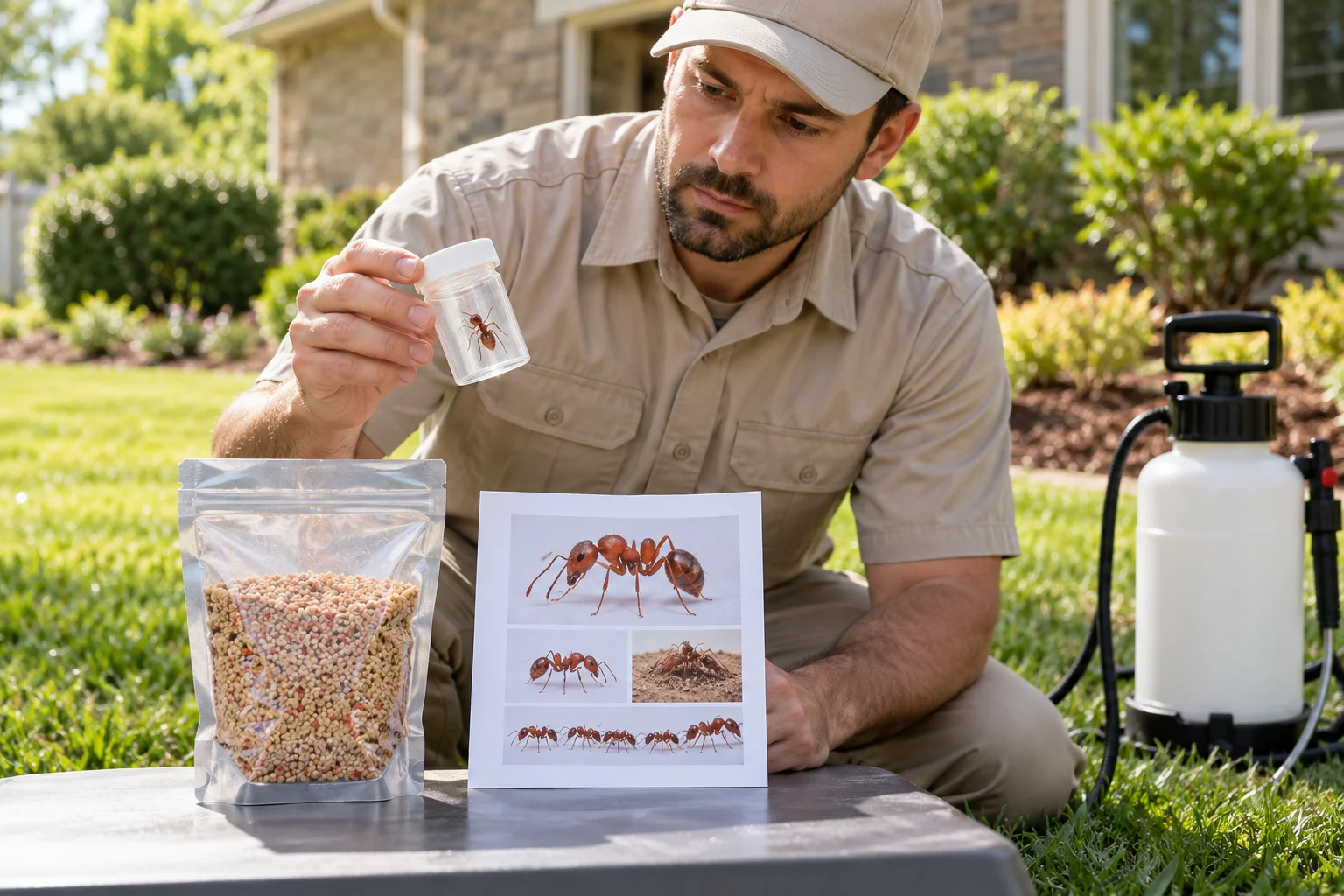
That difference matters across San Diego County. Southern fire ants occur in both coastal and inland areas, but not every stinging ant or soil nest belongs to that species. Start with the ant, then evaluate the label.
Why ant identification comes before choosing bait
“Fire ant” isn’t a complete identification. San Diego County has the native southern fire ant. UC sources describe its workers as varied in size, with amber heads and thoraxes and mostly black abdomens. A photo, mound, or sting alone may not establish the species.
The red imported fire ant creates another identification problem. It’s a quarantined pest in California, but San Diego County isn’t within the state’s regulated area. That area covers Orange County and specified parts of Los Angeles and Riverside counties. A suspected local find is still worth reporting to the California Department of Food and Agriculture.
This distinction affects product selection. A package carrying the words “fire ant bait” doesn’t identify ants collected from a San Diego yard. It also doesn’t show whether separate trails, nests, or indoor activity belong to the same species.
Argentine ants add another local complication. They’re widespread around California homes and can displace native ants, including southern fire ants. Trails along irrigation lines, patios, retaining walls, and foundations may point to a different problem than an active soil nest.
Collect evidence before comparing products. Keep a clear photo or a sealed specimen if that can be done without approaching an active nest. Record where workers appear and whether they form a trail. Note separate activity around the structure, landscape, and paved areas.
Don’t disturb a suspected fire ant nest to obtain a sample. A single red imported fire ant can bite and sting repeatedly. UC IPM also warns that spraying a nest may cause a colony to disperse, making control harder.
Our San Diego fire ant guide provides more identification context. For broader trail and nesting issues, see our guide to ant control in San Diego.
What a registered bait label can establish
A registered bait label tells you what that specific product says it covers. Read the complete label attached to the exact package. Similar names, package designs, or active ingredients don’t make two products interchangeable.
Start with the target-pest section. Look for the ant named on the label, not simply the word “ants” on the front panel. Then review the locations named on the package and compare them with the place where you see activity.
Next, review warnings and restrictions. Pay attention to statements involving people, children, pets, food areas, water, gardens, and animals. Don’t translate “available to consumers” into “safe everywhere.” The label’s actual language controls that decision.
The label may also provide storage and disposal directions. Those details matter before purchase. A product that can’t be stored or managed as directed isn’t a practical choice for that property. The EPA pesticide safety page offers additional consumer guidance.
This article doesn’t provide placement, dosage, broadcast, mixing, watering, or timing instructions. Those details vary by product and site. For product-specific instructions, refer to the complete label attached to the product in your hand.
Slow-acting bait is a recognized fire ant control method. Foraging ants carry bait back toward the nest and colony. That general principle doesn’t tell you whether a particular bait matches the ant, location, or evidence at your property.
Our guide to ant bait traps, species, and labels explains how those decisions connect. It also helps separate a product claim from a confirmed identification.
Which colony evidence the label cannot confirm
The label describes a product. It doesn’t inspect your yard, identify a specimen, or map a colony.
It can’t confirm that every visible ant belongs to one nest. It can’t establish whether activity beside a patio connects with workers near a wall. It also can’t show whether an indoor trail and an outdoor mound involve the same species.
The label can’t confirm colony boundaries. Soil, irrigation, planting beds, paving gaps, and structural edges can hide activity. This matters in dense neighborhoods and attached housing, where visible ants may cross property or unit boundaries. A package can’t determine the source from those patterns.
It also can’t diagnose why ants ignored a bait. Lack of feeding doesn’t prove the colony is gone. It doesn’t establish that the wrong species was targeted, either. Product condition, competing food, the treatment site, or another unconfirmed factor may affect what you observe. The evidence needs interpretation before the plan changes.
The label can’t promise complete colony control at your address. It can’t verify that queens, brood, or hidden nests were reached. It can’t establish whether another colony remains nearby. Marketing language on a package or store page isn’t a property-specific finding.
Predators, food preferences, and attraction claims don’t solve this gap. Even when general biology is accurate, it doesn’t identify the ants present at one San Diego property. The same applies to questions about which chemical “fire ants use.” Those topics don’t replace a specimen and site assessment.
Monitor results against written observations, not memory. Keep dated notes on trails, nest activity, and new locations. Don’t poke, flood, spray, or open a nest to test it. Disturbance can expose people to stings, and spraying may disperse a colony.
A useful decision record has three parts: the identified ant, the exact label, and the observed colony evidence. If one part remains uncertain, the product alone can’t fill the gap.
When a licensed ant company should inspect
Bring in a licensed ant company when the species remains uncertain, stings are occurring, or activity appears in several areas. An inspection also makes sense when bait is ignored, trails move, or activity continues without a clear source.
The company you’re matched with should inspect before proposing treatment. Ask the inspector to identify the ant, explain the evidence, and connect each treatment choice to the site. The written plan should name the treatment areas and describe what will be monitored.
Ask which California credential covers the proposed work. General household pest control falls under Structural Pest Control Board Branch 2. You can check a company or individual through the California Structural Pest Control Board license search.
Don’t accept one product as the automatic answer for every ant. Southern fire ants, Argentine ants, and other local species don’t create identical problems. A plan should reflect the identified species and the property’s actual activity.
A professional inspection is especially useful around multifamily housing, commercial landscaping, shared walls, and large irrigated grounds. Activity in those settings may extend beyond the first visible trail or nest. The inspector can separate confirmed evidence from assumptions and document the proposed response.
Before approving work, request the plan in writing. Product selection, precautions, monitoring, and any follow-up belong in the matched company’s agreement. Pest Pros San Diego doesn’t apply pesticides or set treatment terms. We connect customers across San Diego County with licensed, insured local companies.
Our ant control referral service can help when the label and the colony evidence don’t line up.
When to call us
Call when stinging ants, uncertain identification, or activity across several locations needs a licensed inspection. Call us at (858) 400-6561 and we’ll match you with a licensed local pro.