
The small, stocky spider that hops along your windowsill and swivels to look at you is the one people photograph most and identify least. Search results jump straight to bites, which skips the part that actually matters: what the spider is, and whether the activity in your house is worth a professional look.
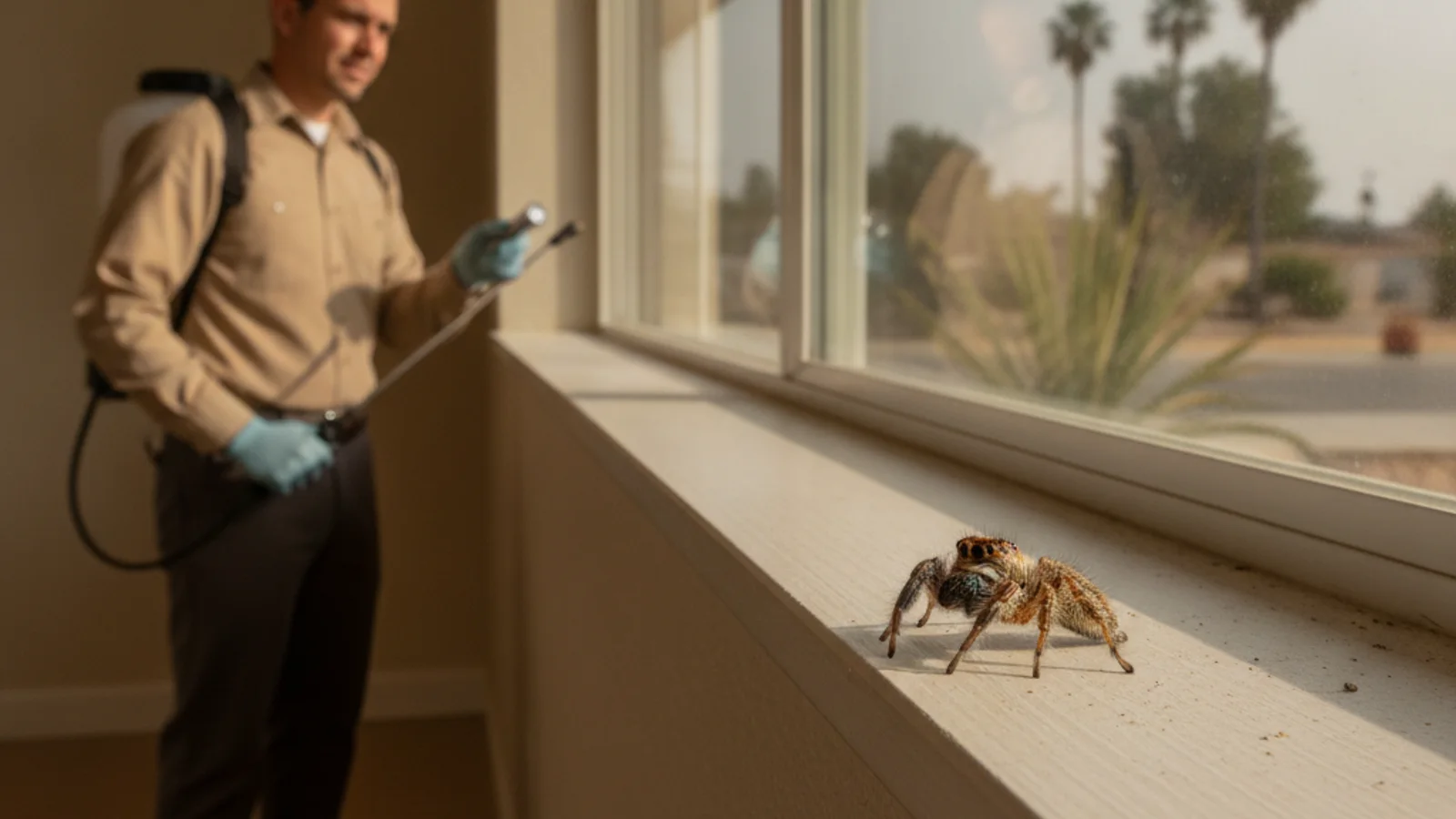
How to identify a jumping spider
Behavior gives it away before the markings do. A jumping spider moves in short, deliberate bursts rather than a steady scuttle, stops often, and turns its whole body to track movement. That tracking is the tell. Most household spiders don’t appear to notice you at all.
The build is compact and short-legged rather than long and spindly. The front of the head carries a pair of large, forward-facing eyes that read as noticeably big for the animal, with smaller eyes set around them. Many species are hairy, and coloring ranges from plain gray or brown to dark bodies with pale markings or a metallic sheen. They’re active in daylight and are usually found in the open: a sunny sill, a stucco wall, a fence rail, a patio table, the frame of a screen door.
Compare that against what else turns up in local homes. A wandering spider you spot on a floor at night is more likely something else, and our wolf spider guide for San Diego covers that larger, ground-hunting body type. For a broader side-by-side, our roundup of the common spiders in San Diego puts body shape, web location and hiding places next to each other.
Two habits are worth keeping. Don’t pick up an unfamiliar spider to look closer, even one that seems to be watching you calmly. And photograph it where it sits, with something nearby for scale, rather than trying to move it into better light. If you want to work through an identification key yourself, UC’s statewide integrated pest management program at ipm.ucanr.edu is a better reference than an image search.
Why a skin mark can’t identify the cause
This is the part most pages get wrong. A red, swollen or itchy mark on skin does not carry the name of what caused it. Bites from different arthropods, stings, plant contact, allergic reactions and infections can all look similar, and a photo comparison online is not a diagnosis. We won’t tell you what bit you, and no honest pest company will either.
The approved sources for this page don’t carry verified data on jumping spider bites in San Diego County: not frequency, not severity, not symptoms. So we’re not going to supply numbers or rank the risk. What is documented locally, by UC IPM, is the western black widow, described as California’s most common harmful spider, identified by the red or orange hourglass marking on the underside of the abdomen of an adult female. UC IPM also notes that black widow bites are rare, even where the spiders are common. That’s the verified local reference point, and it’s a different spider from the one on your windowsill.
If you’re comparing what a mark might be, our piece on spider bites versus mosquito bites in San Diego explains why the visual comparison so often fails. Anything about your own skin, a reaction that’s spreading, or a symptom that worries you goes to a clinician, not to a pest control company. General public health background on insects and disease is at cdc.gov.
There is one thing that genuinely helps. If a spider was actually present when it happened, keep it, safely contained, without handling it. An intact specimen is the only reliable path to a species, and it’s far more useful to anyone assessing the situation than a photograph of a mark.
Where jumping spiders and recurring webs appear
Jumping spiders hunt rather than sit in a web waiting, so their presence tends to track where prey is moving in daylight. Persistent webbing in the same corners tends to point at a different resident. Both are telling you something about the building.
The pattern shifts across the county. Coastal homes in Encinitas, Carlsbad and Cardiff have stucco walls that warm in the afternoon, sliding-door tracks, patio covers and landscaping planted tight to the wall, which puts sunlit hunting surfaces right at the entry points. Inland North County in Escondido, San Marcos and Vista runs hotter and drier, and activity concentrates on garage jambs, shade structures and the sheltered side of outbuildings.
East County adds volume. Alpine, Lakeside, Ramona and Jamul properties often have detached workshops, open rafters, stored equipment and long fence lines, which is more undisturbed surface than a tract home offers. In the central city, older North Park and Golden Hill homes bring deep porches, raised foundations and detached garages. In Chula Vista, National City and Imperial Beach, attached units share corridors, walls and utility penetrations, so an entry point may not be on a wall you control.
What ties all of it together is prey and access. A porch light drawing flying insects every night creates a food supply. Torn screens, worn door sweeps, unsealed utility penetrations and gaps around window frames create the routes. Old webbing left in place makes a doorway look busy long after nothing lives there, so clearing empty webs is what lets you tell current activity from history. Use care around occupied webs and egg sacs, and don’t reach blind behind stored boxes or patio furniture.
When spider activity needs a licensed inspection
One jumping spider on a sill in July isn’t a pest control problem. It’s the pattern that justifies a visit: spiders showing up in occupied rooms week after week, webbing rebuilt in the same concealed spots, activity in voids or crawl spaces you can’t see into, or a species you can’t rule out from a safe distance.
A licensed inspection should start with identification and the conditions behind it, not with a sprayer. Expect the company to look at prey sources, exterior lighting, moisture, screens and entry gaps, and to explain any product it proposes by that product’s own label, including what it says about children and pets. Consumer background from the EPA on safe pest control is useful reading, but the label in hand governs. Follow-up and re-service terms belong in the company’s written agreement. We don’t set them, and we hold no license.
Credentials take a minute to check. General household pest work falls under California’s Branch 2, and you can confirm a company or an individual through the Structural Pest Control Board license search. Cancelled licenses don’t appear in that search, so a blank result is worth a question rather than a shrug.
We match San Diego County homeowners and businesses with licensed, insured local companies. Calls to our line route to the pest company covering your area, and messages get returned. Our spider control page explains how the referral works and what the matched company handles.
When to call us
Call when spiders keep coming back indoors, when the species is uncertain, or when webbing runs into voids and crawl spaces you shouldn’t be inspecting yourself. A licensed company can identify what’s living there, find the entry points, and explain any treatment by its label. Call us at (858) 400-6561 and we’ll match you with a licensed local pro.