
Daytime bites in a San Diego yard are often invasive Aedes mosquitoes, not the dusk Culex people expect. Control starts with the water they breed in. A licensed yard plan is a separate job, not a promise the mosquitoes are gone.
The Aedes mosquito problem in San Diego
San Diego County’s Vector Control Program describes invasive Aedes, or “ankle biter” mosquitoes, as small black-and-white striped mosquitoes that bite during the day, especially around the legs and ankles, can bite more than once, and lay eggs in small containers of water. They were first found in the county in 2014.
Species status has to match the CDPH Aedes detection table, updated May 1, 2026. For named San Diego County communities in that current table, Aedes aegypti is listed Present and Aedes albopictus is listed Not Found. Historical detections of Aedes albopictus in Barrio Logan and Carlsbad (2015) and Mission Valley (2019) sit in CDPH’s historical section, not as current “Present” rows. Do not treat both species as currently established in San Diego. For the thorax-stripe versus lyre field marks, use Asian tiger or yellow fever mosquito: how to tell.
County copy: Aedes aegypti and Aedes albopictus can spread viruses such as Zika, dengue, yellow fever, and chikungunya. Diseases like dengue are rare in San Diego and most local dengue cases have been in travelers. The county also records a 2025 locally acquired dengue case, meaning infection without travel. That is a public-health fact from the county page, not a claim that your yard is transmitting disease. County data on detections and the 10-year view live on Aedes mosquito establishment in San Diego.
If the biter is silent, nearly invisible, and slips through a window screen, it may be a no-see-um, or biting midge, which is a different job.
Why container Aedes are harder than marsh mosquitoes
County Vector Control: these mosquitoes breed indoors and outdoors in small containers. Even 1/4 inch of water is enough. Eggs can survive for months in dry containers and hatch when water returns. In warm weather they can go from egg to adult in less than one week. If you are getting bitten, the mosquitoes are probably coming from somewhere close by.
That is why a marsh-focused spray misses the saucer, gutter, and toy. Native dusk mosquitoes and invasive daytime Aedes aegypti are not the same habitat problem.
Source reduction: tip and toss
County guidance is dump standing water at least once a week. Check buckets, birdbaths, potted-plant saucers, and children’s toys. Talk to neighbors after you dump your own water.
San Diego County’s backyard-source list includes potted-plant saucers, bromeliads, buckets, open trash cans, outdoor furniture, rain barrels, tarps, toys, kiddie pools, wheelbarrows, birdbaths, watering cans, clutter, uncapped fence posts or bamboo, tree holes, decorative rocks, and tires.
Practical county steps:
- Dump saucers weekly, or fill them with sand or gravel so there is no water surface.
- Wipe saucers and the outside of pots. Invasive Aedes lay eggs on the sides of containers.
- Store unused pots upside down or inside.
- Flush bromeliad tanks weekly, or tip potted bromeliads. Follow the label if you use a bacterial larvicide in water you cannot dump.
- Change pet water and birdbaths often. County says mosquitoes can become biting adults in less than a week.
- Clear gutters. Keep tarps from holding rain.
- Store toys under cover. Dump kiddie pools weekly.
- Drill drainage in tire swings. Cap fence posts.
Overgrown shrubs give adult mosquitoes shaded rest. Cutting that back is landscaping, not a pesticide claim. A landscaper such as Bloom Pro SD can handle heavy clearing. For ponds or green pools you cannot dump, the county offers free mosquitofish and points to labeled larvicides. Follow the label. For irrigation runoff, see the San Diego County Water Authority.
What to ask a licensed yard applicator
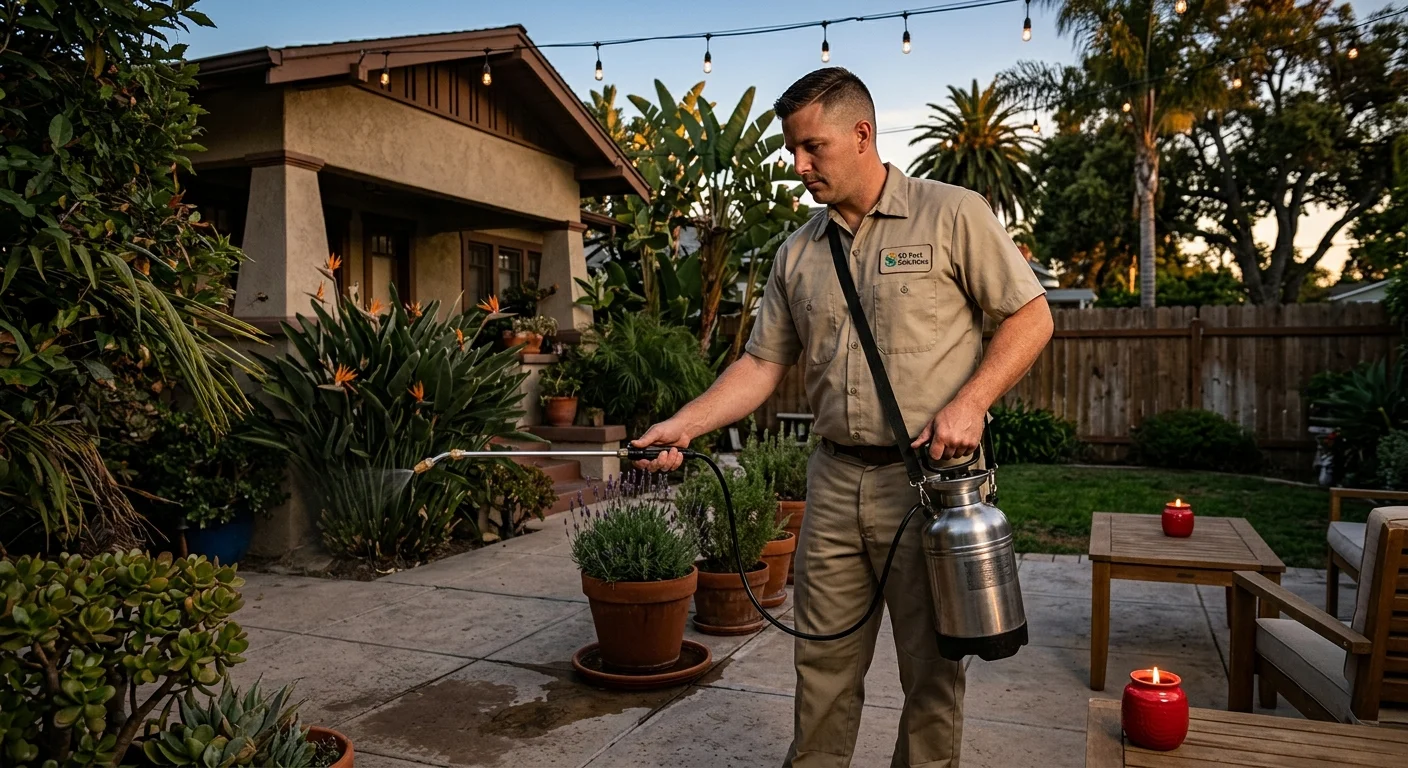
Source reduction is the county’s first tool. It does not always end adult mosquitoes that rest in foliage. A licensed Branch 2 company can inspect breeding and rest sites and propose a written yard plan. Pest Pros San Diego matches you with that company. We do not walk the yard, spray, or schedule a technician.
Ask the applicator, in writing:
- Which species and habitats they are targeting after looking at this property.
- Whether the proposal includes source-reduction notes, larvicide on water that cannot be dumped, and adult treatments on resting vegetation.
- How they will handle flowering plants and pollinators on your lot. That is a question for the applicator and the product label, not a safety promise from this site.
- What happens if mosquitoes return. There is no mosquito-free interval this page can publish.
Do not read “once dry, safe for family and pets,” “every 3-4 weeks you will have a mosquito-free yard,” or “eradicate” as facts we can stand behind. Those are outcome promises a referral site cannot make.
Book a yard assessment
If daytime Aedes aegypti pressure continues after weekly dumping, ask for a licensed inspection. DIY dumping is still the right first step. It is not the same as a residual yard program.
During an assessment, the matched company should show you the water and rest sites it found, then quote only that scope. Every San Diego yard is different. There is no one protocol this matcher can prescribe.
Frequently asked questions
Why are there mosquitoes in San Diego biting during the day?
County Vector Control: invasive Aedes bite during the day, especially around legs and ankles. CDPH currently lists Aedes aegypti as present in named San Diego County communities and Aedes albopictus as not found in those current rows.
How long does a mosquito treatment last?
This page does not publish a knockdown window. New adults keep emerging from water you did not dump. Ask the company how long it claims its product lasts on the label for your site, and keep dumping water weekly.
What counts as standing water for Aedes mosquitoes?
County: even 1/4 inch. Saucers, gutters, toys, bromeliads, buckets, and irrigation boxes all count.
Are mosquito treatments safe around pollinators?
Ask the applicator how it will treat flowering plants on your property, and follow the label. This site does not certify a product as pollinator-safe.
When to call us
If container dumping is not enough, or you want a licensed look at a yard plan, call (858) 400-6561 to get matched with a licensed local pro.