
A mosquito quote that arrives without an inspection is a quote for spraying, not for solving anything. The useful version starts on the ground, looking for water and for the shaded places adults rest during the day. Here’s how to tell which one you’re being sold.
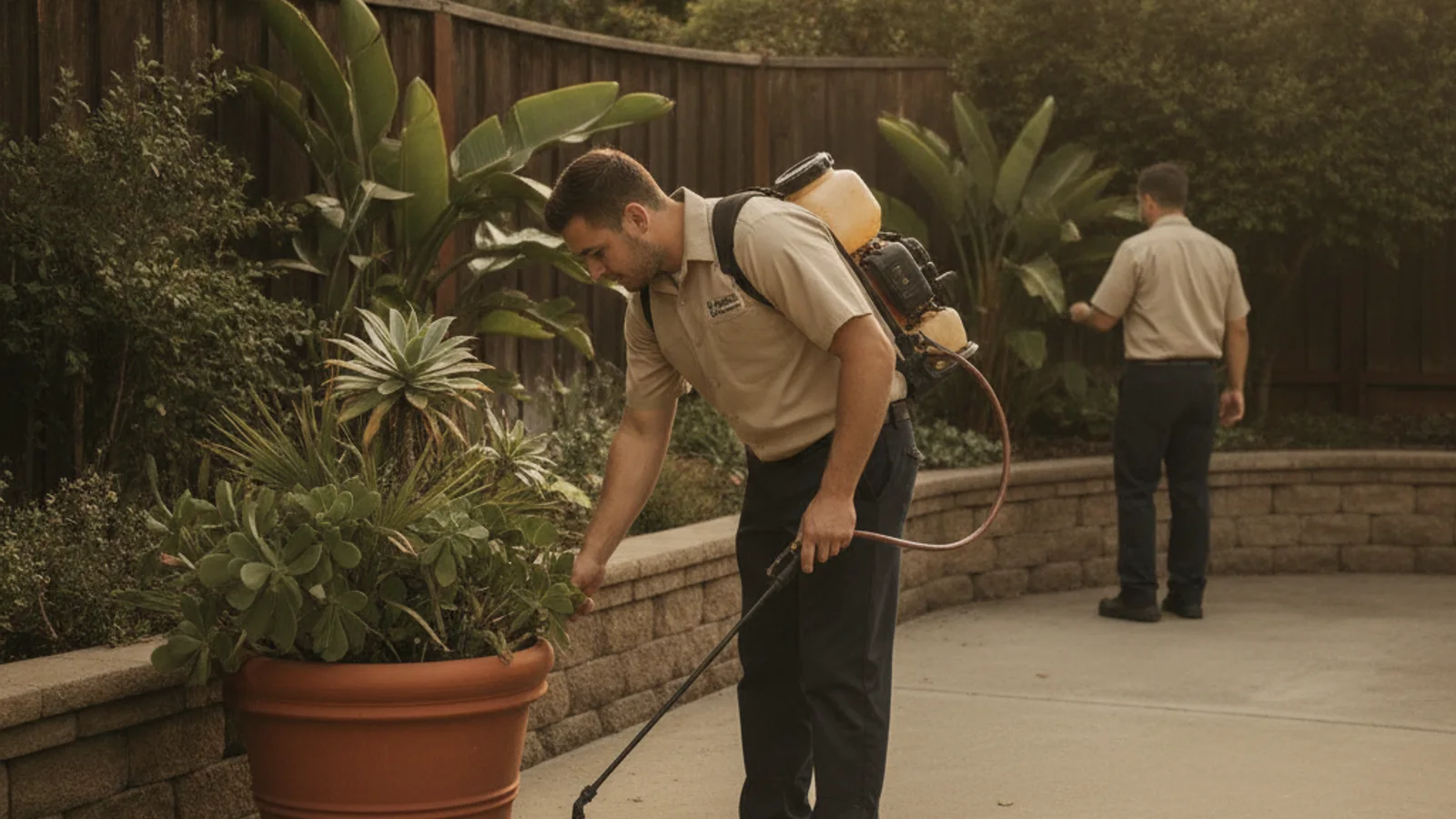
What an outdoor inspection should find first
Water comes first, and in San Diego County almost all of it is ours. Summers here are dry, so the standing water in a typical yard is irrigation overspray, a saucer under a potted plant, a clogged yard drain, a sagging tarp, a birdbath, a fountain, a rain barrel, or a pool nobody is maintaining. A walkthrough that skips those and heads straight for the shrubs has skipped the part that changes anything.
Ask the inspector to name what they found and where. The list should be specific enough that you can go stand next to each item. Plant saucers on a Pacific Beach patio, the low corner of a Chula Vista side yard where the drain backs up, a horse trough or irrigation line on an inland Valley Center property, a neglected pool at a vacant house next door in El Cajon. These are different findings and they lead to different work.
Resting sites are the second half. Adults hold in cool, shaded, humid cover during the day, so dense ground cover, the north side of a fence line, an unfinished crawlspace vent, and the shaded planting against a wall all belong in the notes.
Then there’s what’s outside your fence. The San Diego County Vector Control Program monitors mosquitoes by trapping, batching and testing them, and it also tests dead birds. West Nile virus can be found in all 58 California counties, San Diego included, which is why that surveillance exists. That program, not a private company, is where you report high mosquito activity, a green pool, or a dead bird, through SDVector.com.
The county also offers free mosquito inspections and free mosquitofish to San Diego County residents for artificial water sources like backyard fountains and ornamental ponds. Those are monitoring and education services from the county. No private company provides them, and none should describe them as its own. If a proposal implies otherwise, that’s a red flag about the rest of it. Our San Diego mosquito control guide covers the broader picture, and our post on Aedes establishment in San Diego gets into which species the county has been tracking here.
How source reduction differs from pesticide treatment
Source reduction is physical work on water and cover. Pesticide treatment is a product applied under a label. They aren’t interchangeable, and a scope that only contains the second one is incomplete.
Source reduction is the part that keeps paying. Dumping and scrubbing containers, re-grading a spot that puddles, clearing a blocked drain, fixing an irrigation head that runs onto concrete, screening a rain barrel, thinning shaded ground cover against the house. None of it is glamorous, and all of it removes the reason mosquitoes are producing in your yard rather than knocking down the ones already flying.
Product work does something narrower. It’s aimed at a defined area, for a defined period, under directions printed on a current label. We won’t tell you it controls your mosquito problem, because that depends on what happens with the water, on your neighbors, and on what the label actually permits. And we won’t publish an application schedule or a rate. That’s the licensed company’s call after it inspects, and it comes from the label, not from a blog.
A fair proposal shows both, separately, with who does which. If the source reduction is your homework, say so on paper. Some of it may be beyond what a pest company does at all, like a drainage correction or an irrigation repair, and that’s worth knowing before you sign.
Repellents are a third, separate category, and they protect people rather than treating property. Our roundup of mosquito repellents for a San Diego yard covers where those fit.
What to ask about children, pets, and product labels
Ask this before anything is applied, not after. The answers should come from the product’s current label, read aloud or handed to you, and not from a sales sheet or a website summary.
- What product, by name? Get it in writing. A category like “a barrier treatment” isn’t a product.
- What does the label say about people and pets in the treated area? Re-entry timing, drying, and any precaution are label terms. If it isn’t on the label, nobody gets to invent it.
- Where exactly is it going? Which plantings, which fence line, which surfaces. Ask what’s excluded: vegetable beds, a pond with fish, a play structure, a pet run.
- What about the pond or the fountain? Water features and fish change the answer. Say so up front.
- What’s the plan for beneficial insects and flowering plants? A reasonable company will have one.
- Who is licensed, and for what? General household pest work in California falls under SPCB Branch 2. Check the company and the individual on the Structural Pest Control Board license search.
We can’t tell you a mosquito product is safe around your kids or your dog, because that depends entirely on the product and its label, and we’re not the ones applying it. What we can tell you is that a company unwilling to show you the label is telling you something. The EPA’s guidance on safer pest control is a plain-language starting point on how to read one, and UC IPM publishes the same information without a sales motive.
How to compare monitoring and written service scopes
Two quotes at the same price can cover completely different work. Line them up on paper before you compare numbers.
Look for these in the written scope. What areas are included, by name. What the company does on each visit versus what it did on the first one. Whether monitoring is part of the program, and what gets reported back to you: which containers were found holding water, whether the count is going up or down, what changed since last time. A program with no reporting is a schedule, not a service.
Then check the boundaries. Does the scope cover the whole lot or the back yard. Does it include the neglected pool at the property line, which it probably can’t. Does it commit to anything about the neighbors, which it also can’t. Any warranty or re-treatment term belongs in that company’s own signed agreement, and it’s the only place those terms are real. We don’t set them, and we can’t promise them for anyone.
Price is worth an outside anchor so you know whether a bid is unusual. HomeGuide puts professional mosquito control at $80 to $150 per visit and $350 to $1,000 per season, a national benchmark. That’s a national guide, not a San Diego rate and not ours. The company you’re matched with inspects first and quotes in writing before any treatment begins.
Geography should show up in the scope, because the county isn’t one place. A coastal Encinitas yard with a shaded fountain and year-round marine humidity is a different job from an El Cajon lot that bakes all afternoon and holds water only where irrigation runs. A South Bay property near the Sweetwater or Tijuana River valleys sits next to habitat no contract covers. A scope that reads identically for all three wasn’t written for your property. Our mosquito control referral service matches homeowners across San Diego County with licensed local companies who work these areas.
When to call us
Mosquito work that involves applying a pesticide to your property needs a licensed applicator who inspects first and can explain the label. If you’ve dumped every container you can find and the biting hasn’t changed, or the source looks like it’s next door or in a drainage channel, that’s the point to get a professional set of eyes on it. Call us at (858) 400-6561 and we’ll match you with a licensed local pro.