
That scratching sound in the attic isn’t just the house settling. For many Escondido homeowners, it’s the first sign that rats or mice have moved in. Hearing scurrying in the walls or finding droppings in the garage can be unsettling, but it’s a common problem in our part of North County.
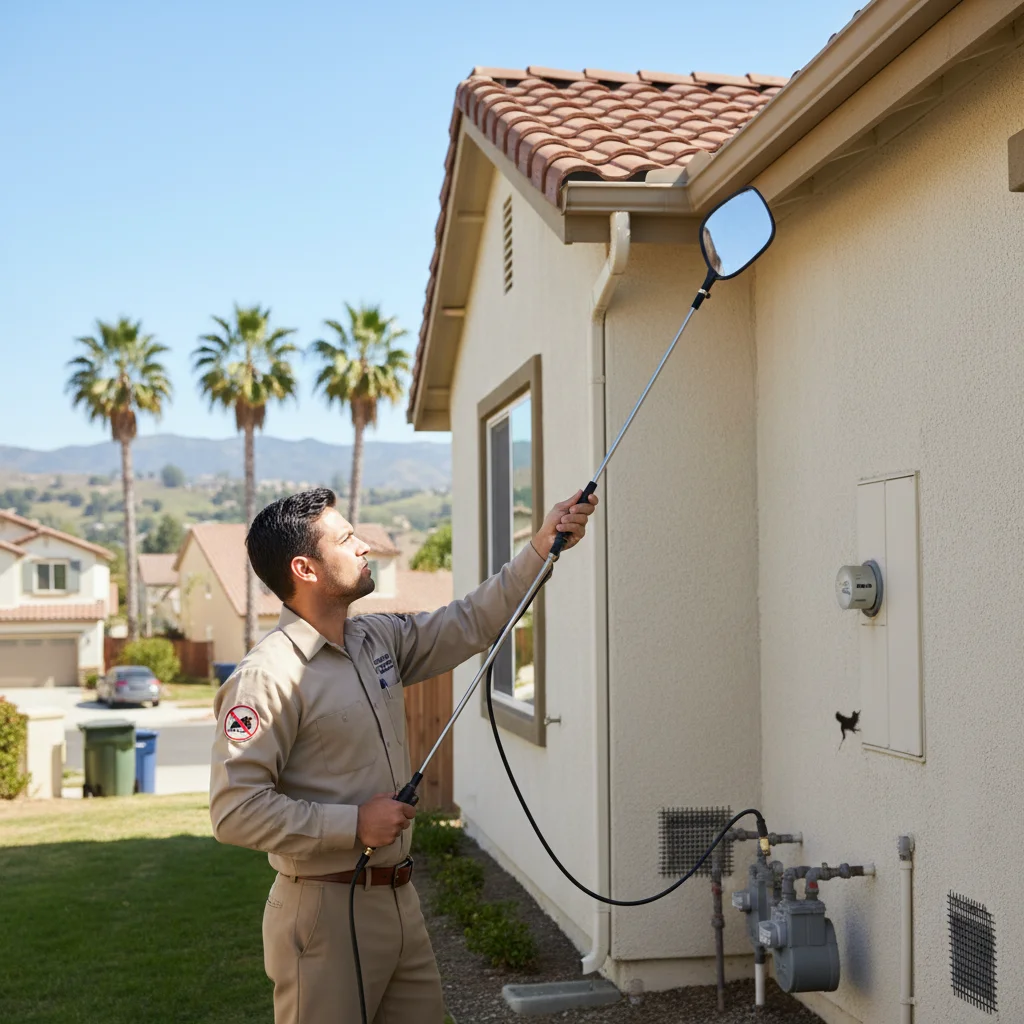
Why Escondido’s geography can lead to more rodent problems
Escondido’s unique landscape is part of its charm. We’re surrounded by rolling hills, canyons, and open spaces like Daley Ranch and the areas around Lake Hodges. UC IPM says roof rats usually live and nest aboveground in shrubs, trees, or dense vegetation, and that residential areas with mature landscaping provide good habitat. Escondido has plenty of both. As our communities have grown, we’ve built homes directly adjacent to their native habitats.
When seasons change or construction disrupts their environment, rodents seek new resources. Our homes offer everything they need: a steady water supply, reliable food sources from our pantries or fruit trees, and warm, protected places to nest. Fruit is part of the draw. UC IPM says roof rats consume avocados and citrus fruits, often while still on the trees.
Rodents are opportunistic. UC IPM says roof rats can often be seen at night running along overhead utility lines or fence tops, and advises removing overhanging tree limbs within 6 feet of roofs. San Diego County recommends trimming trees, bushes, and vines to at least 4 feet away from the roof. A tiny crack in the foundation or an unscreened attic vent is an open invitation.
Identifying roof rats vs. norway rats in North County homes
Not all rats are the same, and knowing which species you’re dealing with is key to effective control. In Escondido, homeowners typically encounter two types: roof rats and Norway rats. These are two of the most common rats in San Diego homes, and they have very different habits.
Roof rats (Rattus rattus)
Roof rats are excellent climbers. UC IPM says they typically nest in enclosed and elevated spaces, such as attics, wall voids, ceiling voids, and cabinets.
- Appearance: UC IPM describes roof rats as great climbers with a tail longer than the head and body, and with ears long enough to reach the eyes when folded over.
- Behavior: You’ll find them in the upper parts of your home, attics, rafters, and between floors. They travel along power lines and tree limbs to access your roof.
- Signs of infestation: Gnaw marks on fruit or nuts in your yard, rub marks caused by greasy rat fur, and, as UC IPM puts it, hollowed-out rinds hanging on the tree. Droppings size doesn’t separate the two species, so treat droppings as evidence of activity rather than a species ID. They are the ones you typically hear scratching and running overhead at night.
Norway rats (Rattus norvegicus)
Norway rats, also called sewer rats or brown rats, are burrowers who prefer to stay closer to the ground.
- Appearance: UC IPM describes a blunt muzzle and ears that do not reach the eyes when folded over.
- Signs of infestation: Burrows in the garden or along the exterior of the foundation. UC IPM notes the stocky Norway rat builds burrows along building foundations, beneath trash piles, or in woodpiles, and that indoors they tend to stay on the ground floor.
Correctly identifying the pest helps determine where to focus trapping and exclusion efforts. According to the UC Statewide IPM Program, understanding their distinct behaviors is critical for successful management.
What a rodent exclusion process involves
Trapping deals with the rodents already inside. Exclusion is the separate step that addresses how they got in, by sealing the openings they use. No exclusion scope promises a permanent result, so ask which openings and materials are included, which are not, and how anything found after the work starts is handled. Professional rodent control is built on this principle.
Here’s what the process looks like:
-
Thorough Inspection: A detailed inspection of your entire property, from the foundation to the rooftop. The technician looks for every possible entry point, no matter how small, San Diego County’s rodent proofing guidance notes that rats can enter through holes the size of a quarter or larger, and that holes should be repaired with 1/4-inch, 18 to 22 gauge wire hardware cloth. Rodent runways, nesting sites, and signs of activity are identified to understand the full scope of the problem.
-
Sealing and exclusion: UC IPM calls this the most successful and longest-lasting strategy for rat control around structures. San Diego County recommends repairing holes with 1/4-inch, 18 to 22 gauge wire hardware cloth, or sealing them with a combination of metal wool and expanding foam. UC IPM warns that rats can chew through plastic, foam, wood, and caulk, so ask which material is going on which opening. Common entry points include gaps around pipes, attic vents, roof intersections, and crawl space access points.
-
Trapping and Removal: Once the home is sealed, traps are placed inside to remove the rodents already trapped within the structure. This is done strategically based on the species and their travel patterns identified during the inspection. San Diego County says never to use baits indoors or under the house, because poisoned rats may die inside walls or attics, creating odors and attracting flies.
-
Sanitation and Decontamination: After the rodents are gone, the mess they left behind is addressed. Rodent droppings and urine can carry diseases and attract other pests. Contaminated insulation can be removed and accessible areas cleaned. San Diego County says not to sweep or vacuum up rodent droppings, urine, or nesting material, and to wear latex or rubber gloves and protective respiratory equipment during cleanup.
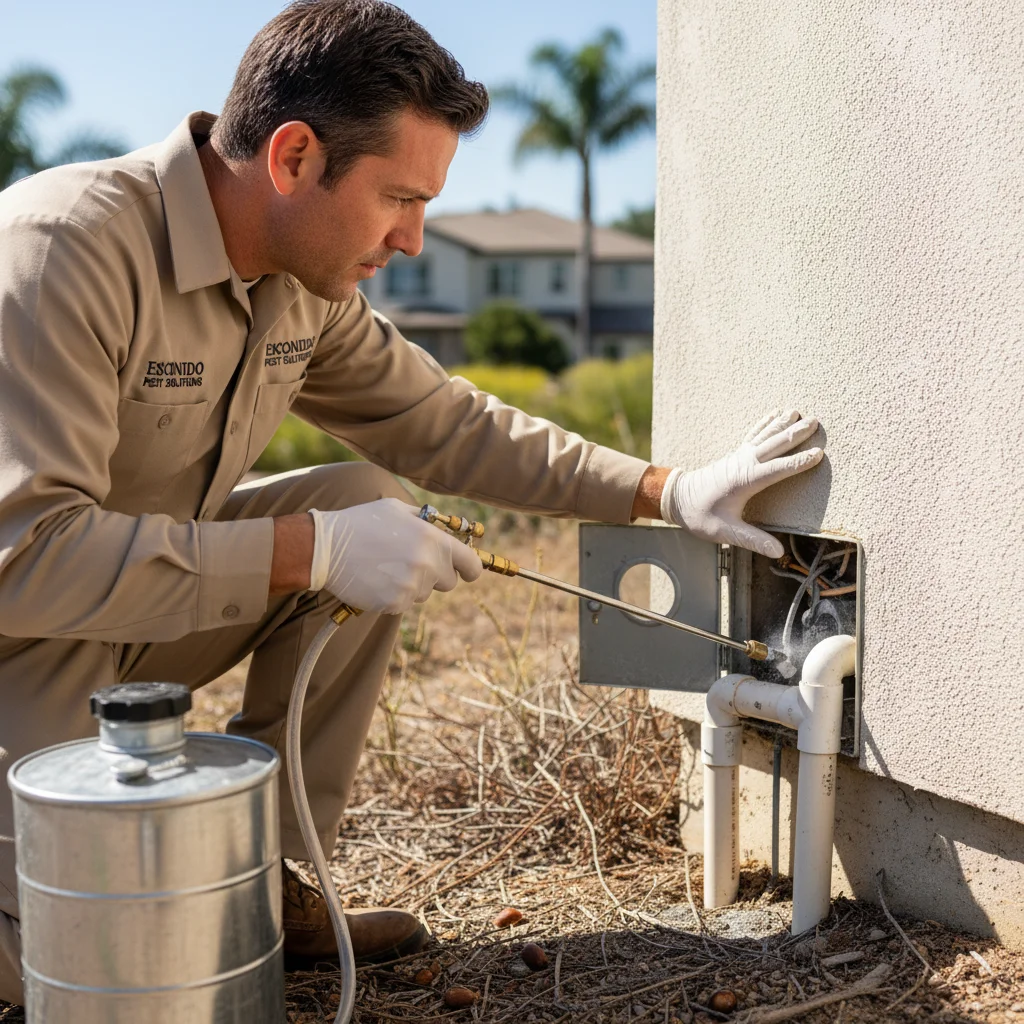
Choosing a local Escondido pest control service
When you need help with a rodent problem, choosing the right company makes all the difference. You want a provider who is not only effective but also licensed, and familiar with the specific challenges of our area.
First, always verify that the company is licensed by the state of California. You can check any company’s license status on the Structural Pest Control Board’s website. You can search by business name, license type, or license number. Cancelled licenses and registrations do not appear in the search results, so ask about anything you cannot confirm.
Ask what the company knows about your setting. Whether it looks at canyon edges, fruit trees, and fence lines, and which entry points it expects on a house built like yours, tells you how much of the quote is thinking and how much is a template.
Finally, a reputable company should put its plan in writing and base it on Integrated Pest Management (IPM). That means addressing entry points and conditions rather than relying on repeated chemical treatments alone. The conversation around DIY vs. professional pest control often comes down to whether the entry points get found and sealed at all. For public health information, the San Diego County Vector Control Program provides educational rodent inspections free to county residents, though it is not a pest control company and does not trap, bait, or remove rodents.
Frequently asked questions
Why are roof rats such a problem in Escondido?
Fruit trees, mature landscaping, and canyon-adjacent development give them both food and a route. Roof rats climb, so overhanging branches, fence lines, and utility lines become highways to the roofline, and from there they enter through unsealed vents, eaves, and gaps where roof meets wall.
Does trapping alone solve a rodent problem?
No. Trapping clears the current population, exclusion stops the next one. UC IPM calls exclusion the most successful and longest-lasting strategy for rat control around structures. Where open space sits next door, the structure is the part you can actually control.
What does rodent exclusion actually involve?
Sealing roof-line entry points, vents, and gaps, then cutting back the routes in. San Diego County recommends 1/4-inch, 18 to 22 gauge wire hardware cloth on holes and trimming trees, bushes, and vines to at least 4 feet away from the roof. Ask whether droppings and insulation cleanup sits inside the quote or beside it.
How do I check that a pest control company is licensed in California?
Look the company up with the California Structural Pest Control Board at pestboard.ca.gov before signing anything. The record shows license status and the branch held: Branch 1 is the control of household and wood-destroying pests by fumigation with poisonous or lethal gases, Branch 2 is household pests excluding that fumigation, and Branch 3 is wood-destroying pests and organisms by insecticide or structural repairs and corrections, also excluding fumigation. Termite work sits in Branch 3, or Branch 1 when the proposal is a whole-structure fumigation. The name on the record should match the name on your proposal.
When to call us
If you hear scratching in the walls, find droppings in your cabinets, or see signs of gnawing, it’s time to call a professional. San Diego County says rodents in homes can spread disease, contaminate food, and cause costly damage to structures. We match you with licensed and insured local companies that do rodent exclusion work on Escondido homes. The company you are matched with inspects, then quotes the work in writing.
Call us at (858) 400-6561 to get matched with a licensed local pro.
Rodents are one of many problems we handle in the area. See the full Escondido pest control lineup.