
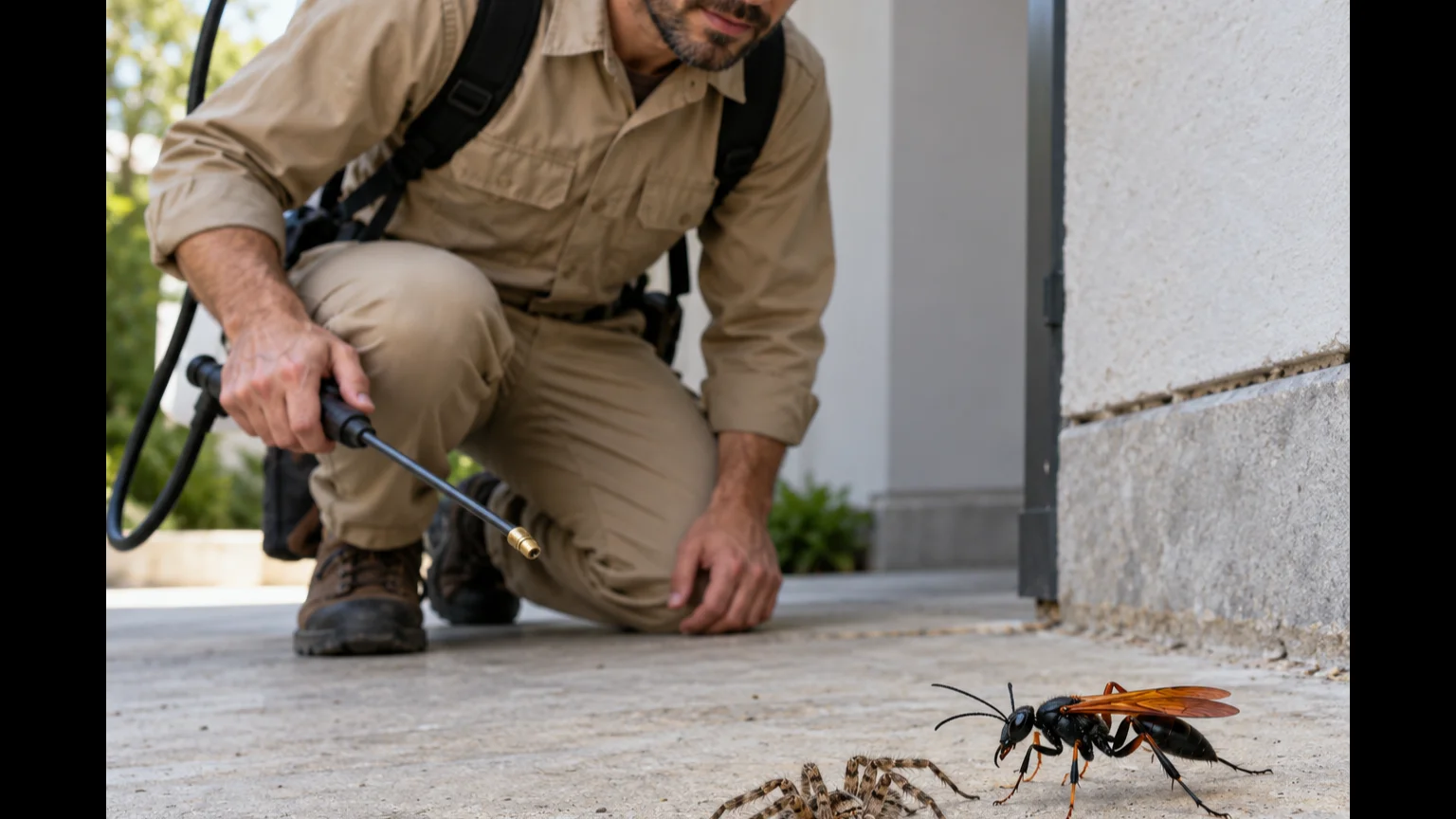
A dark, long-legged wasp near a spider can trigger a quick search for “pompilid wasp.” That search term is a starting point, not a confirmed identification. Clear photographs and exact location notes give an identifier something useful to assess.
What the spider wasp name covers
Treat “spider wasp” and “pompilid wasp” as proposed labels. Neither name confirms the exact insect in your photograph. A picture showing a wasp beside a spider also doesn’t prove their relationship.
The approved source file for this site doesn’t contain verified pompilid species descriptions. It also doesn’t support naming a San Diego species from color alone. We won’t fill that gap with a guessed species, range, or behavior claim.
Common names make online comparisons difficult. Different insects can look similar in a moving phone video. Lighting can change black, blue, brown, or reddish surfaces. Wings may overlap the body. Long legs can appear shorter when folded. A blurred waist or antenna can hide a useful distinction.
Start by separating the observation from the conclusion. “Dark wasp walking beside a spider” is an observation. “Spider wasp carrying prey” is an interpretation unless the recording clearly shows that action. This distinction matters when you send the material to an identifier.
Don’t rely on one search result or image match. Compare the unknown insect with our guide to an ichneumon wasp in San Diego. Also review the differences discussed in paper wasp or yellow jacket identification. Those pages address other identification paths without turning one visible trait into a final answer.
The goal isn’t to force a species name. It’s to gather enough evidence for a careful identification. A group-level answer may be the most defensible result from photographs.
Which body features and behavior to document
Begin with the whole scene. Take one wide photograph before trying close views. That image records the surface, nearby objects, and the insect’s position. Keep the original file because cropping can remove useful context.
Next, photograph the insect from more than one angle. Try to capture these details when they’re already visible:
- The full body from above and from the side
- The head and antennae
- The connection between the middle and rear body sections
- The wings at rest
- The front, middle, and rear legs
- Any visible color changes across the body
- The spider, web, hole, crack, or object nearby
Include scale without touching the insect. A paving joint, screw head, leaf, or other fixed object can help. State what the reference object is. Don’t report an exact body length unless the photo supports a real measurement.
Record behavior in plain language. Useful notes include whether the insect flew, walked, paused, entered an opening, or interacted with another animal. If it moved something, describe exactly what you saw. Avoid assigning a motive.
A short video can preserve movement that still images miss. Keep the camera steady and include the surrounding surface. One clear sequence is more useful than several tightly zoomed clips that lose focus.
Write down the date, approximate time, and setting. Note whether the sighting occurred indoors, against an exterior wall, on open ground, or near landscaping. If a spider was present, photograph it separately. Our guide to common spiders in San Diego can help organize that second identification question.
Documentation should record what’s present in the scene.
Whether San Diego County occurrence can be confirmed
A San Diego County occurrence couldn’t be confirmed from the approved sources available for this page. The source file doesn’t name a verified local pompilid species, distribution record, or county identification program for this group. That means a local species claim would be speculation.
“Found in San Diego” also needs a more precise location. San Diego County contains distinct coastal, inland, central, East County, and South Bay settings. A record from Encinitas isn’t interchangeable with one from El Cajon. Likewise, “San Diego” could mean the city or the entire county.
Record the city or community where you saw the insect. Add the nearest cross streets only if you’re comfortable sharing them privately. Don’t post a home address publicly. For rural land, a trail name or general area may provide better context than “East County.”
Useful location notes could say:
- Exterior wall in Chula Vista
- Paved patio in National City
- Open ground near a home in El Cajon
- Garden edge in Encinitas
- Indoor sighting in City Heights
Those descriptions document place without claiming the insect normally occurs there. One photograph establishes a possible sighting, not a wider range.
For independent reference material, consult the UC Statewide Integrated Pest Management Program. Search its current pages for the proposed group name and compare the source’s photographs, wording, and geographic scope. If no matching primary source appears, keep the identification marked as unconfirmed.
A licensed local company may also review the insect in the context of a property concern. Send the original images, video, date, community, and behavior notes. Ask the company to separate what it can identify from what remains uncertain.
When a licensed company should identify the insect
Professional identification makes sense when the insect is repeatedly entering a structure, activity centers on one opening, or the sighting affects how the property will be managed. It’s also reasonable when photographs produce conflicting names. A wrong label can send the next conversation in the wrong direction.
For household pest work, California’s Structural Pest Control Board describes Branch 2 as the branch covering household pests other than fumigation. Pest Pros San Diego doesn’t inspect, identify, or treat insects. We match property owners with licensed, insured local pest control companies holding the appropriate California credentials.
Before hiring, check the company or individual through the California Structural Pest Control Board license search. The public search can be filtered by business name, license type, license number, and location. Cancelled licenses and registrations don’t appear in its results.
Give the matched company your unedited evidence before discussing control. Include every location where the insect appeared. Mention whether the observations involved one insect or separate sightings, but don’t estimate a population from incomplete views.
Ask what the identifier can support from the evidence. A useful answer should distinguish among a confirmed identification, a likely group, and an unresolved specimen. Ask whether an in-person assessment is needed before any service is proposed.
If the concern involves an active wasp site, review our wasp and bee removal referral service. The company you’re matched with can inspect the property and explain its findings. Any treatment choice, written quote, and service terms come from that independent company after its assessment.
When to call us
Call when repeated wasp activity, an opening near occupied space, or an uncertain identification needs a licensed pest control pro. We’ll connect you with a company that can assess the evidence and property conditions. Call us at (858) 400-6561 and we’ll match you with a licensed local pro.