
Termite prevention is mostly building maintenance, not chemistry. UC Statewide IPM lists subterranean, drywood, and dampwood termites among California’s termite pests, and says subterranean termites are very abundant in most parts of California. The work that reduces your risk is the same work that keeps water and wood apart, and you can do most of it yourself.
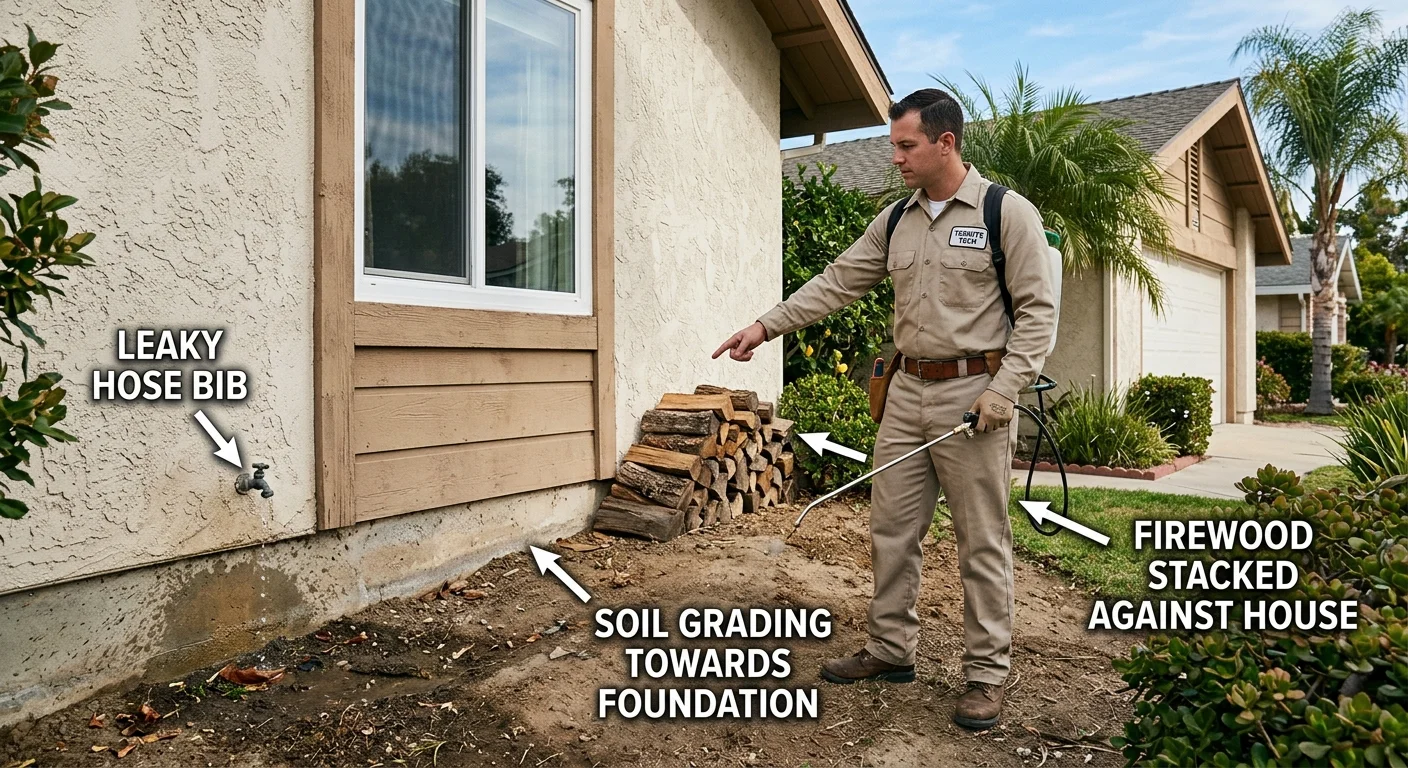
Fixing moisture issues that attract subterranean termites
UC IPM says subterranean termites require moist environments, and that to satisfy this need they usually nest in or near the soil and maintain some connection with the soil through tunnels in wood or through shelter tubes. Soil serves as a source of moisture that protects termites from desiccation. UC also notes that the optimal conditions for foraging, warm temperatures and high soil moisture, are usually present under and around buildings. That’s why damp ground against a foundation is worth your attention.
Look for the places where water collects or leaks over and over. Leaky pipes under sinks, inside walls, or at exterior hose bibs are the usual starting points. Air conditioning condensate dripping near the foundation keeps one patch of soil wet year-round. Poor drainage lets rainwater pool against the structure. Over-irrigating a lawn or a bed right next to the wall does the same thing on a schedule.
Fix the plumbing leaks first, indoors and out, including the hidden ones in crawl spaces. Clean the gutters and run downspout extenders so roof water discharges away from the foundation rather than beside it. Check that the grade slopes away from the structure. Water the landscape so the soil next to the wall isn’t kept saturated. UC IPM also says to keep foundation areas well ventilated and dry. A professional termite inspection starts in the same places, because the moisture is what makes the rest of the structure attractive.
The risk of wood-to-ground contact around your foundation
UC IPM says subterranean termites infest wood that is in contact with soil, or reach wood through earthen shelter tubes, and that reducing chances of infestation starts with removing any wood in contact with the soil. Direct wood-to-ground contact is the shortest route a colony can take into your framing.
Walk the perimeter and look at what touches dirt. Wooden fence posts set straight into the soil beside the foundation. A trellis, deck framing, or steps resting on the ground. Firewood stacked against the wall. Mulch piled up over the siding or window frames. Structural wood such as support posts, porch columns, or siding that runs down into the soil. UC IPM adds that stucco siding reaching the ground may promote infestations, since termites might travel between the stucco and the foundation unseen.
For the clearance figure, use UC IPM’s: ideally all substructural wood beneath the building should be kept at least 12 inches above the soil, and UC says to consult local building codes for exact minimum distances from wood to soil. Lift fence posts off the dirt with concrete footers or metal risers. Store firewood on a raised rack away from the house. Where wood has to stay near grade, UC recommends lumber that is chemically treated or naturally resistant, and exterior-grade pressure-treated lumber for anything exposed to weather. One caveat from UC: if susceptible wood sits above treated wood, subterranean termites can build shelter tubes over the treated wood and infest the untreated wood above.
Signs to look for during your own annual ‘inspection’
You aren’t going to replace a licensed inspector with a flashlight, but you can learn what to photograph. UC IPM points homeowners at the same evidence its professionals look for, and notes that telltale signs often sit in dark or hazardous places such as attics and tight crawl spaces, which is why it recommends contacting a licensed professional for the inspection itself.
Start with foundation walls, inside and out, and any undisturbed space you can reach safely. UC IPM says shelter tubes, sometimes called mud tubes, are the most commonly seen evidence of a subterranean termite infestation, and describes them as earth-hardened tubes made by workers using saliva mixed with soil and bits of wood or even drywall. Look along foundation cracks, at plumbing penetrations, and where the soil meets the structure. UC also lists darkening or blistering of structural wood as another possible indication, with damaged wood typically thin at the surface and easily punctured with a knife or screwdriver.
Shed wings are the other common find. UC IPM says reproductives shed their wings after their swarming flight, and that swarms of winged reproductives in the spring, summer, or fall are a sign of subterranean termite infestation. Don’t assume flying insects are termites: UC separates the two by the ant’s constricted, thin-looking waist against the termite’s broad waist, the ant’s smaller hind wings against the termite’s front and hind wings of about the same size, and the ant’s elbowed antennae against the termite’s antennae, which aren’t elbowed. Our post on signs of termites in San Diego has the visual comparison. For drywood termites, UC IPM says the fecal pellets, distinctive in appearance with six longitudinal flattened sides, may be the first clue to their presence.
Is professional preventative termite treatment worth it?
The DIY work above lowers your risk, but it doesn’t reach the colony. UC IPM is direct about the limits of what a homeowner can buy: there are no reliable over-the-counter termite control products available for the public in California, and all effective products are for professional use only. It also says do-it-yourself pesticides for use against termites are generally not effective.
What a licensed company can do, according to UC IPM, is apply liquid insecticides to the soil around and under the structure by drench or injection, or install slow-acting baits underground at intervals around the building. UC notes that chlorantraniliprole, fipronil, and imidacloprid are nonrepellent to termites and have been shown to be effective at low dosage rates under California’s climatic conditions, and that the most effective bait products use insect growth regulators and are available for professional use only. UC also explains why this is not homeowner work: applications in the wrong place can contaminate heating ducts or damage pipes under the building.
We’re a referral service, so we don’t inspect, treat, or price the work. What we’d tell you to ask is this. Is a preventative treatment being recommended on the strength of something the inspector actually found, or on a schedule? What is the evidence, where is it, and what does the written report say about areas that couldn’t be inspected? Get the scope and the price for termite treatment in writing before anyone starts, and remember that an inspection by a licensed pest management professional is required before any treatment is performed.
Frequently asked questions
What is the single most effective way to prevent termites in San Diego?
Break the contact between wood and soil, and keep moisture away from the foundation. UC IPM says subterranean termites require moist environments and usually maintain a connection with the soil through tunnels in wood or shelter tubes, and it recommends removing any wood in contact with the soil. Fence posts, deck supports, planter boxes against the wall, and stacked firewood are the usual culprits.
Is preventative termite treatment worth paying for?
That’s a judgment call about your specific building, and it should follow an inspection rather than precede one. UC IPM says an inspection by a licensed pest management professional is required before any treatments can be performed. Ask what was found, where, and which areas the inspector could not reach, then compare written bids.
What should I look for on my own between professional inspections?
Shelter tubes, which UC IPM calls the most commonly seen evidence of a subterranean termite infestation. Darkening or blistering of structural wood, with the surface thin enough to puncture with a screwdriver. Six-sided fecal pellets, which point to drywood termites. Shed wings after a flight. Any of those is a reason to book an inspection rather than to start treating.
How does San Diego’s climate change the termite risk?
UC IPM reports that drywood termites are commonly found along the Pacific coastal region, extending into the Central Valley and the deserts of Southern California, and that they can survive in very dry conditions without much moisture or soil contact. Subterranean termites are very abundant in most parts of California and depend on soil moisture, so irrigated foundations and landscape beds are the condition to manage. Which one you have is an inspection question, not a ZIP code question.
When to call us
If you’ve found evidence you can’t interpret, or you want a licensed opinion before you spend money on prevention, that’s the point to bring someone in. Call us at (858) 400-6561 to get matched with a licensed local pro.