
Something large and dark ran across the laundry room floor and disappeared near the drain, and the first word out of most people’s mouths is water bug. That nickname isn’t a species name, but it isn’t useless either. UC IPM ties it to one particular roach, and where you found this one will tell an inspector the rest.
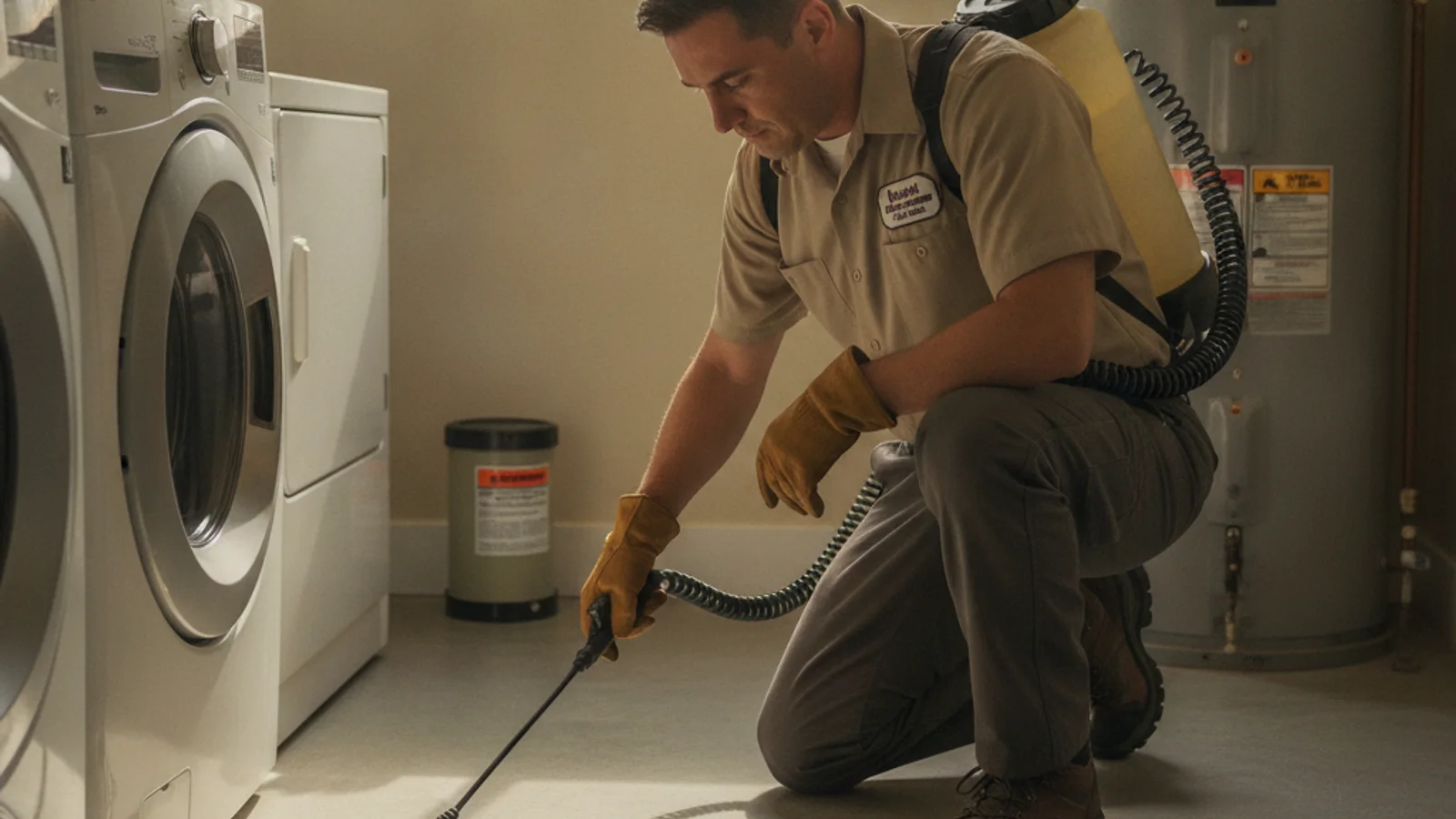
What people usually mean by water bug
In everyday use, water bug describes a big dark insect found somewhere wet indoors: a floor drain, a shower, a garage sink, a crawl space vent. It’s a description of a discovery, not an identification.
“Water bug” is not a species name, but it does point at one. UC IPM’s cockroach guide says the oriental cockroach, Blatta orientalis, is sometimes referred to as a water bug or black beetle, and that it lives in cool, dark, damp places like garages, basements, water meter boxes, and drains. That is the insect most people are describing when they use the nickname.
The oriental cockroach, the roach behind the nickname
UC IPM lists the oriental adult at about 1.25 inches and almost black. On males the wings are shorter than the body. On females the wings never fully form. Neither sex flies.
They also cannot climb smooth vertical surfaces, so UC IPM notes they turn up trapped in porcelain sinks and tubs after falling in or climbing up through damaged drain pipes. If you found a large dark insect stuck in a basin, that detail alone is worth reporting.
The habitat lines up with where people find them. UC IPM says orientals prefer cooler temperatures than the other species, and that populations often build to large numbers in masonry enclosures such as water meter boxes. At night they migrate into buildings looking for food, water, or mates, usually stay on the ground floor, and move more slowly than other cockroaches. UC IPM also says they are most likely in single-family homes surrounded by vegetation like woodpiles, ivy, and ground cover.
One caution before you settle on a name. UC IPM says the oriental cockroach is being displaced by the Turkestan cockroach in southern California, that the females of the two look similar, and that Turkestan females can be told apart by cream-colored markings behind the head and around the short, rounded wings. That is a job for the inspector, not a phone photo.
Why it probably isn’t a German cockroach
UC IPM calls the German cockroach the most common indoor species in California, especially in multi-unit housing. It is a small insect: about half an inch long, light brown, with two dark stripes on the shield behind its head. If what you saw was noticeably larger and darker, it likely wasn’t that species.
The German profile also wants different conditions. UC IPM describes warm, humid areas between roughly 70 and 75 degrees, close to food, water, and dark harborage, concentrated in kitchens, bathrooms, and food preparation areas. Of all the cockroach species in California, UC IPM calls the German the most persistent and troublesome. That profile fits a Chula Vista apartment kitchen better than it fits a drain in a detached Ramona garage.
So treat the nickname as a starting point, then get specific. Our cockroach types in San Diego guide is built for that comparison, and it’s a better first stop than a search for a nickname.
How shape, color, and location narrow the identification
Three observations do most of the work, and none of them require you to catch anything.
Start with size against a reference. Put a coin, a key, or a credit card in the phone photo. “Big” means different things to different people, and half an inch versus an inch and a half is the difference between two very different treatment plans.
Then look at the body outline and color in the photo, not from memory. Note whether the body is uniformly dark or has markings, whether the shield behind the head carries stripes or a pale band, and whether wings appear to cover the abdomen or fall short of it. Whether a roach can fly is its own common question, and our page on whether cockroaches can fly covers what that actually looks like.
Location may be the strongest clue of the three. Write down where it was, what time, and what’s nearby. A roach on a kitchen counter at midnight near a dishwasher gasket is a different story than one on a garage floor beside a sewer cleanout at dusk. One suggests indoor harborage near food and water. The other suggests something came in from outside or up from the plumbing.
Egg cases are worth photographing too. UC IPM notes the female German cockroach carries a light beige egg case about a quarter inch long until close to hatching. Finding cases indoors points to breeding on site rather than a single wanderer.
What none of this does is guarantee a species from an image, and we won’t claim otherwise. A photo narrows the possibilities and helps a licensed inspector arrive prepared. The confirmation still happens on site, with monitoring and a look at the harborage. Our page on what cockroaches look like has the visual comparisons to work from in the meantime.
Why drains and outdoor entry points suggest different plans
The route in shapes the whole job, which is why “found near the drain” is worth more to an inspector than the word water bug.
If activity clusters at floor drains, a sewer cleanout, a laundry standpipe, or the base of a toilet, the questions are plumbing questions. Is a trap dry from disuse? Is a cleanout cap missing or cracked? Is a vent screen broken? A dry trap in a rarely used guest bathroom or a vacation-rental laundry room is a straightforward thing to check, and it’s outside the scope of any spray.
If activity clusters at exterior thresholds, garage doors, hose bibs, irrigation boxes, and utility penetrations, the questions become exclusion questions: door sweeps, weatherstripping, escutcheons around pipes, and the mulch and irrigation right up against the foundation.
Which path fits your home is a question about the building, not the ZIP code. Does it have a raised foundation or a detached garage with a floor drain? Are there fixtures nobody has run in months? Does it share walls and plumbing chases with another unit? Is there irrigation or dense planting right against the structure? Write down the answers before anyone quotes you, because those are the conditions an inspector will want to see. UC IPM notes that during the day roaches hide in warm, dark, moist areas like cracks, water meter boxes, sewers, and crawl spaces.
UC IPM is blunt about the limits of chemistry here: pesticides alone will not solve cockroach problems. Its recommended approach pairs sanitation and exclusion with monitoring, using sticky traps to track where activity actually is, and treats baits as a supplement rather than the whole plan. That’s why an inspection that finds the route beats a treatment that doesn’t. Our cockroach control in San Diego page walks through how those pieces fit together.
What a licensed cockroach company should identify first
The order of operations matters. A company should identify the species, find the harborage, and find the entry route before it proposes a product, not after.
Ask for monitoring rather than a guess. UC IPM recommends sticky traps to track populations, and a few days of trap data tells you where the activity is concentrated far better than one walkthrough. Ask which rooms and exterior areas are in scope. Ask what sanitation and exclusion work is expected of you, because UC IPM’s point about pesticides alone applies to your side of the job too.
Set your expectations on speed from a source, not a sales pitch. UC IPM says it may take seven days or longer before you see fewer cockroaches after baiting. UC IPM also notes that the German cockroach has the fastest reproductive cycle of the common pest species, and that one female and her offspring can produce over 30,000 individuals in a year, which is why a slow first week isn’t a reason to abandon a working plan. We’re a referral service, so we don’t set follow-up schedules or promise elimination timelines. The licensed company that inspects your home sets those, in writing.
On credentials, general household pest work in California sits under SPCB Branch 2, and you can verify any company through the SPCB license search. The pros we match you with are licensed and insured and hold the appropriate California credentials for the work. Ask any company you’re considering to inspect first and put the scope and the price in writing before treatment begins. Our cockroach control referral service explains how we make that match across San Diego County.
When to call us
Call when you’re seeing roaches repeatedly, when they’re coming from a drain or a shared wall you can’t inspect, or when the species is still unsettled after a few photos, because identification and harborage work take a licensed pro. Call us at (858) 400-6561 and we’ll match you with a licensed local pro.