
The same thin line of ants keeps showing up on an El Cajon kitchen counter, even after you wipe it. That trail is a supply route, not the nest. Inland heat, irrigation, and slab gaps in East County housing keep sending workers back until a licensed company finds the colony and the conditions feeding it.
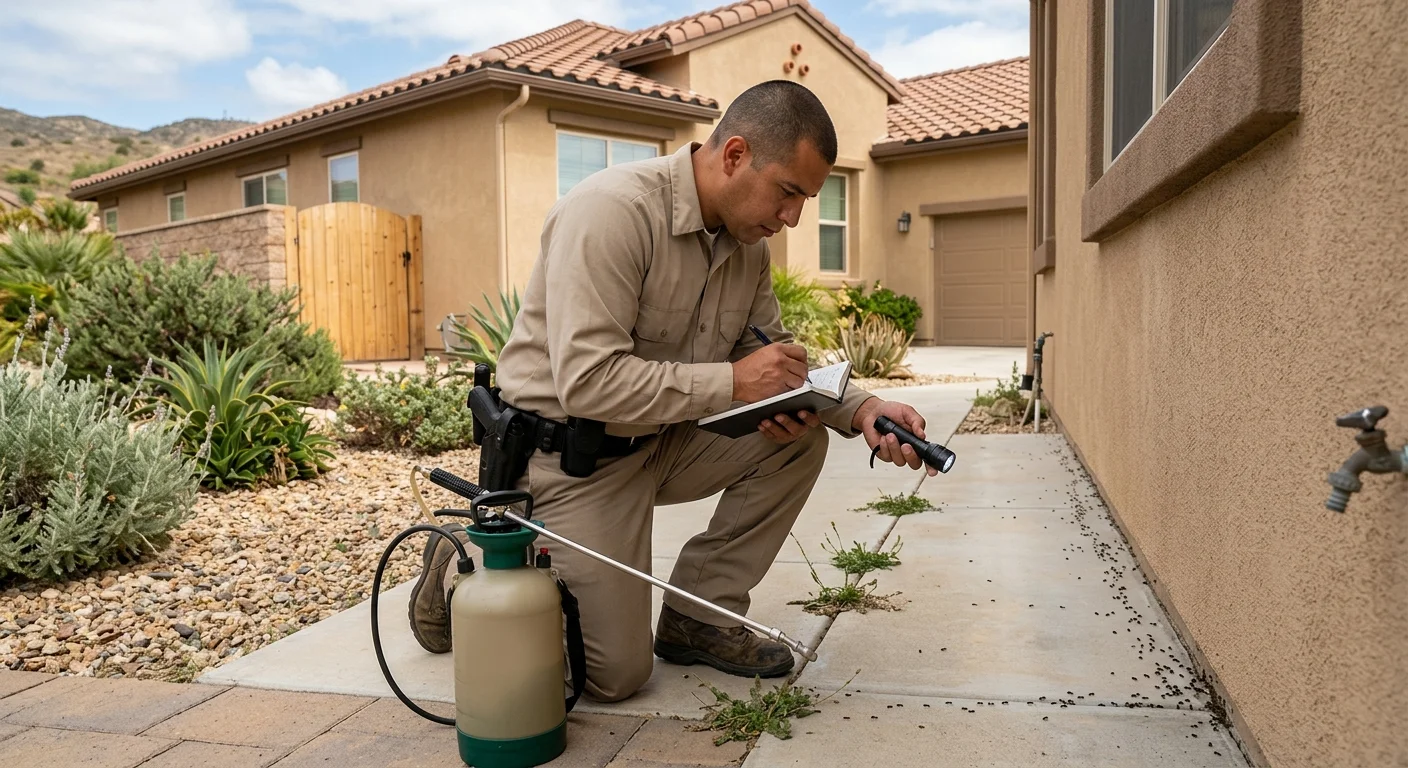
How to document the trail before calling
Wipe the line once, then watch where it rebuilds. Ants in El Cajon homes usually follow the same scent path back to food, water, or a gap in the slab. A photo of that rebuilt line is more useful than a wiped counter and a vague “they’re everywhere” call.
Write down the room, the surface, and the time of day. Note whether the line hits a pet bowl, a sticky bottle, a dishwasher kickplate, or a sliding-door track. Follow it as far as you can without spraying. Indoor workers often disappear into a baseboard, a window frame, or the gap where stucco meets the slab.
Step outside and keep looking. On many East County ranch homes the indoor line is only the last few feet of a much longer route. Check the foundation along Magnolia, Broadway, and the older streets around downtown El Cajon, where postwar slabs, expansion joints, and garage thresholds give ants an easy edge. Check hose bibs, AC condensate, and the first row of mulch or ice plant against the wall.
Take one clear photo of a few workers on a pale surface. UC IPM describes Argentine ants as about 1/8 inch, dull brown, with one node between thorax and abdomen. That match is common in California houses and gardens, but a photo is still only a starting point. Do not crush a pile of them and call it identification. Color in a phone photo can look black when the ant is brown.
Skip the spray can before the visit. A knockdown on the counter scatters foragers and can make the next inspection harder. UC IPM is the public authority on ant biology and baiting. For Argentine ants in particular, spraying the visible line is the move that often makes the problem worse. Our county guide on why spraying Argentine ants backfires covers that pattern in plain terms.
If you rent, note the floor, which wall is shared, and whether a neighbor has the same trail. El Cajon has a lot of multi-unit housing near Fletcher Parkway and downtown. Workers can travel in pipe chases and still show up in a clean kitchen. That detail belongs on the call, because the licensed company has to inspect the path, not only the room you saw.
Bring the notes when you ask for ant control. Pest Pros San Diego matches you with licensed, insured local companies. We do not inspect or treat the house ourselves. The notes help the company you are matched with quote the right scope.
Which El Cajon property conditions need inspection
El Cajon sits in an inland valley, east of La Mesa and west of the Lakeside and Alpine foothills. Summer heat here is harder than on the coast. There is less marine-layer relief than Encinitas or Oceanside, so irrigated soil next to a hot slab becomes the moisture ants will travel for.
Start with water you can see. Drip lines against stucco, overspray on the foundation, a leaking hose bib, and the AC drain line are classic East County attractants. Citrus, oleander, and dense groundcover hold honeydew from aphids and scale. Argentine ants tend those insects, so a “clean” kitchen can still feed a colony in the planter.
Then look at how the house meets the ground. Slab-on-grade ranches around Bostonia, Granite Hills, and the older core of El Cajon often have hairline cracks, utility penetrations, and garage expansion joints. Weep screeds and door thresholds pull foragers inside when the yard dries out. Homes with crawl spaces need that space checked too, especially if irrigation soaks the stem wall.
Mulch piled against the wall, firewood on the slab, and storage bins along the fence line all hide shallow nests. UC IPM notes that Argentine ants nest just below the soil surface in moist, protected spots, and go deeper when the ground dries. Under a rock, a flower pot, or a concrete walkway is enough. You will not usually find a single mound the way people picture fire ants.
Stinging ants are a different inspection. Southern fire ants are native and present in San Diego County, including inland areas. A painful sting from a mound in a lawn or playground is not the same problem as a kitchen trail. The red imported fire ant is a quarantined pest in California, administered by CDFA. San Diego County is not in that interior quarantine area, which covers all of Orange County and specified parts of Los Angeles and Riverside. A suspected find is still worth reporting to CDFA. Do not treat a mound by soaking it with a store spray. UC IPM warns that spraying a nest can scatter the colony and make control harder.
If workers are large and you are seeing damaged or hollow wood, say that on the call. That may be carpenter-ant work, which is a wood-destroying inspection, not a sugar-ant trail. Do not assume the species from size alone. The licensed company identifies what is actually nesting.
A citywide pest control El Cajon overview is useful for the housing mix. This page is narrower: the trail, the irrigation, and the slab. Those three are what keep ants in El Cajon homes after the counter looks clean.
Why worker activity doesn’t identify the colony
The ants on your tile are foragers. They are not the nest, and they are not a head count of the colony. Killing the line you can see leaves the queens and the brood in place. On Argentine ants, that matters more than on most other household species.
UC IPM describes Argentine ant colonies as linked, not separate. They form a large supercolony with multiple queens. Newly mated queens move with workers instead of founding a nest alone. That is why a trail can vanish from one kitchen and show up along the same foundation a week later. You did not “win.” The foraging shifted.
Indoor activity also fails as a map. Workers follow scent to a leaky fridge gasket, then go back through a wall void you cannot see. The nest may be under the walkway, at a neighbor’s drip line, or in a planter two doors down on a shared lot. In apartments, the nest may not be in your unit at all.
Season does not give you a clean off-switch here. East County stays warm enough, and yards stay irrigated enough, that Argentine ants forage through much of the year. Sweet liquid baits attract them year-round, per UC IPM. A quiet January week is not proof the colony is gone.
Store-bought sprays feel decisive because the trail disappears for a day. For Argentine ants, that knockdown can split foraging and push nesting into new gaps. UC IPM recommends liquid borate baits in refillable stations for severe Argentine ant infestations, used by people who can follow the label. That is not a mix-at-home recipe, and it is not a product we sell. A Branch 2 company (California’s license class for household pests, not fumigation) decides bait type, placement, and whether any other labeled product belongs on the job after an inspection.
If you want the county-level picture of how this species behaves in our climate, read ant control in San Diego. El Cajon’s piece of that story is the heat, the irrigation contrast, and the slab housing. Those conditions keep workers on the move even when the colony never steps fully indoors.
Do not wait on a ranking of “hardest pest.” There is no verified local survey that ranks household pests by difficulty in El Cajon. What you can say from UC IPM is simpler: Argentine ants are the most common ant in and around California houses and gardens, and their linked colonies are hard to finish with a counter spray.
What to compare in a licensed company’s scope
Ask for a written inspection before any treatment. The company should walk the interior trail, the foundation, and the irrigated edge of the yard. If they quote a spray of the baseboards and leave, you do not have a colony plan. You have a knockdown.
Compare what they will identify. Species first, then nest conditions, then method. Argentine ants, pavement nesters in concrete cracks, and stinging fire ants are not one product. UC IPM’s baiting guidance is species-specific. A scope that never names the ant is a scope you cannot judge.
Compare baiting versus barrier talk in plain language. For Argentine ants, slow-acting bait that foragers carry back is the method UC IPM points to for serious infestations. A perimeter spray can still appear in a professional plan, but it should not be the whole plan, and it should not be a consumer-grade fogger. Do not accept mixing instructions, application rates, or off-label use over the phone. The label and the licensee own those decisions.
Compare moisture and exclusion work. In El Cajon that usually means irrigation overspray, mulch against stucco, unsealed slab cracks, and door sweeps. The matched company may recommend repairs they do not perform. That is normal. Get those items in writing so you know what the pest visit covers and what a plumber or mason would handle.
Compare follow-up as their written term, not a brand promise. Pest Pros San Diego does not set re-treatment windows, warranties, or prices. The independent company you are matched with inspects first and quotes in writing before treatment begins. We have no ant fee schedule, and no verified local price grid for ant jobs sits in our claims file. Ignore round numbers you see on ads. Ask what is included, what is not, and who comes back if trails return.
Verify the license yourself. Household ant work in California is structural pest control, generally under a Branch 2 company. Fumigation is Branch 1 and is not how kitchen ants are handled. Search the California Structural Pest Control Board license lookup before you sign. Confirm the business name on the quote matches the listing.
If kids or pets use the yard, say so before anyone places stations. Ask where bait will sit, how it is secured, and what you should not disturb. The EPA’s consumer pesticide-safety pages are the plain-language backup for label rules. A good company will still walk the property instead of mailing a spray schedule.
When to call us
Call when the trail rebuilds after you wipe it, when you cannot find where it enters, or when stings or damaged wood show up with the ants. That is licensed Branch 2 work on a real El Cajon property, not a counter wipe. Call us at (858) 400-6561 and we’ll match you with a licensed local pro.