
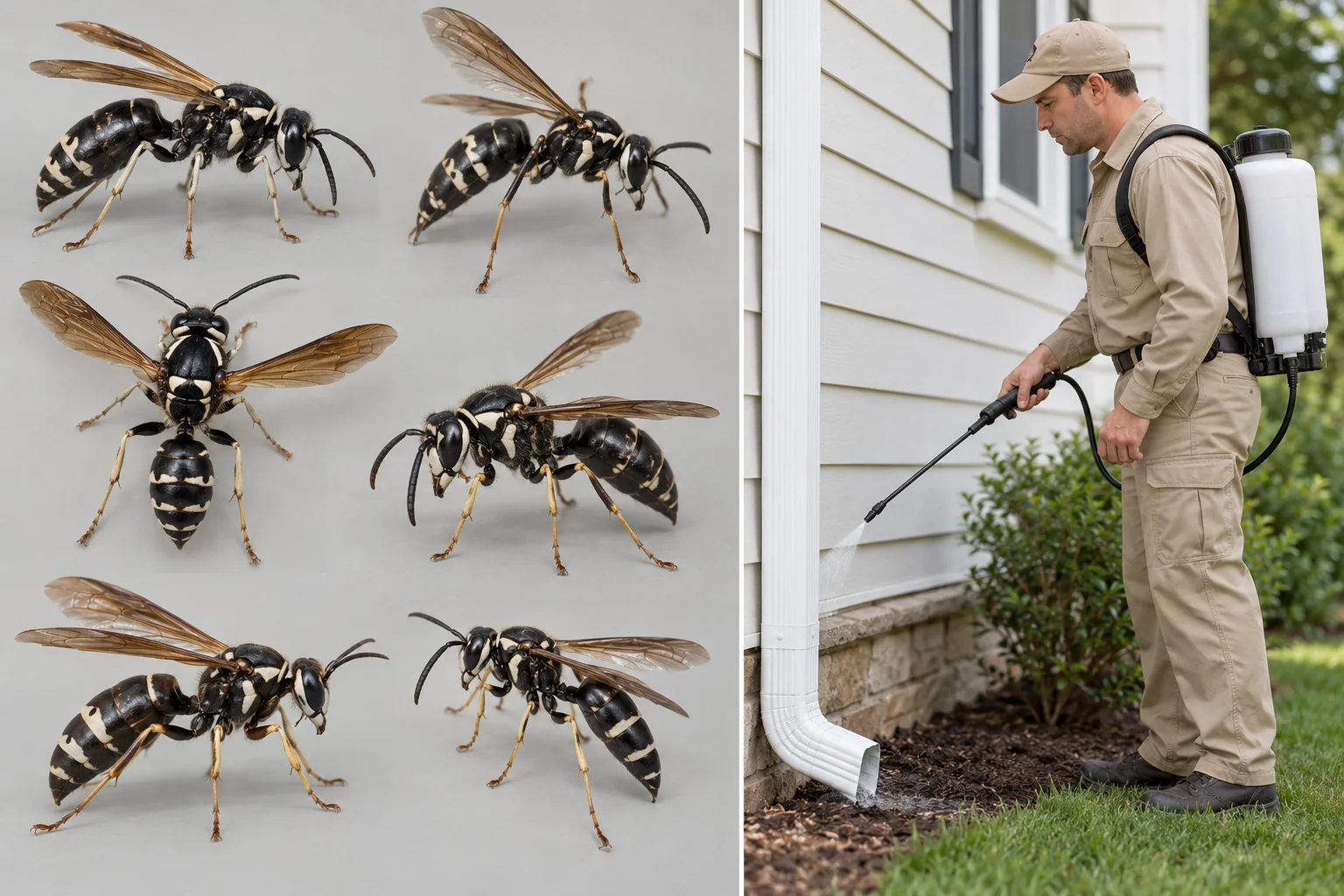
A black and white wasp can catch your attention without giving you a reliable identification. The useful next step is documenting its body, nest, location, and activity without assuming every similar insect belongs to one species.
Why color alone cannot identify a wasp
“Black and white wasp” describes an appearance, not a confirmed species. Photos online may attach that description to several insects. Their markings can also look different under shade, reflected sunlight, or a phone camera’s automatic exposure.
Start by separating what you observed from what you inferred. “The abdomen looked black with pale bands” is an observation. “It was a bald-faced hornet” is a species conclusion. That conclusion needs more evidence than color.
White, cream, pale yellow, and silver-gray markings can appear similar in a quick photo. Dust, glare, motion blur, and worn body surfaces can change the result further. Size is also difficult to judge without a neutral object in the same plane.
Body pattern matters more than a general color label. Note where each pale marking appears. It might be on the face, thorax, legs, or abdomen. Record whether the abdominal markings form complete bands, broken spots, or narrow edges. Don’t rely on memory after the insect leaves.
A nest can provide a second set of clues, but it doesn’t prove an identification by itself. Our guide to a paper wasp or yellow jacket explains why several visible details should be considered together. The related wasp nest and hornet nest comparison focuses on nest evidence.
The approved sources supplied for this page don’t confirm that one named black and white species occurs throughout San Diego County. That gap matters. A name from an out-of-state photo shouldn’t be presented as a local identification.
Which body features and nest evidence to document
A useful identification record starts with clear photographs. Capture the whole insect from above and from the side when those views are available. A front view can preserve facial markings. Don’t crop away the antennae, legs, or end of the abdomen.
Record these visible details in plain language:
- Overall body shape, including whether it looks compact or narrow
- The connection between the thorax and abdomen
- Antenna length, shape, and visible color
- Wing position while the insect is resting
- Pale markings on the face, thorax, legs, and abdomen
- Whether abdominal bands are complete, broken, or absent
- Approximate size beside a familiar object
- Whether the body looks smooth, hairy, glossy, or matte
Location adds context. Write down whether you saw it in coastal North County, the central city, East County, or the South Bay. Add the nearest city or community. A photograph from Oceanside doesn’t establish what appeared at an El Cajon property.
Document the exact setting too. “Near the house” isn’t specific enough. Better notes include “under a second-story eave,” “entering a soil opening beside the walkway,” or “moving through a gap near a roof edge.” These descriptions help a professional compare the insect with the structure or nesting area.
If a nest is visible, photograph its exterior shape and attachment point. Note whether you can see open cells, a covered outer surface, a mud structure, or only an entrance opening. Record whether one insect or several insects use the same location. Don’t assign the nest to the first flying insect that crosses the frame.
Short video can preserve movement and traffic patterns that still photos miss. Keep the original files. Heavy filters, sharpening, and digital zoom can alter small markings. The date, city, body views, and nest context together create a stronger identification record than color alone.
Which San Diego County species may match
A responsible local answer must separate possible names from confirmed occurrence. The approved claims ledger supplied for this page contains no verified San Diego County distribution entry for a black and white wasp species. It also provides no approved local record supporting a single species as the default answer.
That means this page can’t honestly tell you that every black and white wasp in San Diego is a bald-faced hornet, mason wasp, potter wasp, sand wasp, or ichneumon wasp. Those names may appear in search results and image tools. Their appearance online doesn’t confirm the insect at your property.
The same limit applies to range claims. A report from another California county doesn’t prove current occurrence in San Diego County. A photograph without a location doesn’t establish a local record. Even a matching color pattern can leave important body features unresolved.
For a research-based comparison, use the UC Statewide Integrated Pest Management Program and look for a page covering the suspected group. Check whether that source names San Diego County, Southern California, or a broader California range. If it doesn’t give a local distribution, treat local occurrence as unconfirmed.
Our ichneumon wasp identification guide covers another identification path when that group is being considered. Use it as a comparison, not as proof that your insect belongs to that group.
Local geography should remain attached to the observation. San Diego County stretches from coastal communities through inland valleys and East County. A dependable record includes the actual community and property setting. If a licensed company identifies the insect, ask what visible feature supports that conclusion and whether the identification is certain or provisional.
“Black and white wasp” is still a useful starting phrase. It narrows the visual problem. It just shouldn’t become a species label until the remaining evidence agrees.
When a licensed company should confirm the insect
Professional confirmation becomes useful when the insect keeps appearing at one structure, several insects share an entry point, or a nest is connected to an occupied area. It also makes sense when photographs don’t show enough detail for a defensible identification.
Send the company your original images before the visit if requested. Include the city, observation date, exact location, and any visible nest evidence. Mention whether the photographs show one insect or repeated activity. Those details help the company decide what must be examined on site.
Ask the company to identify the insect before discussing control. A color description alone shouldn’t determine the service. The company should explain whether the identification comes from the insect, the nest, the activity pattern, or a combination of evidence.
Pest Pros San Diego is a referral service. We don’t identify specimens, inspect nests, apply pesticides, or perform removals. We match customers across San Diego County with licensed, insured local pest control companies that hold the appropriate California credentials.
You can check a company or individual through the California Structural Pest Control Board license search. General structural pest work falls under Branch 2. Confirm the company’s current status and ask who will make the identification at the property.
Our wasp and bee removal service explains how we connect property owners with local companies. The matched company inspects first and provides its own written recommendations and quote before any treatment begins.
When to call us
Call when repeated activity, a structural entry point, or visible nest evidence needs confirmation from a licensed pest control pro. We’ll connect you with a company that can inspect the location and identify the insect before recommending work.
Call us at (858) 400-6561 and we’ll match you with a licensed local pro.