
To get rid of mice in San Diego, seal every gap wider than a pencil (about a quarter-inch) with steel wool, copper mesh, hardware cloth, or sheet metal, set snap traps along the walls and edges where mice actually run, and remove the food and clutter that keep them fed. Exclusion is the permanent fix. Trapping clears out the mice already inside.
House mice (Mus musculus) are the common indoor mouse across San Diego, a different animal from the roof rats that climb into local attics. If you’re not sure which rodent you’re actually dealing with, our guide on telling a rat from a mouse walks through the differences. UC IPM: when house mice have plentiful and stable resources, they can reproduce year-round, with high population densities that last for months to years. A mouse can enter through an opening as small as 1/4 inch. That’s why anyone searching how to get rid of mice in San Diego needs to start with sealing, not just traps.
How to tell if you have mice in San Diego
The clearest sign is droppings clustered near food sources and along walls. UC IPM: look for droppings, fresh gnaw marks, and tracks, which indicate where mice are active. This page does not publish dropping lengths. Beyond droppings, look for gnaw marks on cardboard, wood, and wiring, greasy dark rub marks along baseboards where their fur brushes the same path night after night, and small nests built from shredded paper, insulation, or fabric tucked into quiet corners. Scratching in walls or the ceiling after dark, especially in the evening, is a common complaint. A faint musky smell near a nest or a heavily used runway is another marker. If the droppings you’re finding look larger or more pointed, you’re more likely looking at a roof rat problem, which our roof rat removal guide covers separately.
How to get rid of mice in San Diego, step by step
Work these in order. Trapping without sealing the entry points just clears the way for the next mouse.
| Step | What to do | San Diego note |
|---|---|---|
| 1. Inspect | Find droppings, gnaw marks, rub marks, and the runways mice actually use | Check garages, canyon-adjacent walls, and behind appliances first |
| 2. Exclude | Seal every gap wider than a quarter-inch with steel wool, mesh, or sheet metal | Watch utility and pipe penetrations and weep screed gaps in stucco |
| 3. Trap | Set snap traps along walls, trigger facing the wall, in the spots you found runways | Garages and laundry rooms see the heaviest indoor traffic |
| 4. Clear food and clutter | Store pantry and pet food sealed, clear cardboard and clutter, secure trash | Dense landscaping and ivy against the foundation add pressure |
| 5. Monitor | Re-check traps and seals weekly, watch for fresh droppings | Older and canyon-adjacent homes need ongoing attention |
Start with the signs, not the traps. A mouse runs the same path along a wall or the edge of a room every night, so the droppings, gnaw marks, and rub marks you find during inspection are literally a map of where to set traps in step three. Skip this and you’re guessing.
Seal the entry points (this is the permanent fix)
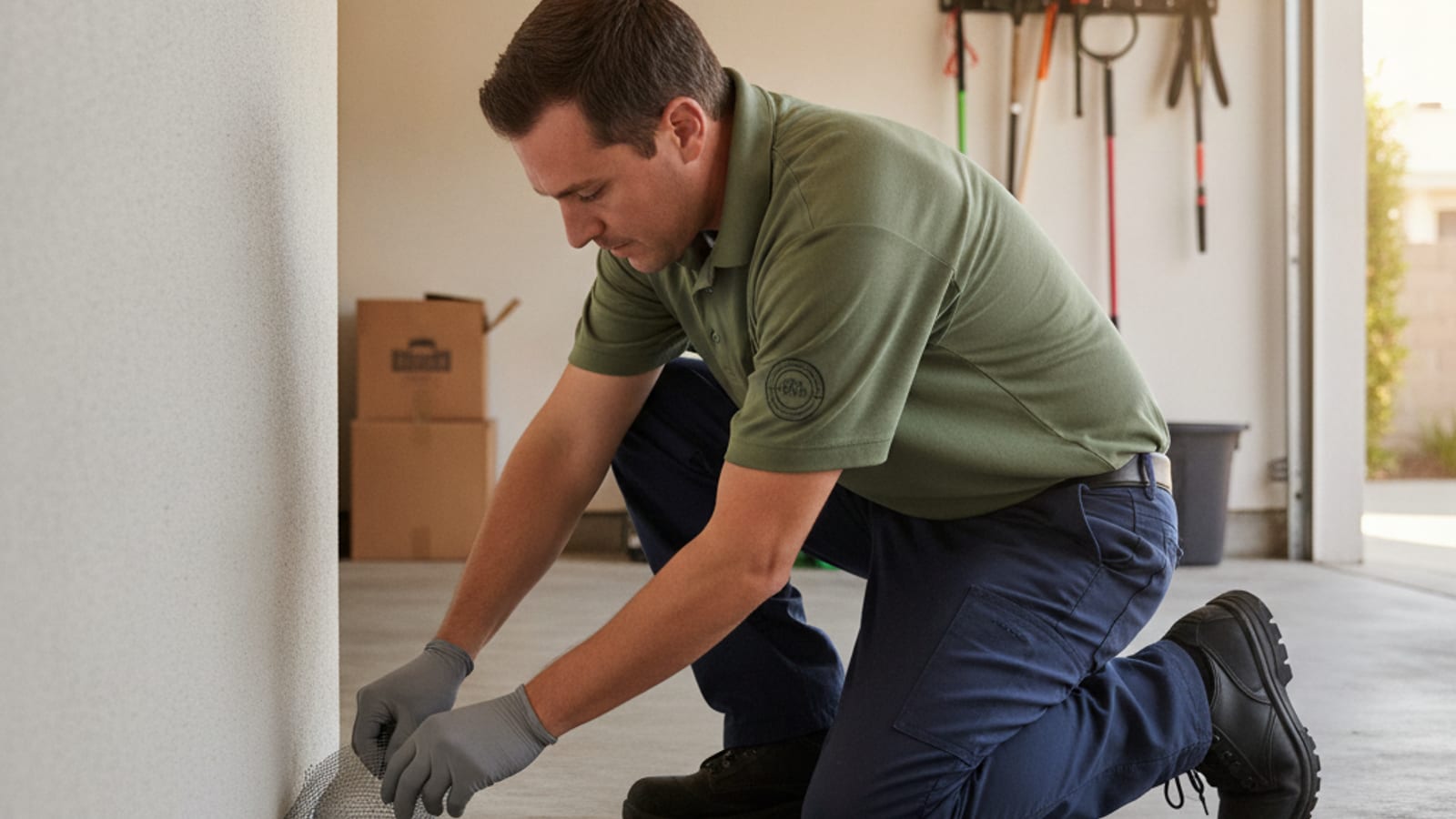
A house mouse squeezes through an opening about a quarter-inch wide, roughly the width of a pencil, so the rule for sealing is simple: anything that size or larger gets closed. This is genuinely how to get rid of mice in San Diego for good, not just for a week. Use materials a mouse can’t chew through: steel wool packed tight into small gaps, copper mesh or hardware cloth over larger openings, and sheet metal for a solid patch. Skip foam, caulk alone, or plastic, since mice chew straight through all three.
The most common entry points on San Diego homes are gaps under garage doors, openings where pipes and utility lines enter the wall, cracks along the weep screed where stucco meets the foundation, dryer vents without a proper cover, and simple gaps under exterior doors. Check all five before you assume the house is sealed.
Trapping mice the right way
Snap traps are the better choice over poison for most home situations. Place them perpendicular to the wall with the trigger end facing in, since mice hug edges and rarely cross open floor. Bait with a small dab of peanut butter rather than a big glob, which mice can grab without triggering the trap. Set more traps than feels necessary, close together along the runway, and check them daily.
Poison is a last resort, and there’s a real reason to skip it in San Diego. A poisoned mouse often dies inside a wall or under a floor, which means an odor you can’t reach for weeks. It also carries a secondary poisoning risk: owls, hawks, and neighborhood pets that catch or scavenge a poisoned rodent can be poisoned themselves. Traps let you remove the mouse and confirm it’s actually gone.
Keep mice out for good
Sealing and trapping stop the current problem. Removing food and shelter is what keeps mice from coming back. Store pantry food and pet food in sealed containers rather than bags, clear cardboard and clutter that make good nesting material, and keep trash secured with a tight lid. Outside, trim dense landscaping and ivy back from the foundation, since thick growth against the house gives mice cover right up to the wall. Older San Diego homes and anything backing up to a canyon stay under more pressure than newer, more open lots, so those properties need to stay on top of exclusion even after the current mice are gone.
When to call a pro
DIY sealing and trapping can clear a small, new mouse problem if you find the gaps. Structural exclusion across a whole house is licensed Branch 2 work when you hire it. San Diego County’s rodent exclusion page is the public checklist for holes, weather stripping, and hardware cloth. Use it before or alongside a quote. Cost context: rodent control cost in San Diego. Service type: rodent control. Verify a company at pestboard.ca.gov. Pest Pros does not send technicians and does not run a seven-day route.
Frequently asked questions
How do I get rid of mice in my San Diego home?
Seal every gap wider than a quarter-inch using steel wool, copper mesh, or sheet metal, then set snap traps along the walls and edges where you’re finding droppings and gnaw marks. At the same time, remove the food and clutter that feed them: seal pantry and pet food, clear cardboard, and secure trash. Exclusion closes off the next generation, and trapping removes the mice already inside.
Is mice removal the same as mouse control?
Yes, they describe the same work. Mice removal, mouse control, and mice pest control all mean trapping the active mice and then sealing the gaps they came through. Removal alone is the half that fails, because a house that still has pencil-width openings gets reoccupied within weeks. Ask the matched licensed company to quote trapping and exclusion as named line items. Pest Pros matches; it does not quote those jobs.
What’s the difference between a mouse and a rat?
House mice are smaller and tend to stay low, along baseboards and inside walls near ground level, while San Diego’s dominant rat, the roof rat, climbs and nests above ground in attics and rafters. UC IPM lists droppings as a mouse sign; this page does not size them. Our rat identification guide covers the full comparison if you’re still unsure which one you have.
How do mice get into a house in San Diego?
Mice come in through anything wider than a quarter-inch, which is smaller than most homeowners expect. The common entry points here are gaps under garage doors, openings where pipes and utility lines enter the wall, cracks along the stucco weep screed, unscreened dryer vents, and gaps under exterior doors. Older homes and homes with dense landscaping against the foundation tend to have more of these gaps.
Do mice go away on their own?
No. UC IPM: when house mice have plentiful and stable resources, they can reproduce year-round, resulting in high population densities that last for months to years. Left alone, a few mice can become a larger population if food and clutter stay available. The work that ends it is exclusion, trapping, or both.
Should I use poison or traps for mice?
Snap traps are the better choice for most homes. They let you remove the mouse and confirm it’s gone, while poison risks a dead-mouse smell trapped inside a wall for weeks and can secondarily poison owls, hawks, or pets that catch or scavenge a poisoned rodent. Traps placed along walls, paired with sealing entry points, are the more reliable approach.
How long does it take to get rid of mice?
A small, new problem can often clear in one to two weeks of consistent trapping once entry points are sealed. A larger or longer-running infestation takes longer and usually needs a full exclusion pass plus sustained trapping. The timeline depends on how many mice are already inside, how many gaps exist in the exterior, and whether food and clutter get cleared alongside the trapping.
Mice breed fast, and a few indoors become many. If you’re hearing scratching or finding droppings, call (858) 400-6561 to get matched with a licensed local pro. Start with the county exclusion checklist, then ask the company to inspect gaps before it quotes trapping.