
Fresh strands in the same patio corner mean that location still supports spider activity. For spider control in Poway, CA, the key decision is whether you’re seeing one outdoor web or a repeating pattern tied to prey, light, shelter, or access. Read the location before choosing a response.
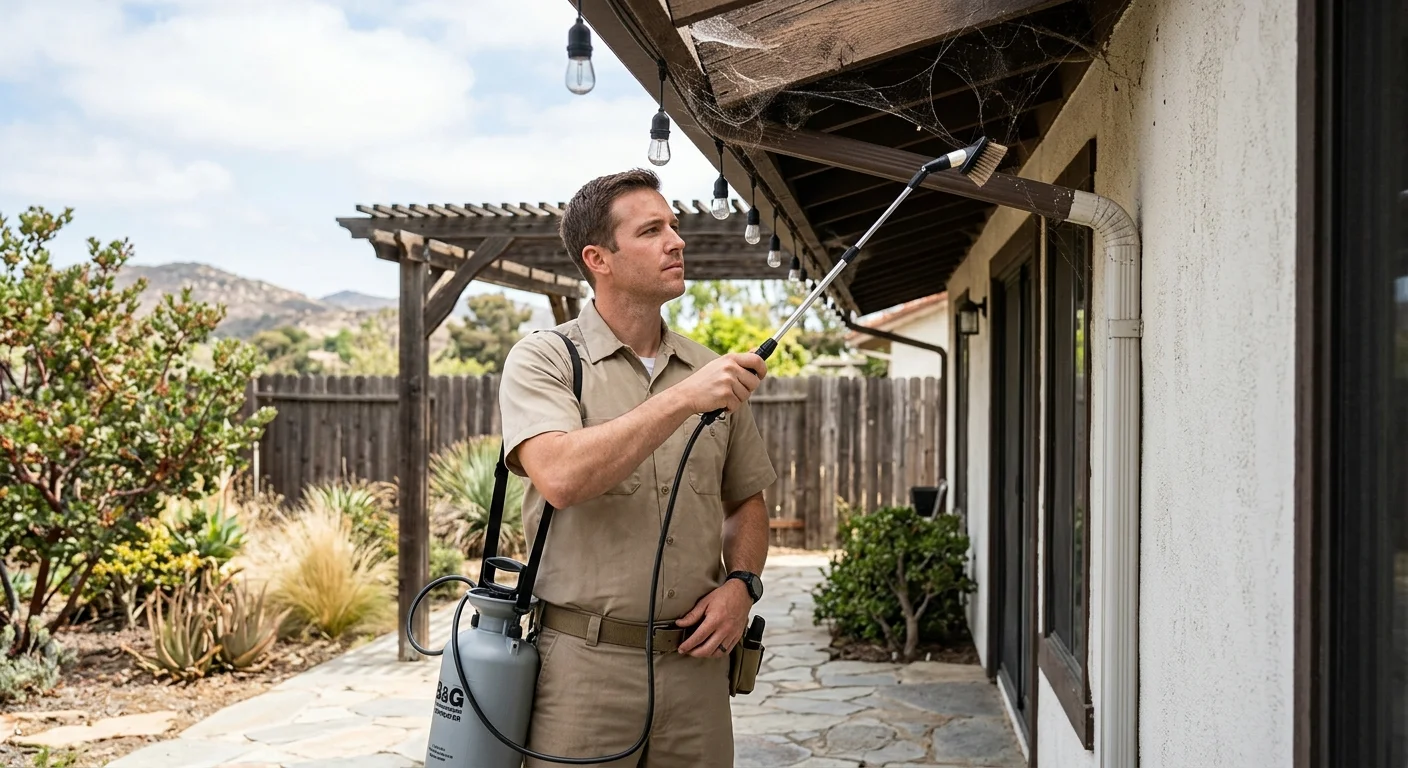
What the web can reveal about spider activity
A web is a location clue. It doesn’t confirm the species, the number of spiders, or whether they’re entering the house.
Start with the exact attachment points. A web stretched between an exterior light and an eave deserves a different check than one behind garage storage. Webbing beside a window frame also raises different questions than strands between shrubs.
Before clearing the web, record a few details:
- The exact wall, room, or outdoor corner
- Whether the web looks clean or holds dust and debris
- Nearby lights, doors, vents, screens, and utility openings
- Insects visible around that spot
- Vegetation, stored items, or fencing touching the structure
- Where fresh strands appear after the area is cleaned
That short record helps separate old webbing from new activity. It also shows whether the pattern follows one wall, one doorway, or several unrelated areas.
Poway properties need an address-level look. A patio near Poway Road may face different light and traffic conditions than a lot near Lake Poway. Homes off Espola Road can also meet open-land edges in ways that enclosed lots don’t. These are inspection variables, not automatic explanations.
Web shape alone shouldn’t become a species verdict. A clear spider photo can be compared with UC IPM identification information and our guide to common spiders in San Diego.
That distinction matters with widow concerns. UC IPM identifies the western black widow by its shiny black body and the red or orange hourglass beneath its abdomen. If the spider isn’t visible, the web can’t confirm that identification.
How prey, lighting, and entry gaps affect activity
Recurring webs often point to a useful hunting location. The spider may be responding to insects, protected anchor points, or both.
Exterior lighting is one place to start. Note which fixtures remain on and where insects gather nearby. Compare those areas with dark sections of the same wall. A repeated web beside one fixture gives the inspecting company a more useful lead than a general report of spiders outside.
Next, trace possible insect sources. Check around trash storage, pet feeding areas, damp plant material, and doors used after dark. The goal isn’t to blame one condition immediately. It’s to see whether the web sits where prey repeatedly passes.
Entry gaps matter when activity crosses indoors. Look at damaged screens, loose door sweeps, garage-door edges, pipe openings, and separation around frames. A web outside a gap doesn’t prove spiders are entering there. However, fresh webbing on both sides makes that route worth examining.
Vegetation and storage can change the inspection path too. Branches against an eave create different attachment points than an open stucco wall. Stacked boxes along a garage edge create sheltered spaces that aren’t present in the center of the room.
For a Poway home near Pomerado Road, the useful evidence may be a lit side entry. Near Twin Peaks Road, it could be one fence line connected to the eaves. If a lot borders open land near Blue Sky Ecological Reserve, record which side faces that edge. Don’t assume the entire property has the same conditions.
Repellents don’t replace this cause check. Our guide to spider repellents and what works explains why the location and source still matter. A product aimed at one corner won’t explain prey movement or an untreated entry route.
Why removing one web may not address the source
Web removal is useful because it resets the evidence. If fresh strands appear afterward, you’ve confirmed current activity at that location. Cleaning alone, however, doesn’t change the conditions that made the spot useful.
A returning web doesn’t always mean the same spider survived. The area may still offer anchor points, prey, shelter, or access. Another spider can use that location. That’s why repeated cleaning without tracking the pattern can feel endless.
Use each return as a decision point:
| Pattern after cleaning | Question to investigate | Next place to check |
|---|---|---|
| Same exterior corner | What remains attractive there? | Light, visible insects, and web anchors |
| Several spots along one wall | Is one condition shared? | Fixtures, vegetation, vents, and gaps |
| Just inside a door or window | Is there a possible entry route? | Screen, sweep, frame, and nearby exterior wall |
| Around garage storage | Is shelter hiding the source? | Boxes, wall edges, door perimeter, and ceiling corners |
This approach keeps the response tied to evidence. It also prevents every strand from being treated as a separate problem.
Avoid changing several conditions at once during your first check. If lighting, storage, vegetation, and webbing all change together, you won’t know which condition mattered. Document the area, clear the visible web, and watch where activity returns.
The same principle applies across the property. One web beneath a Poway patio cover isn’t the same pattern as fresh webbing around several interior windows. A single outdoor location may call for monitoring and maintenance. Repeated indoor activity may justify a closer inspection of entry points and prey insects.
Professional spider control should begin with that pattern. The company you’re matched with can evaluate the spider, the web location, surrounding insect activity, and possible access points before recommending work.
When a licensed spider inspection makes sense
A licensed inspection makes sense when the webs keep returning despite routine cleaning and basic property maintenance. It’s also reasonable when activity spreads indoors, appears around several entry points, or involves spaces you can’t examine clearly.
Identification is another reason to call. A web alone can’t confirm whether the spider is a western black widow or another species. If a shiny black spider has a red or orange hourglass beneath its abdomen, that matches UC IPM’s description of an adult female western black widow. Our black widow control guide explains what a licensed company can assess.
Ask the inspecting company to explain:
- Which spider was identified, if identification was possible
- Where active webbing and likely shelter were found
- Whether prey insects appear concentrated near the web
- Which lights, gaps, storage areas, or plants affect that location
- What nonchemical corrections belong in the plan
- What any proposed treatment targets
- Which follow-up terms appear in the company’s written agreement
California separates structural pest work by licensing branch. Branch 2 covers household pest control other than fumigation. You can review a company or individual through the California Structural Pest Control Board license search.
Pest Pros San Diego doesn’t inspect homes or perform treatments. We match Poway homeowners with licensed, insured local pest control companies holding the appropriate California credentials. The matched company inspects first, explains its findings, and provides its own written quote before treatment begins.
When to call us
Call when spider webs keep coming back indoors, appear across several areas, or point to a species concern that a web can’t confirm. We’ll connect you with a company that can inspect the pattern, identify contributing conditions, and discuss the available control options.
Call us at (858) 400-6561 and we’ll match you with a licensed local pro.