
You swept a small gritty pile off a window sill in the garage, and by Thursday it was back. That pile is either wood dust from something mechanical or it’s frass, the fecal pellets drywood termites push out of the wood they’re living in. Shape settles it faster than color, texture, or how much of it there is.
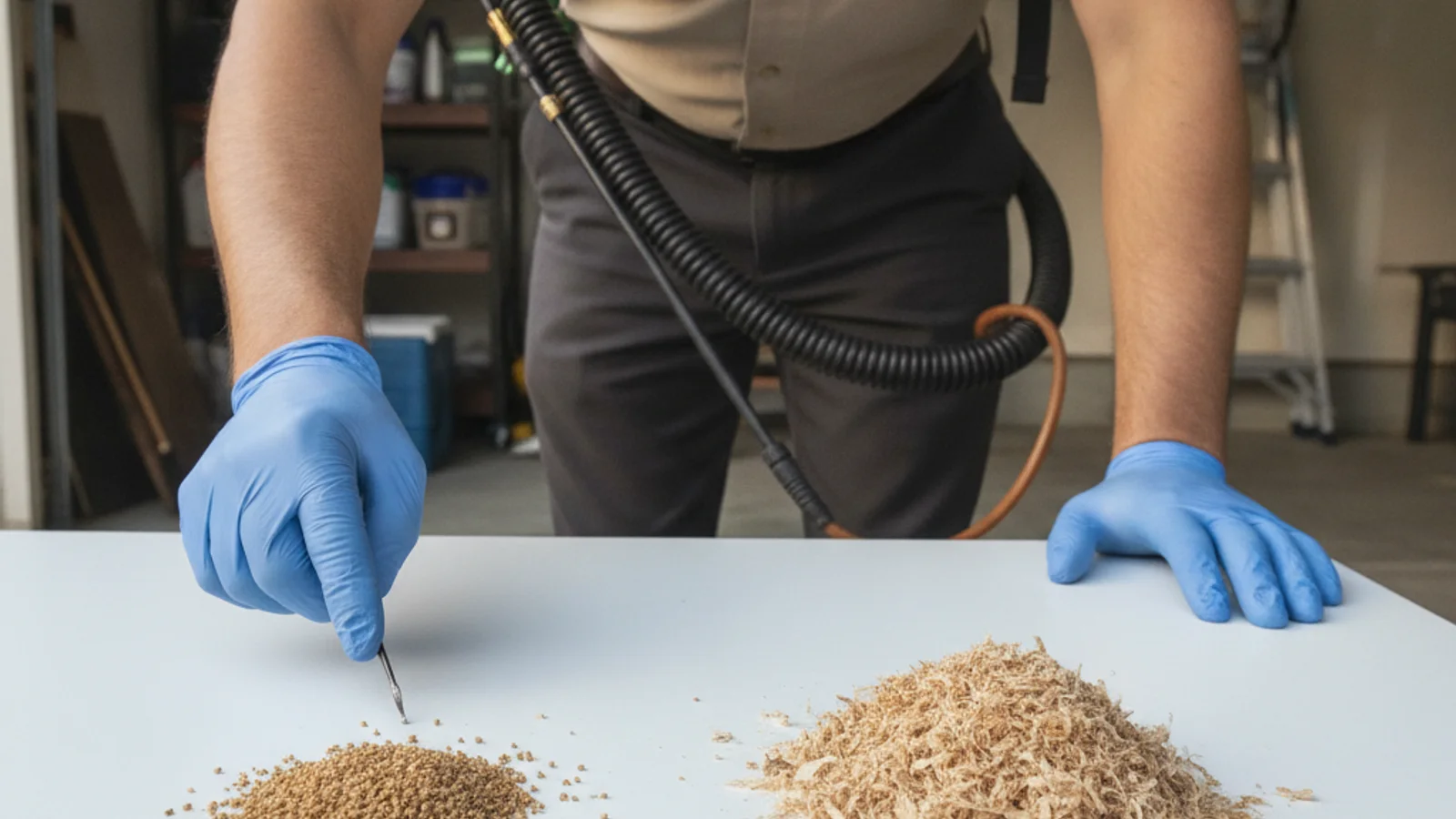
What termite frass looks like
Drywood termites eat wood and stay inside it. They don’t haul waste to a dump pile outdoors, so the pellets build up in galleries and get kicked out through small holes in the surface.
UC IPM is direct about the identifying feature. Its drywood termite guide states that fecal pellets have six hexagonal sides and are diagnostic for drywood termites. That’s the whole test. Six flat sides, each pellet shaped alike, and a pile made of individual grains rather than shavings or fluff.
UC IPM also describes the openings the pellets come through. Kickout holes measure less than 2mm in diameter, which is smaller than most people expect. You’ll often find the hole before you find anything else, a pinhole in painted trim with a fan of pellets under it.
The species behind most of this in our county is the western drywood termite, Incisitermes minor. UC IPM calls it California’s second most important termite pest and notes it’s commonly found along the Pacific coastal region and into the Southern California deserts. That covers Carlsbad and Coronado just as much as it covers Alpine.
Colony size explains why the pile is small. UC IPM says drywood colonies typically contain fewer than 1,000 individuals, far fewer than a subterranean colony. A teaspoon of pellets on a sill isn’t a minor finding, it’s the normal amount of evidence a real infestation produces. Don’t judge severity by volume.
To see what the insects themselves look like next to the debris, compare our guide to what termites look like in San Diego before you decide the pile is nothing.
How frass differs from sawdust and insect debris
Sawdust is a byproduct of cutting, drilling, sanding, or a chewing insect scraping wood away. It comes off in slivers, curls, and fine powder, and the particles don’t repeat one shape. Frass repeats one shape because it passed through an insect that makes it that way.
So the first question isn’t “which pest,” it’s “grains or shavings.” Put a little on a white index card and use your phone camera zoomed in. Distinct six-sided grains of consistent size point one direction. Mixed fibers and powder point another.
Then account for the boring things. A garage sill under a hanging tool rack collects dust. A door jamb someone drilled for a new strike plate leaves a pile that never comes back. Old construction debris sits in a crawl space for decades and doesn’t mean anything is alive up there.
Other wood-nesting insects also push out debris. Drywood termite pellets are the ones with a checkable shape, six sides with ridges between them, visible under a hand lens. Carpenter ants and wood-boring beetles leave something different, and sorting those out is identification work rather than a photo-chart guess. If your debris isn’t clearly hexagonal pellets, that means it needs identifying, not that it’s harmless. Our page on carpenter ant control in San Diego covers that separate possibility.
UC IPM states that fecal pellets with six hexagonal sides are diagnostic for drywood termites. That is the pellet test worth knowing. Mud-looking tubes on a stem wall are a separate finding from pellets on a sill. Photograph both and let a Branch 3 inspector sort them. Our comparison of drywood and subterranean termites walks through both, and our list of termite signs in San Diego covers the rest of the evidence set.
Where drywood termite evidence may collect
Pellets fall. That means you find them below the infested wood, not inside it, which is why the same handful of spots keep showing up across the county.
Look at interior window sills and the tracks of sliding doors, the tops of baseboards, the ledges of door casings, the floor under garage door trim, and attic surfaces below rafters and blocking. Anywhere gravity can drop a pellet onto a flat horizontal surface, it will.
Housing details change where that lands, so treat city names as a checklist of places to look, not as a report of infestations we have seen. Check exposed rafter tails, wood fascia, and window frames on older cottages. Check wood sills, detached-garage framing, and open attic blocking on Craftsman and Spanish revival houses. Check patio-cover lumber and workshops where the summers are hot and dry. On stucco tract homes, the accessible wood is often trim, jambs, eaves, and attached-garage framing.
Timing also helps. UC IPM notes drywood swarmers are visible during summer and fall daytime hours, which is a different window than what many homeowners assume. Discarded wings on a sill in August alongside a pellet pile is a stronger finding than either one alone.
Two more cautions. UC IPM notes the Formosan termite, a subterranean species, is currently restricted to a small area near San Diego, so no one should describe it as widespread here. And when the evidence sits in an attic, a wall void, or a crawl space you’d have to crawl into, stop and note the location. Poking at galleries destroys the evidence an inspector needs.
What a licensed inspector should confirm
A pile of pellets tells you evidence exists. It doesn’t tell you which wood members are infested, how many colonies are involved, or whether the right answer is localized treatment or whole-structure work. UC IPM states plainly that do-it-yourself treatments are not recommended for drywood termites, and that whole-structure approaches have the advantage of reaching hidden infestations that localized methods can miss.
So the inspection has jobs to do before any treatment is discussed. Confirm the pellets are drywood frass. Locate active kickout holes rather than old ones. Map the affected members. Separate drywood evidence from subterranean evidence, because soil contact and shelter tubes change the plan. Put findings in writing.
In California, that written product is usually a Wood Destroying Pests and Organisms Inspection Report, written on a form prescribed by the Structural Pest Control Board and issued by a company registered in Branch 3. Its findings cover visible and accessible areas only, which is exactly why an inaccessible attic bay or a sealed wall matters to the scope. Termite and wood-destroying work sits under Branch 3, general household pest work under Branch 2, and fumigation under Branch 1. You can check any company’s standing through the SPCB license search.
On price, Fixr’s termite exterminator guide puts a one-time termite inspection at $150 to $350, from a guide last updated in early 2025. We don’t set that number and we don’t have a fee schedule, so treat it as a market reference and get the actual figure in writing. The company you are matched with inspects first and quotes before any treatment begins. Our termite inspection referral service explains how that match works.
When to call us
Call once you’ve found repeating pellet piles, pinholes under 2mm in painted wood, or discarded wings on a sill, because confirming species and mapping the infested members takes a licensed Branch 3 inspection and a written report. Call us at (858) 400-6561 and we’ll match you with a licensed local pro.