
Most homeowners hear about heat before they’ve had anyone look at the problem. That’s backwards, and it’s how people end up paying for a method that was never matched to their building. The questions below are the ones worth asking before you sign anything.
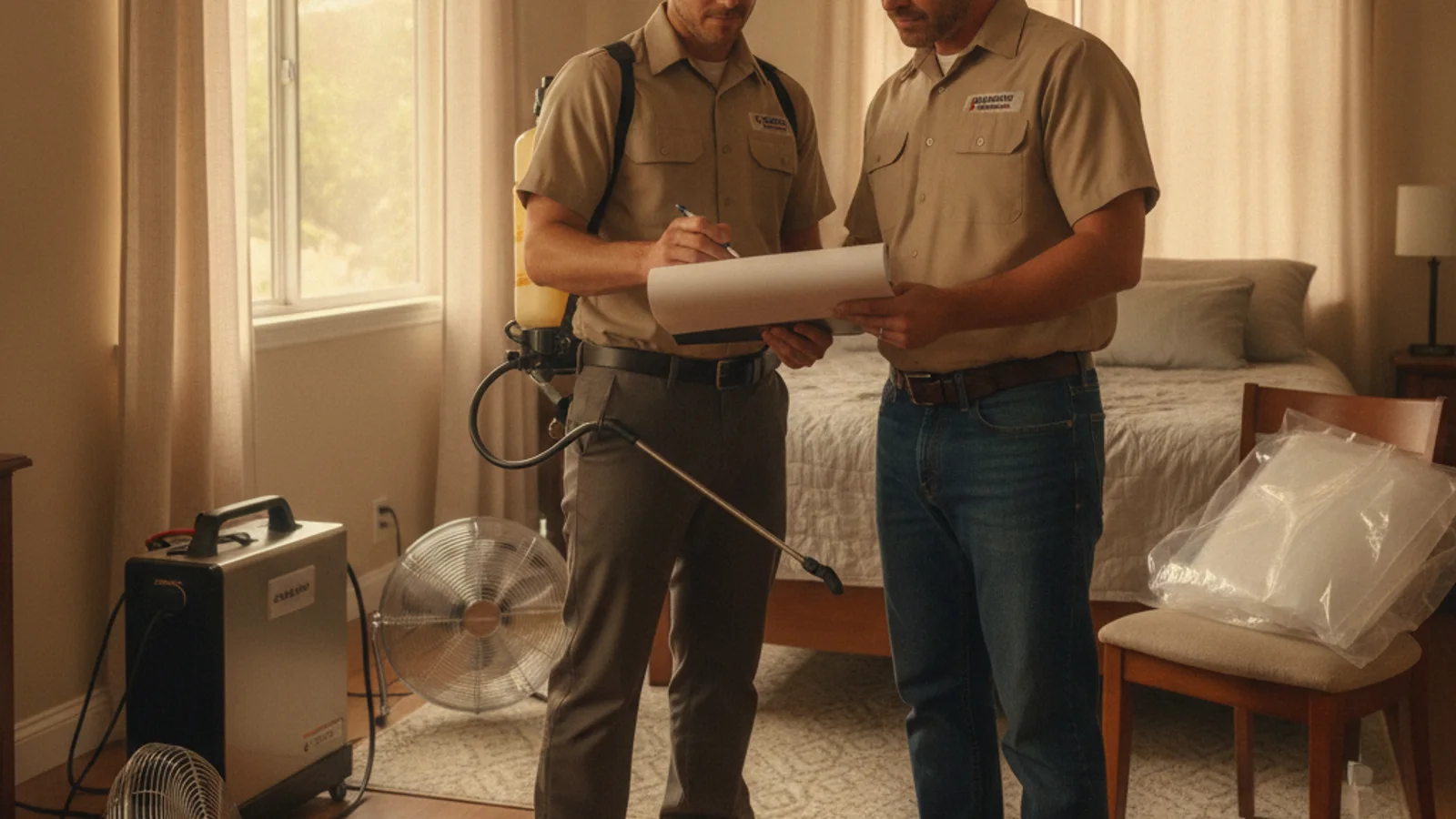
Why inspection comes before choosing heat
A treatment method is a conclusion, not a starting point. The inspection is what tells anyone whether bed bugs are present, which rooms are involved, and whether the infestation has spread past the bedroom. A company that quotes a method over the phone hasn’t seen any of that.
Ask what the inspection covers and how long it takes on site. Ask whether the inspector checks adjoining rooms, upholstered furniture, and shared walls, or only the bed. Ask what the findings will be given to you in: a written report is worth more than a verbal summary you’ll forget by dinner. Our professional bed bug inspection checklist lays out what a thorough one includes so you can compare against what you’re offered.
Identification matters more than people expect, because several insects get mistaken for bed bugs and the treatment plans aren’t interchangeable. If nobody has confirmed the species from an actual specimen, you’re buying a plan for a guess. Our guide on how to get rid of bed bugs in San Diego covers what confirmation looks like.
Building type changes the inspection scope too. A detached home in Poway or Alpine is a closed problem: the inspector can reasonably cover the whole structure. A unit in a Chula Vista or City Heights apartment building isn’t, because bed bugs move along shared walls, through utility penetrations, and with furniture in common hallways. Treating one unit while neighboring units stay unchecked is a known way to spend money twice.
If you rent, that scope question is partly a legal one. Under California Civil Code section 1954.605, after a pest control operator inspects units, the landlord must notify the tenants of the units that were inspected in writing within two business days of receiving the operator’s findings. Civil Code section 1954.602(a) also states a landlord “shall not show, rent, or lease to a prospective tenant any vacant dwelling unit that the landlord knows has a current bed bug infestation.” Our renters guide goes further into how those duties work.
What heat treatment can and can’t address
Heat is a whole-room or whole-structure approach that uses equipment to raise temperatures inside the treated space. Nobody should tell you it always works. UC IPM’s current recommendation for effective commercial heating calls for at least 140°F for two hours, or 130°F for three hours, with 113°F as the minimum lethal temperature. Those are air targets that have to be reached in the places bed bugs actually sit, which is the hard part. Ask the company what temperature target it works to, where it places its sensors, and how it documents that the target was reached and held. A company that measures and logs is telling you something real. A company that says “we get it hot” isn’t.
What heat does not do is change the conditions that let the problem start or return. It doesn’t seal a gap between units. It doesn’t address a piece of furniture that stays in a garage during the job and comes back afterward. It doesn’t cover a second bedroom that wasn’t in the scope.
There are physical limits worth asking about directly. Heat has to reach into voids, mattress seams, hollow furniture legs, and behind baseboards, and how well it does that depends on the space and the equipment layout. Ask what items have to be removed because they can be damaged: electronics, candles, musical instruments, aerosols, medications, artwork, and some plastics all come up. Ask what happens to items that can’t take heat, and get the answer before the truck arrives, not while it’s idling in your driveway.
Ask what the plan is if follow-up work is needed. Some plans are structured around a single heat visit with monitoring afterward; some pair heat with other methods in the same scope. Neither is automatically better, but you need to know which one you bought. No honest company promises one visit before it has inspected, and re-treatment terms belong to that company’s own written agreement.
Access is a practical filter in this county. Heat equipment needs power, and it needs a place to sit. A downtown high-rise condo may have HOA rules about elevator use, generator placement, and after-hours work. A canyon-lot home in La Jolla or Encinitas may have a long carry from the nearest parking. An older East County house may not have the electrical service the equipment expects. Ask how the company plans to power and stage the job at your address.
How preparation and monitoring affect the plan
Preparation is where most treatments succeed or quietly fail, and it’s almost always the homeowner’s job. Ask for the prep checklist in writing before you commit, and read all of it. Follow the company’s own written instructions, not a checklist you found somewhere else, because the details differ between companies and between methods.
Typical prep questions worth asking: what gets bagged and where do the bags go, what gets laundered and at what setting, what has to leave the property entirely, what happens to pets and plants, and whether anything needs to be moved away from walls. Ask how long you and any pets need to be out, and ask who tells you it’s safe to come back in. That last one should be the licensed company, based on its own procedure, not a time you picked.
Monitoring is the part people skip, and it’s what tells you whether the treatment worked. Ask whether interceptors or monitors are installed, who checks them, and on what schedule. Ask what result would trigger the company returning under the agreement you signed. Ask how they’ll distinguish a new introduction from a survival of the original population, because in an apartment building those are different problems with different fixes.
Documentation earns its keep here. Keep the inspection report, the prep instructions, the treatment record, and every monitoring result in one folder. If you’re a tenant, that folder is also your record of what you reported and when. Civil Code section 1942.5 protects tenants from specified retaliatory actions within 180 days after providing notice of a suspected bed bug infestation, and a dated paper trail is what makes that protection usable.
For a general grounding in how consumer and professional pesticide products are meant to be handled, the EPA’s pest control guidance is a reasonable starting point. It doesn’t replace the label or the licensee’s instructions for your job.
What to compare in written treatment scopes
Get two or three written scopes and put them side by side. Price alone tells you almost nothing, because two quotes can describe genuinely different jobs.
Compare these lines:
- Rooms and areas included. Named rooms, not “the affected area.”
- Method and equipment. Whether heat is the whole plan or part of it.
- What you must do. The prep checklist, attached to the agreement.
- Occupancy and re-entry. How long you’re out and who clears the return.
- Monitoring. What’s installed, who reads it, for how long.
- Follow-up and warranty terms. What triggers a return visit, in writing.
- Licensing. The company name and license exactly as it appears on the state record.
Verify that last one yourself through the Structural Pest Control Board license search. California puts general household pest work under Branch 2, and the board’s public search will show a company’s current standing. It takes two minutes and it’s the single best-value check on this list.
On cost, we have no fee schedule, because we don’t perform treatment. For a market reference point, HomeGuide put bed bug heat treatment at $1 to $3 per square foot, with a whole-job span of $2,000 to $6,000 for a 2,000 sq ft home (HomeGuide national benchmark)
If you’d rather have the comparison handled by someone who has seen your rooms, our bed bug treatment referral service connects you with licensed local companies.
When to call us
Bed bug work needs a licensed pro when the species hasn’t been confirmed, when the activity reaches more than one room, or when you share walls with neighbors. It also needs one when a first treatment didn’t hold, because that usually means the scope was wrong rather than the method. Call us at (858) 400-6561 and we’ll match you with a licensed local pro.