
Homeowners usually call about rats after the noise in the ceiling stops being deniable. The first quote often covers traps, and the traps do real work. What they don’t do is change the reason the rats found your house in the first place.
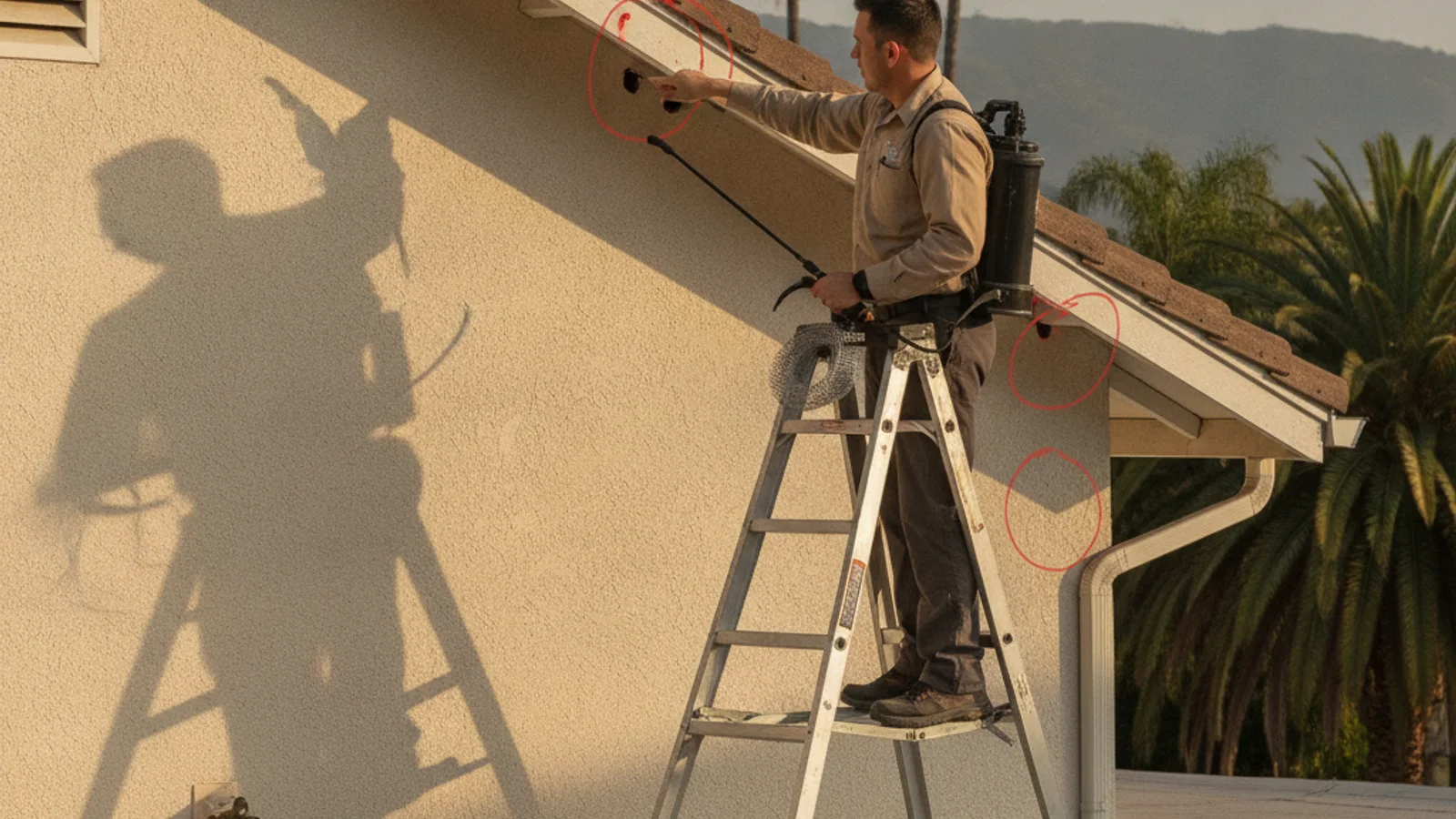
How rodents get into local homes
Rats follow lines. A branch touching a roof, a fence rail running to a soffit, a bougainvillea trained up a stucco wall, a cable or conduit entering under the eave: each one is a route, and each one ends at a gap that was never meant to be a door. Once inside, they use the same voids your wiring and plumbing use.
Species matters here, because the two common local rats behave differently. Roof rats climb and like the upper part of a structure, while Norway rats are heavier, burrow, and stay low. Our guide to the common rats in San Diego homes walks through telling them apart, and the roof rat guide covers the climbing pattern in more detail. Which one you have changes where anyone should be looking.
Geography changes it too. Coastal North County neighborhoods in Encinitas, Carlsbad and Cardiff have mature landscaping, canyon edges and older wood-framed additions, which is a good combination for a climbing rat. The central city’s older stock in North Park, Normal Heights and Golden Hill brings crawl spaces, raised foundations and detached garages into the picture. East County properties in Alpine, Lakeside and Ramona add barns, tack rooms, feed storage and long fence lines. In Chula Vista, National City and Imperial Beach, attached and multi-unit buildings mean a shared wall or a shared utility chase can carry activity between homes that belong to different owners.
There’s a local resource most people don’t know exists. The County of San Diego Vector Control Program offers free on-site rat inspections and a free Rat Control Starter Kit to county residents, and details are at SDVector.com. Those services are monitoring and education, not treatment, and no private company can offer them in the county’s place. They’re still a genuinely useful first look, especially if you’re unsure whether what you’re hearing is rodents at all.
What trapping can solve, and what it can’t
Trapping answers one question well: how do we remove the animals that are in here now. Snap traps placed where the licensed company reads the evidence, checked and reset on a schedule they set, will reduce a resident population. You get a countable result, and that matters when you want to know whether anything is working.
It also gives you information. What gets caught, where, and how fast tells the company whether they’re working a single animal that wandered in from a canyon edge or a population that’s been breeding in a crawl space. A trap line that goes quiet in a week reads very differently from one that keeps producing in the same corner of the attic for a month, and that difference should change the plan rather than just extend it.
Trapping does not seal anything. It doesn’t repair the gap at the eave, it doesn’t cut the branch, and it doesn’t remove the food and water that made the property worth the trip. A trapping-only program can run for a long time on a house that keeps refilling from outside, and the trap count starts to look like proof of progress when it’s really proof of a route.
Bait is a separate decision with its own considerations, and it belongs to the licensed applicator, not to a blog post. Product placement, the risk to pets and to non-target wildlife, and where a poisoned animal ends up are label and judgment questions. San Diego County Vector Control notes that baiting is illegal without a tamper-proof bait station that keeps children, pets, and nontarget animals from reaching the bait. Ask the company whether bait is even in the proposal, where stations would go, and what the current label requires. Do not treat a blog as a spacing chart.
Two related things a trap doesn’t fix. Contamination in an attic or crawl space is a cleanup and sanitation item that needs its own plan and its own protective equipment. And the hantavirus question comes up a lot. San Diego County Vector Control notes that wild mice can spread hantavirus. That is a wild-mouse disease question, not a species ID for a roof rat in a Mission Hills attic. For general background on rodents and disease, cdc.gov is the place to read, and any medical question goes to a clinician rather than to a pest company.
Why exclusion matters after rodents are removed
Exclusion is the physical work of closing the ways in. Hardware cloth over a foundation vent, sheet metal or mortar at a utility penetration, a repaired roof-to-wall junction, a rebuilt garage door seal, screened attic and eave vents, capped chimney, and a gutter line that isn’t doubling as a walkway. It’s construction-flavored work, and on a lot of houses it’s the part that actually ends the problem.
Nobody should sell it to you as permanent, and we won’t. Buildings move, seals age, landscaping regrows, roofs get worked on, and a new gap next year is an ordinary outcome rather than a failure. What good exclusion buys is that new activity has to start from scratch instead of walking a route that’s already open.
Sequence is where the decisions get real. Sealing a structure while animals are still inside can trap them in a void, which is worse than the problem you started with. Most programs remove first and seal as they confirm, and a company should be able to tell you which openings they’re closing now, which they’re holding open on purpose, and when that changes.
Then there’s the part that isn’t pest control at all. Trimming a tree back off the roof, keeping firewood and feed off the wall, fixing an irrigation leak, closing a pet-food bin, harvesting fruit before it drops: those change the property’s appeal, and they’re yours to do. If you’re weighing what to hand over and what to handle yourself, our comparison of DIY and professional pest control in San Diego lays out where the line usually falls. UC’s integrated pest management program at ipm.ucanr.edu publishes the habitat side of this in plain language.
Questions to ask a licensed rodent control company
Bring a short list to the estimate. The answers separate an inspection-driven program from a subscription to traps.
Ask what species they believe it is and what evidence told them so. Droppings, rub marks, gnawing, sound location and where the activity concentrates should all be part of the answer. Ask what the inspection covers: attic, crawl space, garage, roofline, exterior perimeter, and whether they intend to enter the spaces at all.
Ask whether exclusion is included in the price or quoted separately, and get the openings listed on paper. A line item reading “seal entry points” can mean two hours or two days. Ask about the order of operations, when sealing begins relative to trapping, and what triggers the end of the trapping phase.
Ask what products they plan to use, where, and what the label says about children, pets and wildlife. Ask who handles carcass removal, contaminated insulation and sanitation, since some companies subcontract that or leave it out entirely. Ask what happens if activity returns, and get any re-service or warranty terms in the company’s own written agreement. We don’t set those terms and we hold no license, so anything binding comes from the company you hire.
Then verify the license. Household pest work sits under California’s Branch 2, and you can check a company or an individual through the Structural Pest Control Board license search. Cancelled licenses don’t appear in that search, so an empty result is a question, not a clean bill of health. If price is the sticking point, our rodent control cost guide for San Diego explains which factors move a quote, and our rodent control page explains how we match you.
When to call us
Call when you’re hearing activity in a ceiling or wall, when trapping has been running without an end in sight, or when the entry points are on a roof or in a crawl space you shouldn’t be in. A licensed company can identify the species, inspect the structure, and quote trapping and exclusion as the two separate jobs they are. Call us at (858) 400-6561 and we’ll match you with a licensed local pro.