
A pale cluster inside a wall void can look like decisive proof. It isn’t enough to confirm termite eggs from a household photo. The useful next step is documenting the surrounding evidence for a licensed inspection.
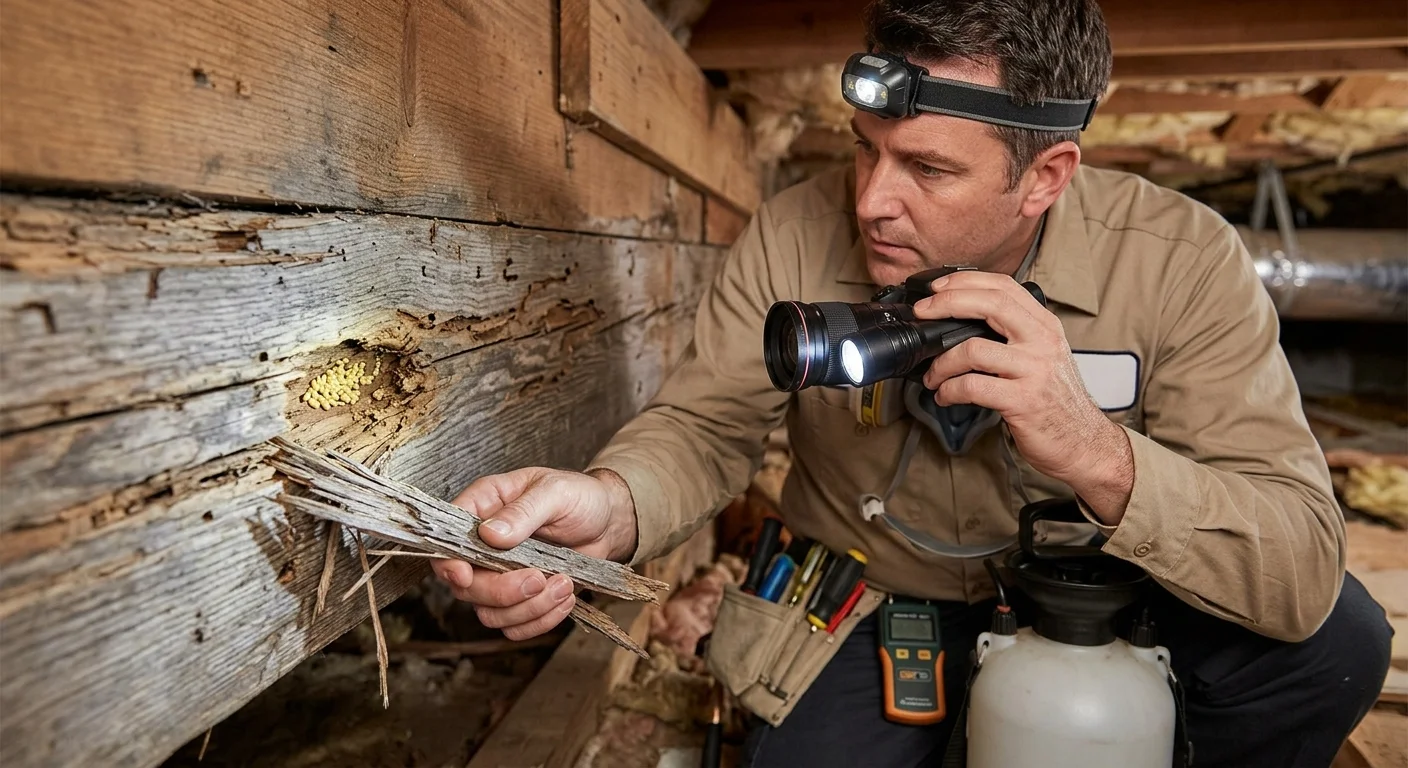
Why visible eggs don’t confirm termites
A picture of small objects near wood doesn’t confirm termite eggs. Their identity depends on where they were found and what surrounds them. A close photo can preserve that context, but it can’t replace an inspection.
There is a structural reason the cluster is hard to place. Termite eggs are laid by the queen deep inside the nest, and the colony’s workers care for the eggs and immatures there. UC IPM describes the queen’s main function as laying eggs, sometimes thousands in a single day, and workers as responsible for the care of eggs and immatures inside the colony. For drywood termites that nest sits deep inside the wood itself, in galleries that stay entirely above ground and do not connect to the soil. For subterranean termites it sits in the soil, sometimes many feet below the surface, in a sealed underground chamber a mated pair builds and enters. Either way the eggs are not on an exposed surface, which is why a homeowner almost never sees them.
Keep the discovery labeled as unidentified. Record the room, surface, and exact location. Take one wide photo showing the area. Then take a close photo without moving the material. Don’t pry open wood, scrape nearby tubes, or enlarge a hole to improve the view.
Location within San Diego County doesn’t settle the question either. A discovery in coastal Encinitas and one in inland El Cajon may need different property context, but a ZIP code can’t authenticate an egg photograph.
Compare the surrounding area with our broader guide to what termites look like in San Diego. Focus on observable evidence, not a single close-up. Wood condition, expelled material, shelter tubes, and visible flying adults offer more useful context.
If no nearby termite evidence appears, the objects remain unidentified. A licensed Branch 3 professional can examine the material and accessible wood. You can also review UC IPM’s termite guidance before assigning a species or life stage.
How termite life stages differ
Searchers often use “termite larvae” for any pale, small insect found near wood. That search phrase isn’t a reliable identification by itself.
Later stages are easier to pin down. UC IPM describes flying adult termites as swarmers. For western drywood termites, those adults may be visible during summer and fall daytime hours. That timing helps document an observation, but it doesn’t prove that nearby pale material contains eggs.
Colony context also differs. UC IPM’s drywood termite guidance reports that western drywood termite colonies typically contain fewer than 1,000 individuals. These termites live within wood rather than requiring soil contact.
Subterranean termites follow a different pattern. They nest in soil, sometimes well below the surface. Their colonies can contain hundreds of thousands of foragers, according to UC IPM’s subterranean termite guidance. They build shelter tubes between soil and wood.
Those differences matter more than an unsupported egg description. They help an inspector connect visible evidence with the structure and surrounding ground. Our drywood versus subterranean termite guide explains that distinction in more detail.
Until a qualified inspector evaluates the evidence, use neutral labels. “Unidentified pale material beside damaged wood” is accurate. “Termite eggs” or “termite larvae” states more than the photo can support.
Which nearby evidence deserves documentation
Drywood termite pellets provide stronger identification value than suspected eggs. UC IPM says their fecal pellets have six hexagonal sides and are diagnostic for drywood termites. The termites expel them through kickout holes measuring less than 2 millimeters across.
Photograph any pellet pile where you found it. Include the wall, trim, beam, or furniture around it. Don’t sweep the pile away before recording its location. Also note whether more material appears beneath the same point later.
A hole near the pile deserves its own close photo. Don’t probe it or push anything inside. A clear image of the untouched opening preserves evidence for the company conducting the inspection.
Visible swarmers also matter. Record where they appeared, whether they were indoors or outside, and the time of day. Save a photograph if you can do so without disturbing wood or entering an unsafe area. Our guide to signs of termites in San Diego covers the evidence worth comparing.
Subterranean evidence looks different. UC IPM confirms that these termites require soil contact for moisture and construct shelter tubes between soil and wood. They don’t produce the distinctive hexagonal pellets expelled by drywood termites.
Photograph a suspected tube from a short distance and close range. Show how it connects to the soil, slab edge, foundation, or wood. Don’t break it open for a photograph. An intact feature gives the inspector better context.
Write down the discovery date and exact location. “Garage” isn’t as useful as “inside the garage, beside the wood door frame at floor level.” That record helps a licensed professional retrace what you saw without treating the photograph as a diagnosis.
When a licensed termite inspection makes sense
An inspection makes sense when suspected termite eggs appear beside stronger evidence. That includes drywood termite pellets, small kickout holes, shelter tubes, or visible swarmers. Concern about accessible structural wood also supports having the area examined.
California assigns termite and wood-destroying pest inspections to properly registered Branch 3 companies. A Branch 3 field representative can identify infestations, conduct inspections, and submit bids for a registered company. Pest Pros San Diego isn’t a licensed operator and doesn’t perform those inspections. We match property owners with termite inspection companies serving San Diego County.
Ask the matched company what type of inspection it proposes. A general termite inspection isn’t automatically the same as a Wood Destroying Pests and Organisms report. A formal WDO report records evidence found in visible and accessible areas and recommends corrections. Only a properly registered Branch 3 company may issue it.
You can verify a company or individual through the California Structural Pest Control Board license search. Check the business name, license type, and current status. Don’t rely only on a logo, advertisement, or verbal claim.
Treatment shouldn’t be selected from an egg photograph. The company needs to determine whether termites are present, which evidence supports that finding, and how far the accessible evidence extends. Drywood and subterranean termite work can involve different approaches.
If treatment is recommended, review the inspection findings and written proposal first. Our termite treatment overview explains the referral process and the questions to raise. The licensed company performing the work sets the treatment scope and agreement terms.
When to call us
Call when suspected eggs appear beside pellets, kickout holes, shelter tubes, or swarmers. A licensed pest control pro can inspect accessible areas and determine what the evidence supports.
Call us at (858) 400-6561 and we’ll match you with a licensed local pro.