
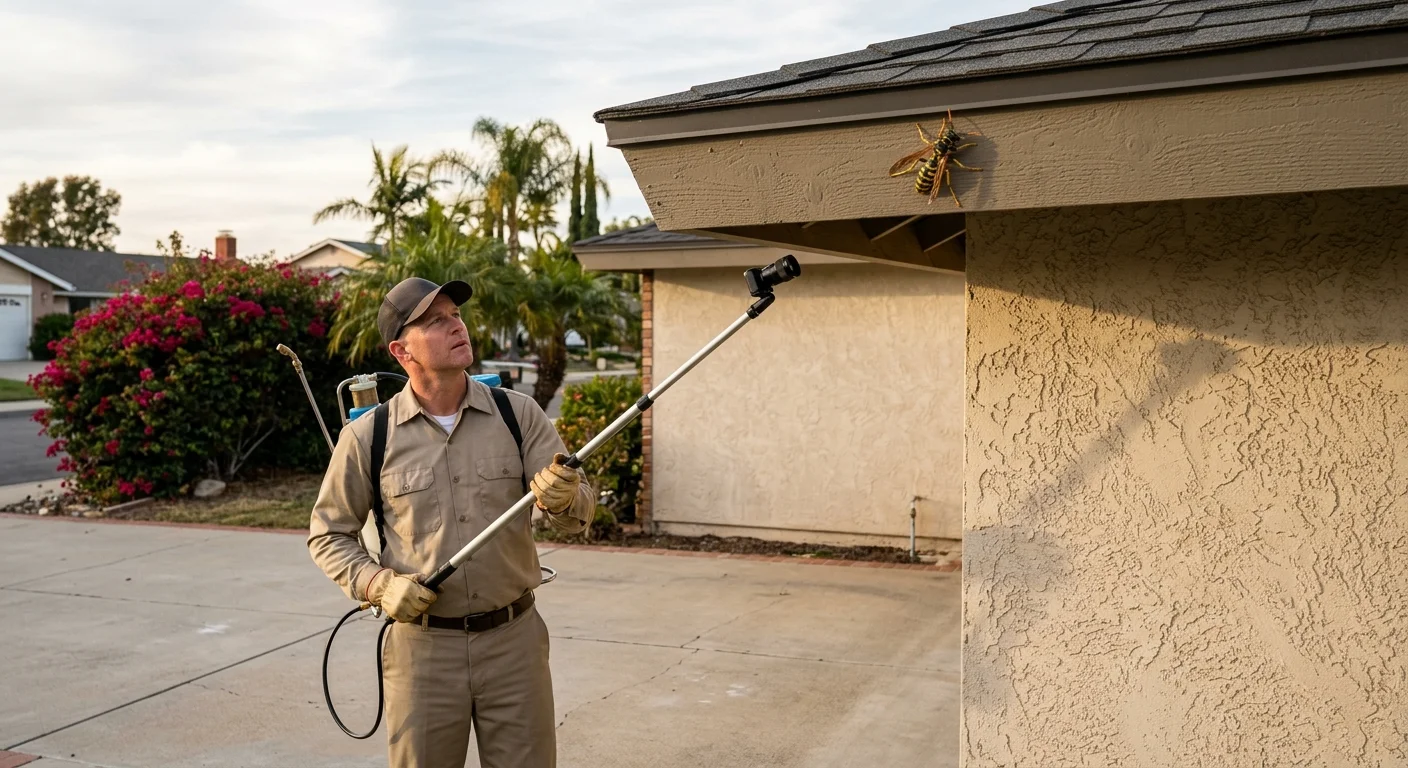
One oversized wasp on a Clairemont eave in late September can look like a nest in the stucco. In San Diego County, that insect is often a fall queen hunting a winter gap, not a commute into comb. The decision is simple from a safe distance: watch for traffic, photograph what you can, then call a licensed company only when the signs say nest.
Why a large wasp in fall is not always a nest
Social yellowjackets and paper wasps in California run on an annual colony. UC IPM describes the pattern: a queen starts the nest in spring, workers build it through summer, and late in the season the colony produces new queens and males. Then the nest declines. Only new queens live into the next year. A San Diego County date chart for that shift is not in our verified claims file. The County of San Diego Vector Control Program also does not publish a wasp-queen calendar. Use UC IPM for the statewide biology. Use your own yard for the local timing.
The county is not one climate. Coastal north county (Encinitas, Carlsbad, Oceanside) keeps cooler nights. A large wasp can still work an eave in October. Inland valleys (Escondido, El Cajon, Santee) stay hotter through September. Worker traffic at trash cans and outdoor tables often looks worse there first, then fades. East County lots in Alpine, Lakeside, and Ramona have more dry banks, gopher holes, and oak litter. Yellowjacket activity there often shows at the ground, not the fascia. South Bay tile and stucco in Chula Vista, National City, and Imperial Beach give paper wasps long, warm eave lines.
Housing stock changes the picture too. Older wood eaves in North Park and South Park hold more gaps. Post-war stucco in Clairemont and Kearny Mesa hides void space behind a small hole. Rural lots in Valley Center and Alpine add rodent burrows and stacked firewood. A queen will check all of those. So will workers, if a nest is already in place.
A nest shows as a commute. Several wasps using the same soffit gap, the same valve box, or the same thumb-sized hole in the lawn, over and over, is nest traffic. One large wasp that lands, walks a crack, then leaves is often a queen checking shelter. She may inspect a hose bib, a garage weatherstrip, a light fixture, or the top of a sliding-door track. That is search behavior, not brood defense.
Do not read a single fall wasp as a booking for yellow jacket nest removal. Do not ignore a hole you cannot see, either. Wall voids and ground entrances hide both queens and active colonies. Watch for a few minutes from inside, or from well back. Killing that one insect does not collapse a nest that already has workers. It also does not clear a yard of other queens. Fall produces many, and they do not share one address.
Which body features and locations to photograph
Stay far enough that the wasp is not trapped against you. Phone zoom is enough. You are not collecting a specimen. You are building a record the matched company can use.
Photograph the whole insect against something with scale: a brick edge, a door frame, a hose. Then a closer shot of the abdomen bands, if you can get it without stepping in. Note the waist. Paper wasps look longer-legged and more slender. Yellowjackets look stockier, with shorter-looking legs in flight. If the wasp vs yellow jacket split is still unclear, that is normal from a patio chair. Shoot the landing spot next: wood, stucco, soil, trash, ripe fruit, a soda can. Then shoot what the insect did. Hovering at one hole is different from walking a crack and leaving.
Locations worth a photo in this county:
- Tile eaves and stucco fascia in coastal and South Bay houses
- Attic vents and garage weatherstrips
- Irrigation valve boxes and retaining-wall weep holes inland
- Dry banks and rodent holes in East County yards
- Palm skirts, ice plant, and stacked patio furniture near the coast
- Outdoor kitchens and covered patios in Mission Valley, North Park, and Chula Vista
If there is an entrance, photograph it from the same safe distance, then stop. Do not poke it. Do not soak it. Do not stuff a hole while wasps are using it. Wasp nest removal in San Diego is work for a licensed company, not a weekend product run. If the only evidence is a large wasp on a screen, the photos still help. Time of day, sun or shade, and whether kids or pets use that side of the house all change the call-or-wait choice.
Take one wide shot of the wall or yard so the inspector can see height and access. A close crop of bands without the building around it is harder to use. Write the city and the side of the house on the filename if you can. Encinitas eave light is not El Cajon stucco heat, and the matched company will ask.
How queens differ from workers still on a nest
Queens of yellowjackets and paper wasps are usually larger and heavier in the abdomen than the workers from the same nest. Size is a hint, not a lab ID. A big worker can fool you from the driveway. Behavior does more work than a ruler.
Workers still on a nest keep a route. They leave, forage, and return to the same point. That point may be a paper comb under a patio cover, a wall void, or a ground hole. Queens in fall are often alone. They check gaps. They rest on warm stucco. They are not feeding brood on a schedule you can watch.
Are wasp queens aggressive? Workers at an active entrance are the ones that defend the nest. A solitary fall queen is usually not sitting on comb. She is looking for a winter site in an attic, a shed, a woodpile, or a wall void. San Diego’s mild coastal winter makes those indoor gaps attractive. Inland nights get colder in Ramona and Alpine, so queens still hunt protected structure, just on a sharper evening cool-down.
Will a queen wasp sting you? She can, if you trap her in a sleeve, a glove, or a slamming door. Do not handle her to check. We are not ranking medical danger here. If someone in the home has a known severe allergy to stings, that is a medical plan with their doctor, and a 911 issue if a sting happens. It is not a reason to swat at the eave.
Does killing the queen wasp get rid of the nest? Not in fall, if workers are already present. The nest is built. The commute continues. Swatting the largest insect you see does not shut that down. If she is a new queen with no nest yet, removing her also does not empty the neighborhood of other queens. Do not make that the plan.
Some late-season wasps are males, and they can look large too. Sorting male, worker, and queen is a job for someone who can see the insect clearly. You should not grab it to find out. That is one reason to have a licensed inspector confirm what you photographed.
Paper-wasp comb under a La Jolla or Coronado eave is often visible: a small open umbrella of cells. Yellowjacket traffic in a Santee or Lakeside lawn may show only a hole and a stream of insects. The queen question is the same in both places. Is this one insect hunting shelter, or is this a colony still on duty?
When a licensed company should confirm the insect
A licensed company should confirm the insect when you have nest traffic, not when you have a single fly-by. Use this split.
Ask for a match when wasps keep using one hole in a wall, soffit, or valve box. Ask when a ground entrance sits in a lawn, play area, or walkway. Ask when you hear activity in a wall or attic and see wasps at a vent. Ask when the suspected entrance is on a door, a play structure, or a path you cannot avoid. Ask when you cannot tell paper wasp from yellowjacket and the activity is on a surface people use.
Watch and wait when one large wasp checks an eave, does not return in a stream, and you never find an entrance. Take the photos. Check again the next afternoon. Fall queens move. An active nest does not.
General wasp work in California is structural pest control under Branch 2. Fumigation is a different branch and a different job. Pest Pros San Diego does not hold an SPCB license and does not treat. We match you with licensed, insured local companies that do. You can verify a company at the California Structural Pest Control Board license search.
If the signs point to a nest, skip the home remedies and skip the wait. Read when to call a wasp exterminator in San Diego, then use wasp and bee removal as the service path. The company you’re matched with inspects first. They tell you whether you have a fall queen, a paper comb, or a yellowjacket entrance you should not approach.
Shared walls in Carmel Valley, Scripps Ranch, and Chula Vista townhomes add one more reason to get an ID. A void can serve more than one unit. Do not treat a neighbor’s cavity as your DIY project. The matched company can see where the traffic actually goes.
When to call us
If wasps are commuting into a wall, a ground hole, or a play structure, treat it as nest work. Call us at (858) 400-6561 and we’ll match you with a licensed local pro. The company you’re matched with inspects first and quotes in writing before any treatment begins.