
UC Statewide IPM reports that drywood termite swarmers fly during daytime hours during summer and fall, and that Reticulitermes subterranean termites swarm during the afternoon in either spring or fall on clear days after a soaking rain. Rain is the typical trigger rather than a requirement: UC lists swarms of winged reproductives in the spring, summer, or fall among the signs of a subterranean infestation, with no rain condition attached. UC also cautions that seeing swarms of flying termites does not always mean your home or building is infested, and that a professional inspection is usually required to confirm one.
Termites are just one part of San Diego’s year-round pest cycle. For the full picture of which pests peak when, see our San Diego pest season calendar.

A swarm is a colony sending out winged reproductives, called alates, to mate, disperse, and establish new colonies. UC IPM says the time of day and year when those flights occur varies with species and geographic location. That’s why the timing is worth writing down: it narrows which termite you may be dealing with, and the two groups need different treatments.
The San Diego termite swarm calendar
California’s structural termite pests split into subterranean, drywood, and dampwood species. UC IPM gives the broad flight windows for the two that matter most to homeowners here. Here’s how that maps onto the year.
| Season | What UC IPM reports | Termite type |
|---|---|---|
| Winter (Dec-Feb) | Foraging is minimal from November to February | Subterranean, low activity |
| Spring | Swarms during the afternoon, typically on clear days after a soaking rain | Reticulitermes subterranean |
| Summer | Flying adults occur during daytime hours during summer and fall | Drywood |
| Fall | Both windows overlap: daytime drywood flights, and afternoon subterranean swarms after rain | Drywood and subterranean |
Fall is the one stretch where either group can fly, so the month alone won’t settle the species. UC IPM adds that in buildings with heated basements, termites occasionally fly inside during winter.
Western drywood termites
UC IPM calls the western drywood termite (Incisitermes minor) California’s second most important termite pest after the subterranean termite, and the most common species of drywood termite. It lives deep inside the wood it eats and doesn’t require much moisture or contact with soil. UC reports colonies are usually fewer than 1,000 individuals, can be widely dispersed, and take years to mature.
One caution about porch lights. UC IPM separates dampwood termites from the western drywood termite partly by the dampwood’s larger size and its attraction to lights at dark, and notes that in parts of southeastern California other species may also swarm to lights. So a pile of insects under a light fixture is not by itself a drywood identification. UC also says drywood termites are commonly found along the Pacific coastal region, extending into the Central Valley and the deserts of Southern California. For a deeper breakdown, see our guide on the signs of termites in San Diego homes.
Western subterranean termites
Subterranean termites (Reticulitermes species) live and breed in soil, sometimes many feet below the surface, and reach wood through earthen shelter tubes. UC IPM describes their winged reproductives as dark brown to brownish-black with brownish-gray wings, seen emerging en masse on warm, sunny days following fall or spring rains. UC calls spring, especially a warm sunny day following rain, the optimal time for subterranean swarming.
UC IPM also says the optimal conditions for foraging, warm temperatures and high soil moisture, are usually present under and around buildings. That’s the practical reason irrigation and drainage against a foundation matter. We cover the full split in our post on drywood vs. subterranean termites in San Diego.
What a termite swarm actually means
A swarm is not proof of a problem in your structure. UC IPM states plainly that seeing swarms of flying termites does not always mean your home or building is infested, and that finding swarming termites in your yard doesn’t necessarily mean your house has termites, since most soil around a home has buried cellulose debris such as roots, stumps, or fence posts.
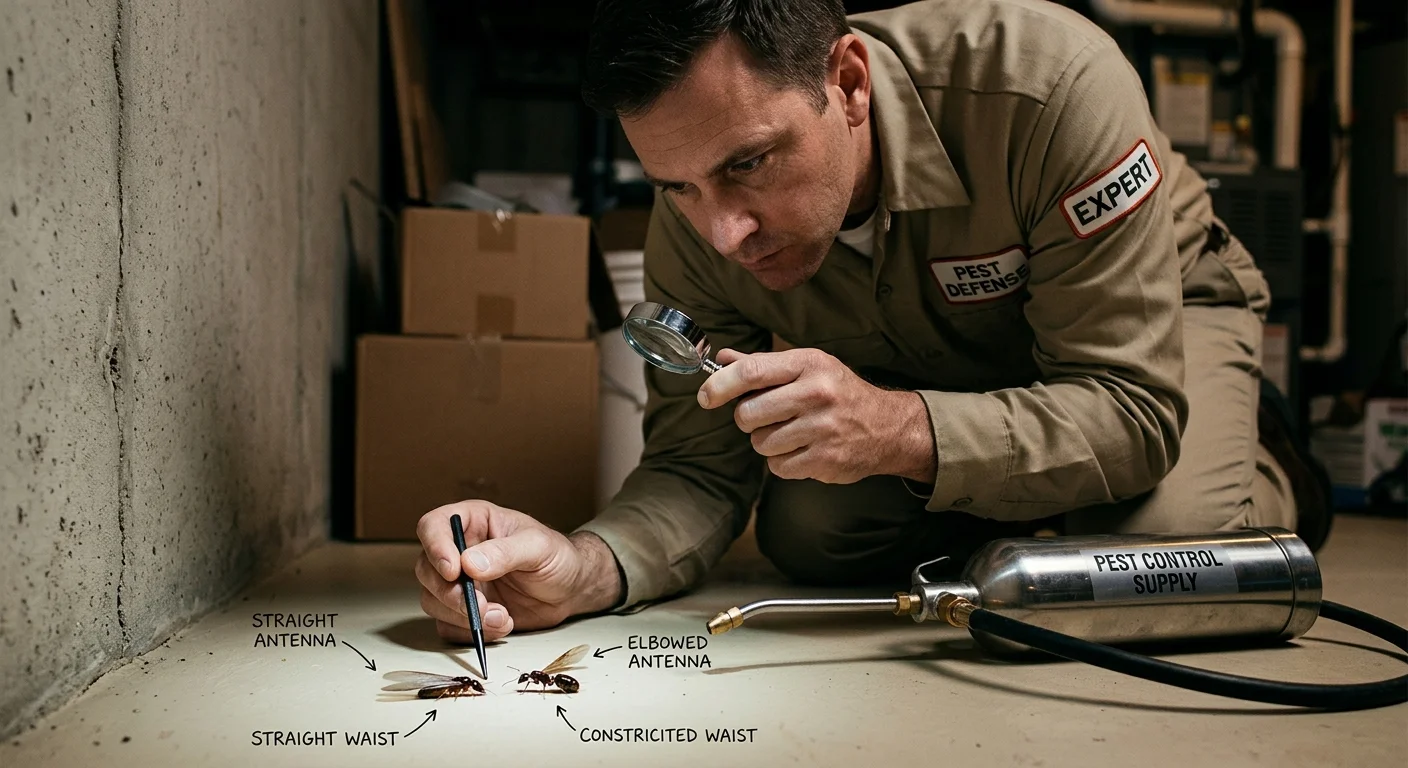
What a swarm does tell you is that a colony somewhere nearby has matured. UC IPM says winged reproductives appear once a colony is composed of a large number of individuals, often thousands, and that drywood colonies take years to mature. Most of those reproductives perish during the flight due to predation by birds, lizards, ants, or other insects, and after the flight they shed their wings. A pile of shed wings indoors is a reason to book a termite inspection, not a reason to guess.
How to tell termite swarmers from flying ants
UC IPM separates ants from termites on three characteristics. The ant’s body is constricted, giving it the appearance of having a thin waist, while the termite has a broad waist. The ant’s hind wings are smaller than its front wings, while the termite’s front and hind wings are about the same size. Winged female and worker ants have elbowed antennae, while the termites’ antennae aren’t elbowed.
One catch worth knowing: UC notes that shortly after their flights, both ants and termites lose their wings, so wings usually aren’t present. We walk through it with photos in flying ants vs. termite swarmers.
What to do if you see a swarm in San Diego
Don’t reach for a can. UC IPM says do-it-yourself pesticides for use against termites are generally not effective, and killing the visible winged termites does nothing to the colony producing them. Capture a few in a bag or jar so the species can be confirmed, note where you saw them and the date, and leave any mud tubes or pellet piles alone so an inspector can read them.
Then get it looked at. UC IPM recommends regular inspections every 3 to 5 years to help detect infestations before they become damaging, and says a professional inspection of the structure is usually required to confirm an infestation.
If you’re buying or selling, this matters on paper too. The Structural Pest Control Board says most lending institutions require that homes in California be inspected for wood destroying pests and organisms (WDO) before financing a home loan, and its property search shows whether a WDO inspection was completed on an address within the last two years. Whether the activity is drywood or subterranean changes which termite treatment gets quoted. For budgeting, see our termite inspection cost guide for San Diego along with what termite treatment costs in San Diego by method, and for keeping swarms from starting in the first place, our notes on termite prevention for San Diego homes.
Any pest control company you hire should be licensed by the California Structural Pest Control Board (SPCB), which you can verify at pestboard.ca.gov before work begins.
Frequently asked questions
When do termites swarm in San Diego?
UC IPM reports drywood termite swarmers fly during daytime hours during summer and fall. Reticulitermes subterranean termites swarm during the afternoon in either spring or fall on clear days after a soaking rain. UC adds that the time of day and year when flights occur varies with species and geographic location.
What months do drywood termites swarm in California?
UC IPM gives the window as summer and fall, during daytime hours, rather than specific months. It doesn’t publish a month-by-month San Diego schedule, so treat any calendar that does as an estimate and confirm the species instead.
Do subterranean termites swarm in spring?
Yes. UC IPM says Reticulitermes swarms during the afternoon in either spring or fall on clear days after a soaking rain, and calls spring, especially a warm sunny day following rain, the optimal time for subterranean swarming. Read rain as a typical trigger, not a condition that has to be met: UC’s list of subterranean infestation signs includes swarms of winged reproductives in the spring, summer, or fall. Their winged forms are dark brown to brownish-black with brownish-gray wings.
Does a termite swarm mean I have an infestation?
Not on its own. UC IPM says seeing swarms of flying termites does not always mean your home or building is infested, and that finding swarming termites in your yard doesn’t necessarily mean your house has termites. A professional inspection of the structure is usually required to confirm one.
What attracts termite swarmers?
It depends on the species. UC IPM says dampwood termites are drawn to lights at dark, and that in parts of southeastern California other species may swarm to lights too. For subterranean termites, UC ties the flights to warm, sunny days following fall or spring rains.
Should I worry about finding termite wings on my windowsill?
Shed wings are worth acting on. UC IPM says reproductives shed their wings after their swarming flight, and that shortly after flights both ants and termites lose their wings. Save a few wings or swarmers and book an inspection so the species gets confirmed rather than guessed.
If you’ve spotted swarmers, discarded wings, or mud tubes anywhere on your property, don’t wait for the damage to spread. Call us at (858) 400-6561 for a termite inspection in San Diego County, and we’ll match you with a licensed local pro. You can also start with our San Diego pest control service area.