
Stripping the bed and finding small dark marks on white cotton is where most bed bug worries start. Those marks are worth taking seriously, and they still aren’t a diagnosis. What separates a suspicion from a confirmation is a live insect, a shed skin, or an egg found by someone who inspects for a living.
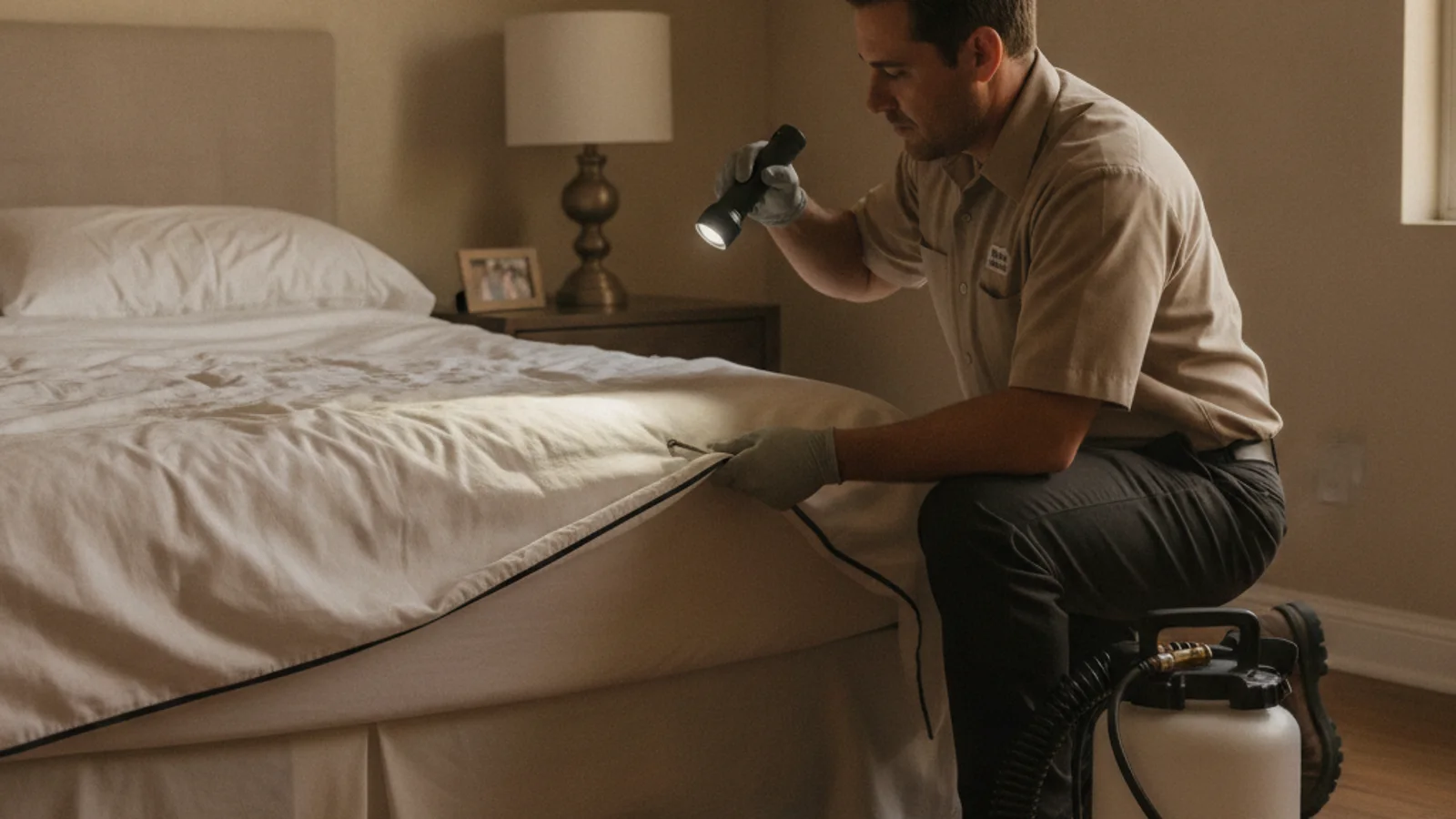
Which marks on sheets can be evidence
Sheets hold four kinds of findings worth photographing before you wash anything. Live insects are the strongest. A single live bug found in bedding, no matter how small, ends the guessing and starts the treatment conversation.
Shed skins come next. Bed bugs leave translucent castings behind as they grow, and those castings collect in the same seams and folds the insects hide in. A casting is physical, keepable evidence. Put it in a sealed clear bag or a small container so an inspector can look at the real thing instead of a blurry photo.
Eggs are the hardest for a homeowner to spot and the most useful once found. They’re pale, very small, and stuck to fabric rather than loose on it, so shaking a sheet won’t dislodge them. If you think you see them, don’t scrape at the spot. Leave it and mark the location with a pin or a piece of tape.
Then there’s spotting: the dark marks that get people searching in the first place. Spotting can be evidence, but only as part of a set. On its own it tells you something was on that fabric, not what it was.
What isn’t evidence: a bite, a welt, or an itchy patch of skin. We won’t tell you what bit you from a mark, and neither should anyone selling you a treatment. Skin reactions vary from person to person and several unrelated things produce similar marks. Use the fabric, the seams, and the insect itself.
Before you compare anything, get a clear look at what you’re comparing against. Our visual guide to what bed bugs look like is the right place to start, because the body shape and the flatness are what rule most look-alikes out.
Why stains alone don’t confirm bed bugs
A dark spot on a sheet has too many possible authors. Household lint, a crushed unrelated insect, makeup, a dropped crumb, a pet’s paw, a leaked pen, dried food, and ordinary wear all leave marks in the same places bed bugs do. Fabric weave and wash history change how those marks spread and set, which is exactly what makes them unreliable as a species test.
There’s also the look-alike problem, and San Diego has a real version of it. Bat bugs turn up in attics and upper walls and resemble bed bugs closely enough that people treat the wrong pest in the wrong room. Our comparison of bat bugs and bed bugs in San Diego attics walks through why the room matters as much as the insect. Ticks get mistaken for bed bugs too, especially in homes with dogs that walk East County trails, and telling a tick from a bed bug comes down to whether the insect is still attached.
So treat a stain as a reason to look harder, in a specific order:
- Photograph the mark in place, with something for scale, before you strip the bed.
- Save any solid object you find, castings included, in a sealed clear bag.
- Note the room, the side of the bed, and the date on your phone.
- Don’t launder the bedding yet if you can hold off, because washing destroys the only sample you have.
- Don’t spray anything. A repellent product can push insects deeper into voids and make a later inspection harder.
If you rent, that documentation does double duty. California’s AB 551 requires landlords to give tenants written bed bug information, covering identification, behavior, and prompt reporting, and it prohibits a landlord from showing, renting, or leasing a vacant unit they know has a current bed bug infestation. Report in writing and keep a copy. Under the same law, after a pest control operator inspects units, the landlord must notify the tenants of the inspected units in writing within two business days of receiving the operator’s findings.
Where to check beyond sheets and mattress seams
Sheets are the alarm, not the address. The search widens outward from where a person actually sleeps, and it goes into places a flashlight reaches and a hand shouldn’t.
Work the mattress seams, the box spring corners and its underside fabric, the bed frame joints, and the screw holes and slats where the frame bolts together. Then the headboard, including the back of it and the wall behind. Then the nightstand drawers and their runners, the seams of an upholstered chair in the same room, and the edge of carpet where it meets the baseboard.
The building type changes where the search stops. A single-family house in Santee or El Cajon can usually be treated as its own closed problem, and the inspection stays inside the unit and its furniture. A shared-wall property in City Heights, National City, or Chula Vista can’t. Insects move along utility penetrations, shared framing, and hallway routes, so an honest inspection of one apartment includes the question of whether the neighboring units need looking at too. That’s a conversation for the property manager and the licensed company, not something you can settle from your own bedroom.
Coastal North County adds a different wrinkle. Short-term rentals and guest turnover in places like Oceanside and Carlsbad mean luggage arrives from somewhere else on a regular schedule, so the likeliest introduction point is a suitcase rather than a wall. Inland North County homes in Escondido and San Marcos more often have detached guest space or converted garages, which are easy to leave out of a search because nobody sleeps there most weeks.
Our professional bed bug inspection checklist covers the full sequence a company works through, including the parts of a room homeowners routinely skip.
What a licensed inspection should document
An inspection you can act on produces a written record, not a verdict at the door. Ask for the findings in writing before any treatment is scheduled, and read what’s actually on the page.
A useful report names the pest it found, not the pest it suspects. It says where each finding was located, room by room and surface by surface, and it distinguishes a live insect from a casting from spotting of unknown origin. It says which areas were inspected and which weren’t reachable, because an inaccessible void is a real limit on what the inspection can claim. If a proposed treatment is chemical, the report or the estimate should name the product and let you read its registered label, since the label controls where a product may be used and every precaution around people and pets.
It should also be clear about what happens next. Any follow-up schedule, any re-treatment terms, and any warranty language belong in the company’s own written agreement. Those terms are the company’s to set, not ours, and they differ from one company to another. Compare them in writing before you sign.
California puts general household pest work under Structural Pest Control Board Branch 2. The Board licenses applicators, field representatives, and operators, and only a field representative or operator may make inspections and identify infestations on behalf of a registered company. You can check any company or individual through the SPCB license search or at search.dca.ca.gov. If you want general background on pesticide use in a home before that visit, the EPA’s safe pest control pages are a reasonable place to read up.
We don’t inspect and we don’t treat. We match San Diego County homeowners, renters, and property managers with licensed, insured local companies, and the company you’re matched with inspects first and quotes in writing before any treatment begins. Our bed bug treatment referral service explains how that works.
When to call us
Call when you’ve found something solid and can’t identify it, when marks keep coming back after laundering, or when you share walls with neighbors and need the scope of the problem settled by someone licensed to say. Confirmation and treatment both belong to a licensed company, and guessing at either one costs more than the inspection does. Call us at (858) 400-6561 and we’ll match you with a licensed local pro.