
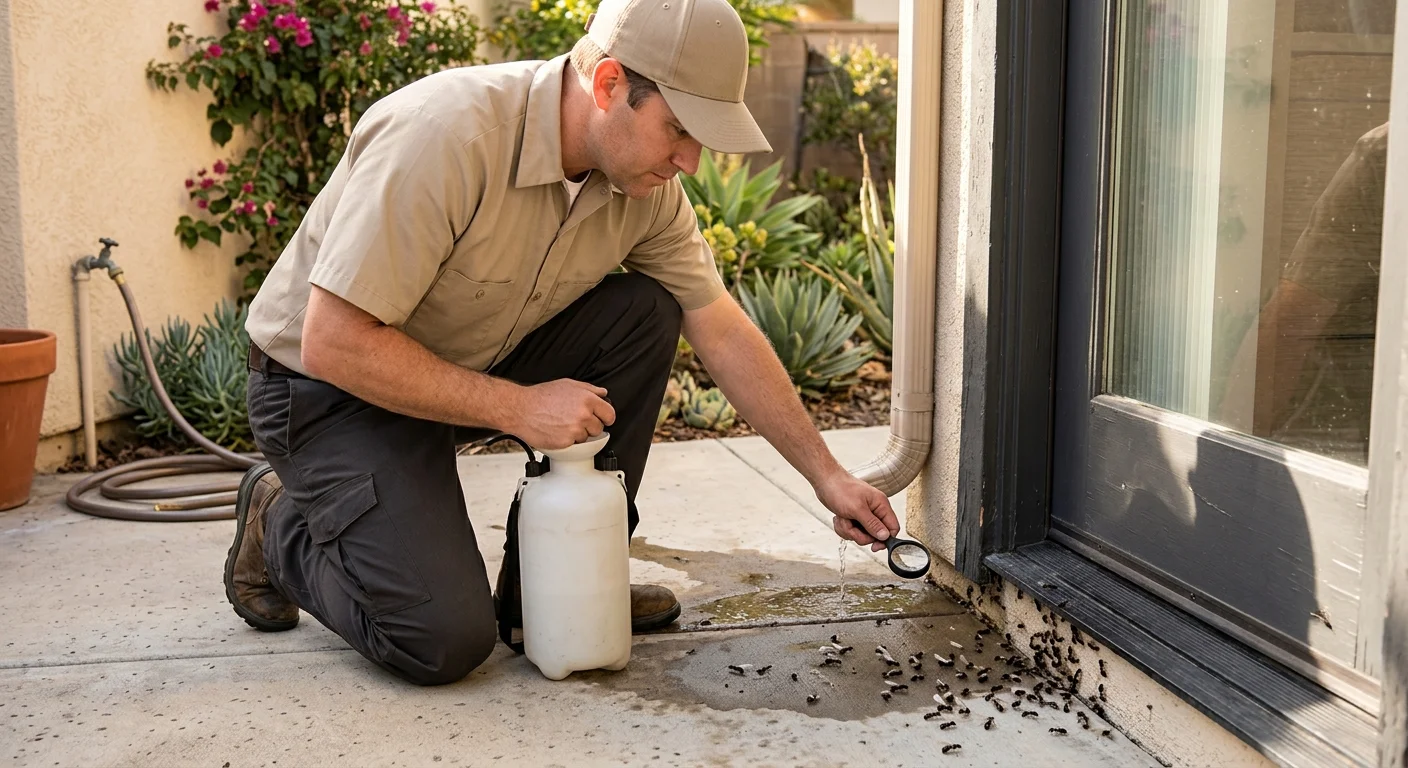
You walk out after the afternoon watering cycle and a cloud of winged insects lifts off the patio threshold. In Clairemont, Chula Vista, and Escondido, that burst usually means a mature ant colony is sending out reproductives. A clear photo helps the licensed inspector you get matched with. It does not close the ID by itself.
How to tell a flying ant from a termite swarmer
Start with the insect in your hand or on the slab, then stop. The flying ant versus termite swarmer guide owns the full side-by-side anatomy. This page is about what the swarm is telling you in a San Diego yard.
Flying ants (the reproductive caste of a regular ant colony) have a pinched waist, elbowed antennae, and two pairs of wings with the front pair clearly larger. Termite swarmers have a more even body, straight antennae, and two pairs of wings that look about the same length. UC Statewide IPM is the authority to keep bookmarked for both groups: ipm.ucanr.edu.
Look at the leftover evidence around the fliers. Drywood termites, the western drywood termite (Incisitermes minor) in particular, leave hexagonal fecal pellets and kickout holes less than 2 mm across, per UC IPM. Those pellets are the diagnostic sign, far more than a blurry wing on a windowsill. Subterranean termites nest in soil, build shelter tubes from soil to wood, and do not dump those six-sided pellets. UC IPM also notes drywood swarmers in California show during summer and fall daytime hours, which is a timing clue you can put next to what you saw, not a calendar you can treat as a schedule.
One insect on a Carlsbad porch light is a weak ID. A pile of equal-length wings on an interior sill, plus shelter tubes on a stucco stem wall in El Cajon, is a stronger termite pattern. A pinched-waist flier over a worker trail coming out of a watered planter in National City is a stronger ant pattern. Carpenter ants can still nest in wet or damaged wood, so a large dark flier near an oak fascia in Alpine or Lakeside still belongs in front of a licensed inspector.
Do not let a phone zoom call the species. Lighting flattens waists. Wings tear. Argentine ant reproductives and termite swarmers both look like “flying ants” from three feet away. Save the insect in a clear bag or take several photos from the side, then let the matched company name it on site.
If the fliers came from inside a wall, a light fixture, or a bathroom fan, treat that as a reason to book a termite inspection while you still sort the ant question. Indoor emergence is the piece that changes the next call.
Why San Diego homes see winged ants after heat and watering
Flying ants are not a separate pest that blew in from somewhere else. They are winged males and queens leaving a colony to mate. UC IPM calls the Argentine ant (Linepithema humile) the most common ant in and around California houses and gardens. That is the species behind a lot of the sudden clouds on San Diego patios.
Argentine ants nest in shallow soil, under pots, under logs, in pavement cracks, and in wall voids. UC IPM notes that moist ground is especially attractive, and that under dry conditions they move deeper. That maps onto how this county waters. Coastal north county lawns in Encinitas and Carlsbad stay damp under marine layer and automatic irrigation. Inland valleys in Escondido and El Cajon bake through the afternoon, then the clock dumps water on the same slab edge every evening. South Bay courtyards in Chula Vista sit tight to planters and shared walls. Each pattern pulls foraging workers, then later reproductives, to the same wet line.
Heat plus water is the local trigger people notice. Warm days prime the colony. The first heavy irrigation after a hot stretch lifts humidity at the foundation, around ice plant, and along the base of the wall. Reproductives use that window to leave. UC IPM describes year-round Argentine ant activity with seasonal variation. It does not publish a San Diego swarm calendar with named months, and this page will not invent one.
The other local fact that changes control is how these colonies are built. Argentine ant colonies are linked into one large supercolony with multiple queens, per UC IPM. Newly mated queens leave with workers rather than founding alone. A swarm on a Kensington walkway can mean the network under the sidewalk, the neighbor’s mulch, and your irrigation valve box is already connected. Knocking down the fliers on the glass does nothing to that network.
Native ants still live here. The southern fire ant is listed among native species in San Diego County urban surveys and shows in coastal and inland areas. Argentine ants have been documented displacing natives, including raiding southern fire ant nests in Rice Canyon sampling. A sting from a mound in a dry inland yard is a different problem than a brown 1/8-inch worker trail on a Mission Valley kitchen counter. Flying ants control still starts with naming the species, then treating the colony the fliers came from.
Keep irrigation off the foundation, lift pots off soil, and clear rotting wood and dense mulch at the slab. Those steps cut the moisture Argentine ants nest in. They do not replace a licensed look at a colony that is already sending out queens.
What indoor wings and trails can and cannot confirm
A single flying ant in the house is a weak signal. Lights pull night fliers to windows. A patio swarm can ride the HVAC return or a sliding door. One insect on a Mira Mesa kitchen island does not prove a wall nest, and it does not prove termites.
Indoor evidence gets useful when it stacks. Shed wings in a pile on a sill, in a tub, or under a hall light mean reproductives landed and dropped their wings after the flight. That still fails to name the insect. Ant queens shed wings. Termite swarmers shed wings. The body that belonged to those wings is the ID, and a licensed inspector should make it.
Worker trails are ant evidence. A line of wingless ants from a watered hibiscus, along a crack in the wall, into a dishwasher kickplate is foraging, usually Argentine ants in this county. Trails confirm a colony is feeding in or on the structure. They do not confirm wood damage. They do not rule termites out in a different part of the house.
Termite signs sit in a different pile. Shelter tubes on a stem wall or in a crawl. Soft wood along a baseboard. Hexagonal pellets and tiny kickout holes for drywood termites, per UC IPM. Clicking in a wall is something people report; it is not a field test you should trust on its own. Our signs of termites in San Diego page walks those clues. When termites swarm in San Diego covers the seasonal piece without turning one warm night into a diagnosis.
Flying ants and termites are both worth a serious look. They are not the same risk. Argentine ants contaminate food, tend aphids, and keep returning because of that supercolony structure. They do not eat structural lumber. Drywood and subterranean termites do consume wood. UC IPM describes drywood colonies as typically fewer than 1,000 individuals, and subterranean colonies as massive, with hundreds of thousands of foragers. Subterranean species need soil moisture and often show at wood-to-soil contact, including wet spots from irrigation and poor grade. The Formosan termite is currently restricted to a small area near San Diego, per UC IPM, so treat a suspected find as a licensed inspection, not as a county-wide panic.
Carpenter ants sit in the middle. They nest in wood that is already wet or decayed. A large flier plus coarse frass in an East County fascia is a carpenter-ant pattern, and it still needs a person with the right California license to separate it from termites. See carpenter ant control in San Diego if the insect was big, dark, and near damaged wood.
Do not spray a swarm and call the job done. You will kill the reproductives you can see and leave the colony that produced them. Do not mix baits from a forum recipe. Product labels and California rules belong to the licensed company, and off-label mixing is how indoor treatments go wrong around kids and pets.
When a licensed ant or termite inspection makes sense
Book an ant inspection when you have repeated indoor trails, winged ants plus workers, or a swarm that keeps forming at the same watered edge. That work is general household pest control. In California it sits with Structural Pest Control Board Branch 2 companies. We match you with licensed, insured pest pros who hold the appropriate California credentials for each service type. Start at ant control and read the local playbook on ant control in San Diego.
Book a termite inspection when swarmers appear to have come from inside the structure, when you find pellets, kickout holes, shelter tubes, or damaged wood, or when a lender wants a Wood-Destroying Pests and Organisms Inspection Report. Branch 3 companies issue those WDO reports (form 43M-41). Most lending institutions require one before financing a home loan in California. That is not the same as every sale in the county. The report covers visible and accessible areas and records findings plus recommendations. You can search public WDO activity through the Structural Pest Control Board. Confirm the company’s license at the SPCB license search (the public lookup runs through search.dca.ca.gov; choose Structural Pest Control Board).
If you cannot tell the fliers apart, say so on the call. The matched company can inspect for both. Do not wait for a photo to “prove” termites. Do not skip a termite look because the workers on the counter look like Argentine ants. Those can both be true in the same week.
UC IPM states that do-it-yourself treatments are not recommended for drywood termites, and that effective subterranean termite products are for professional use only. Fumigation, when it is even on the table, is Branch 1 work only. This brand does not fumigate, inspect, or apply pesticides. The licensed company you are matched with inspects first and quotes in writing before any treatment begins. There is no verified per-job price guide on file for ant work, so skip the guesswork ranges you will see on random cost pages.
A swarm after watering is the moment to act on identification, then on the colony behind it. Flying ants control is colony work. Termite work is a wood-destroying inspection with a different license. Get the right one on site, then follow that company’s written findings.
When to call us
Call when winged insects show up indoors, when a patio swarm returns after watering, or when you also see pellets, tubes, or damaged wood and need a licensed ant or termite inspection. Call us at (858) 400-6561 and we’ll match you with a licensed local pro.